
Bara: When Public Authorities Share Data Without Telling the People Affected
In Bara, the CJEU held that public authorities must inform people when sharing and using their income data to assess health insurance contributions, unless a valid exception applies. Government data sharing does not dispense with transparency.
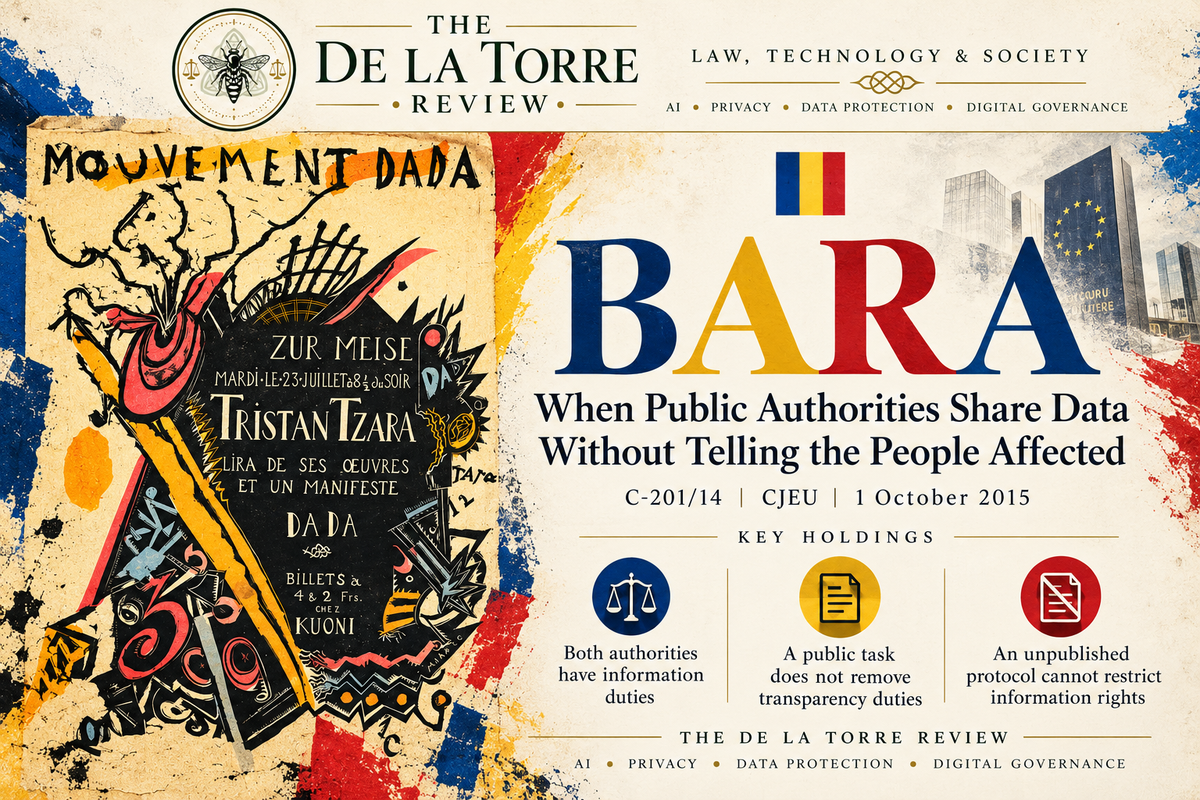
Case C-201/14 | Smaranda Bara and Others v Președintele Casei Naționale de Asigurări de Sănătate and Others | Court of Justice of the European Union | Third Chamber | 1 October 2015
Practice Takeaways: 1. Both disclosure and the recipient’s subsequent use are processing operations. 2. The sending and receiving authorities must each address their information duties. 3. A statutory public function does not automatically excuse a failure to inform. 4. An unpublished interagency protocol cannot supply the legislative basis required to restrict information rights.
Can information supplied to a tax authority be passed to a health insurance body and used to demand unpaid contributions without telling the people concerned?
In Bara, the Court examined an exchange of income data between two Romanian public bodies. The central issue was whether the authorities could carry out that transfer and subsequent processing without providing the information required by EU data protection law. The Court held that the national arrangements did not satisfy those requirements or establish a valid exception.
NOTE: The judgment interpreted Directive 95/46, the GDPR’s predecessor. Its transparency analysis remains relevant, but present-day obligations and exceptions must be assessed under the GDPR, particularly Articles 13, 14, and 23.
Practice Tip: Review the legal authority for sharing and the obligations to inform separately. A lawful public function does not, by itself, establish an exception to transparency.
What happened
Smaranda Bara and the other applicants earned income from self-employment. Romania’s National Tax Administration Agency (ANAF) transferred information about their declared income to the National Health Insurance Fund (CNAS). CNAS used the information to require payment of arrears of health insurance contributions. (Judgment, para. 14.)
The applicants challenged the transfer before the Court of Appeal in Cluj. They argued that their data had been transferred and used for purposes other than those for which they had supplied them to ANAF, on the basis of an internal protocol, without their explicit consent or prior information. (Judgment, para. 15.)
Romanian legislation provided for communicating data needed to establish whether someone qualified as insured. According to the referring court, those data included identifying information, but not income information. The detailed arrangements for transmitting income data were set out in a 2007 protocol between ANAF and CNAS. (Judgment, paras. 11–17.)
The national court asked whether the transfer and subsequent processing could take place without informing the applicants. Three additional questions concerned Article 124 TFEU, which addresses privileged access by public bodies to financial institutions. The CJEU declined to answer those questions because they were unrelated to the data protection dispute. (Judgment, paras. 18–28.)
Why the case matters
Information collected by one public authority may become useful to another. That usefulness does not resolve what the individual must be told about the exchange or the recipient’s use.
Here, the exchange had a concrete consequence: information declared for tax purposes became the basis for demands for health insurance contributions. Transparency mattered because the applicants needed to know who was using their information, for what purpose, and how to exercise their rights.
A reason for using data does not, by itself, explain why the person concerned should be kept uninformed.
The case also separates two questions that are easily confused: whether processing requires consent and whether it requires information. A public task may support processing without consent while leaving information duties intact.
Key holding
The Court held that Articles 10, 11, and 13 of Directive 95/46 (the Data Protection Directive) precluded national measures such as those at issue, which permitted a public body to transfer personal data to another public body and their subsequent processing without informing the people concerned. (Judgment, para. 46 and operative part.)
Three conclusions support that holding:
- ANAF had to address its information duties as the collecting authority. Fair processing required information about the transfer to CNAS. The statutory provision relied on did not establish that the applicants already had the required information about the recipients of their income data. (Judgment, paras. 32–38.)
- CNAS had its own information duties as the recipient. Because it obtained the data from ANAF, it had to provide the information required for indirect collection, including the processing purposes and relevant data categories. (Judgment, paras. 42–44.)
- The national arrangements did not establish a valid exception. The legislation and unpublished protocol did not satisfy the conditions for dispensing with information under Article 11(2) or restricting the duties under Article 13. (Judgment, paras. 39–45.)
The Court’s analysis
1. Income information was personal data and the exchange was processing
The income information related to identified or identifiable individuals and therefore constituted personal data. Both ANAF’s transmission and CNAS’s subsequent handling of the information constituted processing. Moving information between public bodies did not take those operations outside the Directive’s safeguards. (Judgment, para. 29.) See also, Satakunnan & Satamedia: Public Data Is Still Personal Data.
2. A lawful basis did not replace the other requirements
The Court recalled that processing had to satisfy both the data quality principles in Article 6 and one of the lawful bases in Article 7, subject to the Directive’s permitted exceptions. Controllers also had information duties under Articles 10 and 11. These were cumulative requirements. (Judgment, paras. 30–31.)
Identifying a legal obligation or public task cannot finish the analysis. The controller must also address fairness, purpose limitation, the other applicable principles, and information duties.
3. Fair processing required information about the transfer
Article 10 governed information where data were collected from the individual. Unless the person already had the information, the controller had to explain its identity, the purposes of processing, and additional matters needed to ensure fairness, including recipients or categories of recipients. (Judgment, para. 32.)
The Court connected these duties to the individual’s ability to exercise access, rectification, and objection rights. People need to know about processing to challenge it effectively. Fairness therefore required ANAF to inform the applicants about the transfer to CNAS. It had not done so. (Judgment, paras. 33–35.)
4. The legislation did not supply the missing information
Romania argued that Article 315 of Law No 95/2006 required authorities to transmit information needed to determine whether self-employed people qualified as insured. (Judgment, para. 36.)
- The Court examined what that provision actually covered. According to the referring court, the information needed to establish insured status did not include income data: people without taxable income could also qualify as insured. The provision therefore could not constitute prior information relieving ANAF of its duty to explain who would receive the income information. (Judgment, paras. 37–38.)
- The conclusion was specific to the law and data exchange before the Court. It did not establish that legislation can never be relevant to whether an individual already has the required information.
Practice Tip: Compare the actual data fields and uses with the provision relied on. A rule about verifying eligibility may not explain a transfer of income information for calculating contributions.
5. A public financial interest did not automatically restrict information rights
Article 13 allowed Member States to restrict certain duties where necessary to protect specified interests, including important economic or financial interests and related monitoring or regulatory functions. But those restrictions required legislative measures. (Judgment, para. 39.)
- The definition of the information to be transferred and the detailed transfer arrangements appeared in the protocol between ANAF and CNAS, which had not been officially published. The Court held that the conditions for derogating from Article 10 were not satisfied. (Judgment, paras. 40–41.)
- An arrangement explaining how agencies will exchange information did not supply the legislative basis needed to restrict the affected individuals’ information rights.
6. The receiving authority had a separate transparency obligation
Article 11 governed data obtained from someone other than the individual. It required information about the controller, the processing purposes, and further matters necessary for fairness, including data categories and access and rectification rights. (Judgment, para. 42.)
- In the circumstances, CNAS had to inform the applicants of the purposes of its processing and the categories of data concerned. It had not provided the required information. Receiving the data from another authority did not remove that duty. (Judgment, paras. 43–44.)
7. The statutory disclosure exception also failed
Article 11(2) provided an exception where, among other circumstances, recording or disclosure was expressly laid down by law, with appropriate safeguards. This was a distinct route from the restrictions permitted by Article 13. (Judgment, para. 45.)
- For the same reasons that undermined the claimed Article 13 restriction, the legislation and protocol did not support reliance on Article 11(2). Neither route justified CNAS’s failure to inform. (Judgment, para. 45.)
Practice Tip: Identify the precise exception invoked and test its conditions. Authority to exchange data and authority to omit information are separate legal questions.
The Advocate General’s Opinion
Advocate General Pedro Cruz Villalón delivered his Opinion on 9 July 2015. He proposed substantially the same outcome, while examining consent and necessity more expressly than the Court’s judgment did.
- He considered that CNAS’s processing could fall under Article 7(e), covering public-interest tasks or official authority, so consent was not required. The national court nevertheless had to verify that the data transmitted and processed did not exceed what was strictly necessary for CNAS’s task. (Opinion, points 68–70.)
- That conclusion did not remove transparency duties. General obligations of cooperation between public institutions could not, by themselves, exempt the authorities from informing the people concerned. The provision about insured status did not explain the income-data transfer. (Opinion, points 71–80.)
- He also explained that restrictions on information duties required a legislative measure, a recognized public-interest objective, and strict proportionality. The protocol was not a duly published legislative measure of general scope enforceable against the affected individuals. (Opinion, points 81–86.)
His analysis makes the distinction clear: processing without consent can still require information. The Court’s operative ruling focused on the information duties and the failure to establish a valid exception.
What the Court did—and did not—decide
The Court did decide that:
- income data were personal data, and their transfer and subsequent use were processing operations;
- ANAF had to inform the applicants about the transfer to CNAS;
- CNAS had separate information duties concerning its processing;
- the legislation relied on did not supply the missing information about the income-data transfer; and
- the legislation and unpublished protocol did not establish a valid exception to those information duties.
The Court did not decide that:
- public authorities cannot share personal data;
- every government data exchange requires consent;
- informing individuals alone makes a transfer or new use lawful;
- public financial interests automatically justify withholding information; or
- the applicants were entitled to compensation or annulment of their contribution assessments.
Bara does not prohibit all exchanges of data between public authorities. It addresses an exchange and subsequent use carried out without the required information and without an applicable exception.
Under the GDPR, the corresponding analysis requires attention to the current text. Articles 13 and 14 distinguish direct from indirect collection; Article 14(5)(c) addresses obtaining or disclosure expressly required by law with protective measures; and Article 23 governs legislative restrictions. Article 14(3) supplies its own timing rules, so Bara should not be treated as a universal GDPR requirement to notify before receiving data. Articles 13(3) and 14(4) separately address information before further processing for another purpose.
Conclusion
Bara requires public authorities to account for transparency at both ends of a data exchange. The authority disclosing information must address its duties to the people who supplied it, and the receiving authority must address the duties arising from its own processing.
A public purpose can explain why information is useful. Dispensing with information to the people affected requires a separate legal justification that satisfies the applicable exception.
Sources and Useful Reading
Sources
CJEU judgments, Advocate General opinions, and related case materials are available through InfoCuria, the Court of Justice of the European Union’s official case-law database. The case can be located using Case C-201/14, Smaranda Bara and Others.
- Court of Justice of the European Union, Third Chamber, Case C-201/14, Smaranda Bara and Others v Președintele Casei Naționale de Asigurări de Sănătate and Others, Judgment of 1 October 2015, ECLI:EU:C:2015:638.
- Opinion of Advocate General Pedro Cruz Villalón, Case C-201/14, delivered 9 July 2015, ECLI:EU:C:2015:461.
Directive 95/46/EC, particularly Articles 6, 7, and 10–13. Read the Directive.
Useful reading from The de la Torre Review
- EU Data Protection Law and the General Data Protection Regulation (GDPR) — Provides the broader framework for understanding Bara, including lawful bases, transparency, and individual rights. Helps explain why a public authority’s justification for processing does not dispense with its information duties. Free membership is required to access this resource. Read the Article.
- What Is “Public Task” under the GDPR? — Explains the legal foundation and necessity requirements for Article 6(1)(e). Provides context for the Advocate General’s view that CNAS could process without consent while remaining subject to information duties. Read the Article.
- What Is “Consent” under the GDPR? — Explains consent’s place among the lawful bases. Helps distinguish permission to process from the obligation to explain the processing. Read the Article.
- Satakunnan & Satamedia: Public Data Is Still Personal Data — Explains why publicly available tax information remains personal data under EU law. In paragraph 29, Bara expressly cites paragraph 35 of Satakunnan & Satamedia to establish that the income data transferred between the authorities concerned identified or identifiable individuals. Read the Article.
- Österreichischer Rundfunk: When Salary Transparency Meets the Right to Privacy — Examines the safeguards governing disclosure of personal income information by public bodies. Bara cites the case in paragraph 29 to establish that transferring and subsequently using personal data constitute processing, and in paragraph 30 to confirm that processing must satisfy both the data protection principles and a lawful basis. Read the Article.
- Puškár: Tax Fraud Lists, Court Access, and the Limits of Procedural Barriers — Examines public-task processing by tax authorities and the safeguards needed to challenge it. The later judgment draws on Bara when discussing personal data, cumulative lawfulness requirements, and legislative restrictions on information and access rights. Read the Article.
- Huber: “Necessary” Really Means Necessary — Explains why a public task does not justify every processing operation. Bara cites Huber on processing and cumulative lawfulness requirements; the Advocate General also relies on it when discussing necessity. (Judgment, paras. 29–30; Opinion, points 54 and 70.) Read the Article.
- ASNEF: When Member States Cannot Rewrite the Lawful Bases for Processing — Explains the Directive’s exhaustive lawful bases. Bara cites it when distinguishing compliance with the data quality principles from the need for a lawful basis. (Judgment, para. 30.) Read the Article.
- Rijkeboer: When the Right of Access Reaches Into the Past — Examines access to information about past disclosures and how access supports other data protection rights. The Advocate General in Bara cites paragraphs 67–68 of Rijkeboer when discussing information duties. The reference appears in point 57, footnote 19 of the Opinion, rather than in the Bara judgment. Read the Article.
- IPI, C-473/12 — Addresses information duties and legislative restrictions under the Directive. The Advocate General cites it in discussing the indirect-collection framework. (Opinion, point 57, footnote 19.) Read the Judgment.



Comments ()