The EU AI Act Explained: A General Guide to Europe’s Risk-Based AI Regulation
A practical introduction to the EU AI Act, explaining its risk-based framework, global reach, regulated actors, AI system classifications, phased implementation, governance and significant penalties for noncompliance.

The European Union Artificial Intelligence Act (EU AI Act) establishes a comprehensive regulatory framework for artificial intelligence in the European Union. Rather than attempting to regulate AI as a technology in the abstract, the Act focuses primarily on how AI is developed, placed on the market, put into service and used.
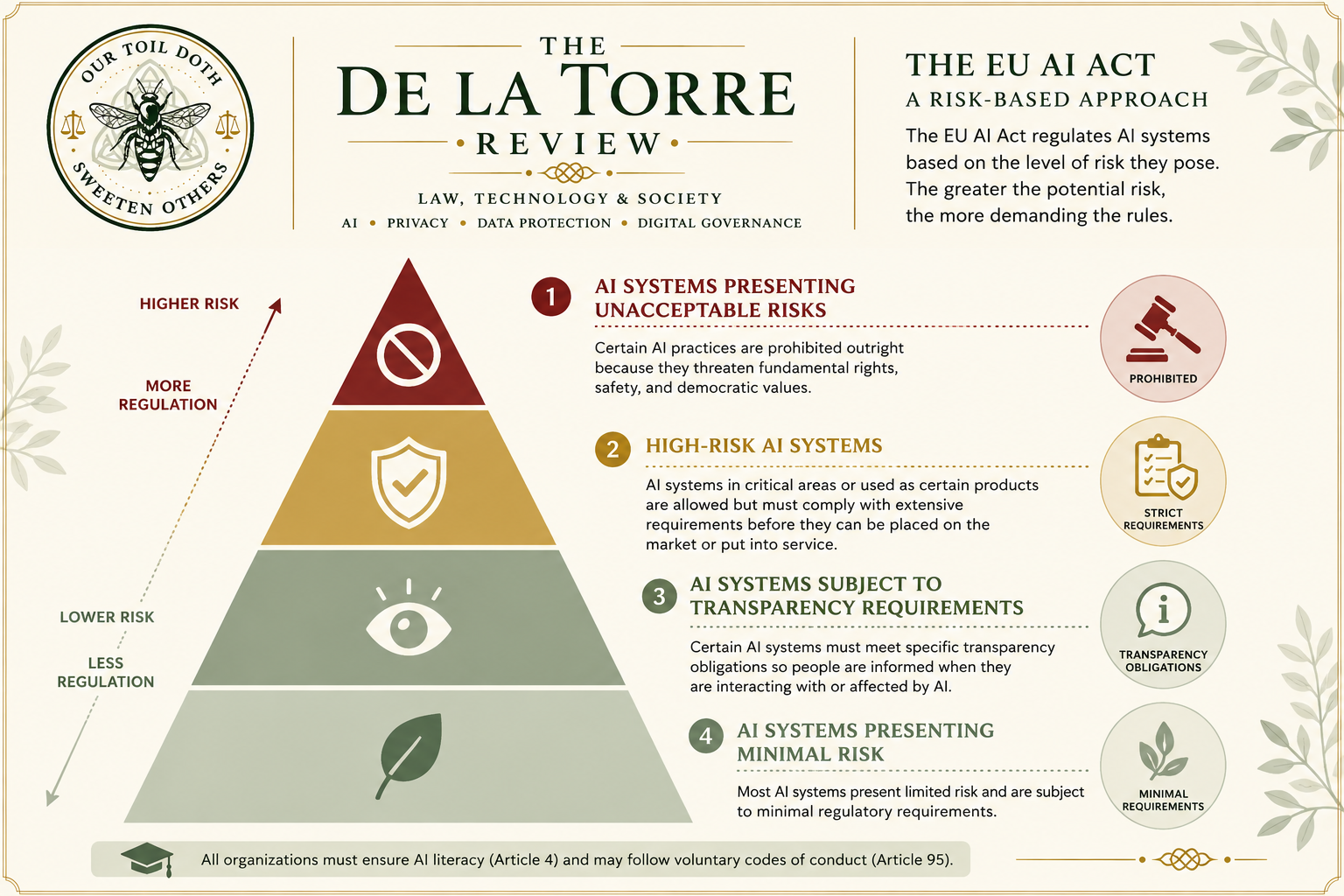
Its basic logic is risk-based: the greater the potential risks associated with an AI system or its use, the more demanding the regulatory requirements become. Some AI practices are prohibited altogether; certain systems are classified as high-risk and subject to extensive requirements; other systems are primarily subject to transparency obligations; and many lower-risk systems face comparatively limited requirements. The Act also creates a separate regulatory framework for general-purpose AI (GPAI) models.
This article provides a general introduction to the framework. More detailed articles address the individual categories, obligations and enforcement mechanisms separately.
What Is the EU AI Act?
The EU AI Act approaches artificial intelligence in significant part through the lens of product regulation and safety. At its core are requirements that must be satisfied before certain AI systems can be placed on the EU market or put into service.
- This approach differs from the General Data Protection Regulation (GDPR). The GDPR regulates the processing of personal data. The AI Act regulates AI systems and certain AI models, and the information they process may include personal or non-personal data and content.
The two frameworks therefore complement one another. An organization using an AI system involving personal data may have obligations under both the GDPR and the AI Act.
A useful way to understand the AI Act is that it generally seeks to regulate AI use cases and risks rather than AI technology itself.
The EU AI Act Has Potentially Global Reach
The AI Act is an EU law, but its significance is not limited to companies headquartered in Europe.
A provider does not necessarily have to be established in the EU for the Act to apply. Among other circumstances, the Act applies to providers placing AI systems or GPAI models on the EU market or putting AI systems into service in the EU. It also applies to deployers established or located in the EU.
Most importantly for organizations outside Europe, the Act can apply where a provider or deployer is outside the EU but the output produced by an AI system is used in the EU.
The EU AI Act can affect organizations throughout an international AI supply chain.
When Does the EU AI Act Apply?
The AI Act entered into force on August 1, 2024, but its requirements become applicable progressively rather than all at once.
The result is a phased implementation structure. Determining whether a particular requirement applies therefore requires asking not only what kind of AI is involved, but also when it was placed on the market or put into service.
What Activities Are Outside the Scope of the EU AI Act?
Even where a technology qualifies as an AI system or AI model, the analysis does not end there. Article 2 excludes certain activities and uses from the scope of the AI Act. Some of these exclusions are broad, while others depend closely on the purpose for which the AI is developed or used.
Being outside the AI Act does not necessarily mean that an activity is unregulated. Article 2 expressly preserves the application of EU data-protection, privacy and communications-confidentiality law, as well as other EU consumer-protection and product-safety rules. AI Act, Art. 2(7), (9).

(1) Military, Defense and National Security
The AI Act does not apply to AI systems that are placed on the market, put into service or used exclusively for military, defense or national-security purposes, regardless of whether the relevant actor is a public authority or a private entity. It also does not affect Member State competences concerning national security. AI Act, Art. 2(3); Recital 24.
The word “exclusively” is important. The exclusion turns on the purpose or use of the system—not the identity of the organization using it. A private contractor acting for a national intelligence agency, for example, can therefore fall within the exclusion when using an AI system for national-security purposes.
But a system does not escape the Act merely because national security is one of its possible uses. Dual-use systems offered for both excluded and non-excluded purposes remain within scope. For example, a remote biometric identification system offered for both national-security and law-enforcement purposes is within scope because law enforcement is not itself excluded, the provider must comply with the AI Act. Similarly, an AI system originally used exclusively for national security can become subject to the Act when it is subsequently used for civilian, humanitarian, law-enforcement or public-security purposes. Recital 24.
National security and law enforcement are not interchangeable. AI used for ordinary law-enforcement purposes generally remains within the AI Act, including its restrictions on crime prediction and real-time remote biometric identification.
(2) Certain International Law-Enforcement and Judicial Cooperation
A narrower exclusion applies to public authorities of third countries and international organizations using AI systems under international cooperation or agreements for law-enforcement or judicial cooperation with the EU or its Member States.
The exclusion applies only where the third country or international organization provides adequate safeguards for individuals' fundamental rights and freedoms. The Commission also explains that private entities entrusted with particular tasks in support of that cooperation may, where relevant, fall within the exclusion. EU and Member State authorities receiving and using the resulting AI outputs remain responsible for complying with Union law. AI Act, Art. 2(4); Recital 22.
(3) Research, Testing and Development Before Market Entry
The Act generally does not apply to research, testing or development activities concerning AI systems or AI models before they are placed on the market or put into service. This permits developers to experiment with and refine AI technologies during the development process without automatically triggering the Act's substantive requirements. AI Act, Art. 2(8); Recital 25.
The exclusion ends, however, when the resulting system is placed on the market or put into service. And importantly, testing in real-world conditions is expressly excluded from this exemption and is instead governed by the Act's specific rules for such testing. AI Act, Art. 2(8).
Research and development that falls outside the AI Act must also continue to comply with other applicable EU law—including, where personal data is involved, EU data-protection law. See, EU Data Protection Law and the General Data Protection Regulation (GDPR)
(4) AI Developed Solely for Scientific Research
Article 2 separately excludes AI systems and AI models, including their outputs, specifically developed and put into service for the sole purpose of scientific research and development. AI Act, Art. 2(6); Recital 25.
The AI developed solely for scientific research exclusion is distinct from the pre-market R&D exclusion.
Article 2(8) protects research and development before market placement or putting into service; Article 2(6) can cover systems or models that are actually put into service, provided they were specifically developed and are used solely for scientific R&D.
(5) Purely Personal, Non-Professional Use
Natural persons using AI systems in the course of a purely personal, non-professional activity are not subject to the Act's obligations for deployers. AI Act, Art. 2(10).
Activities performed professionally, commercially, occupationally or on a freelance basis do not qualify. Thus, an individual using facial recognition to control access to a private home may fall within the exclusion, while a freelancer, journalist or doctor using an AI system in a professional capacity does not.
This is an exclusion for the individual deployer's obligations, not an exclusion of the AI system itself from the Act.
The provider that places the system on the market, as well as importers, distributors and professional deployers, may still be subject to their respective obligations.
(6) Certain Free and Open-Source AI Systems
AI systems released under free and open-source licenses are generally excluded, but the exception has important limits. It does not apply where the system is placed on the market or put into service as:
- a high-risk AI system;
- an AI system involving a prohibited practice under Article 5; or
- an AI system subject to the Article 50 transparency requirements.
AI Act, Art. 2(12)
The open-source exclusion is not a blanket exemption for open-source AI. The system's classification and use still matter.
What Does the AI Act Regulate?
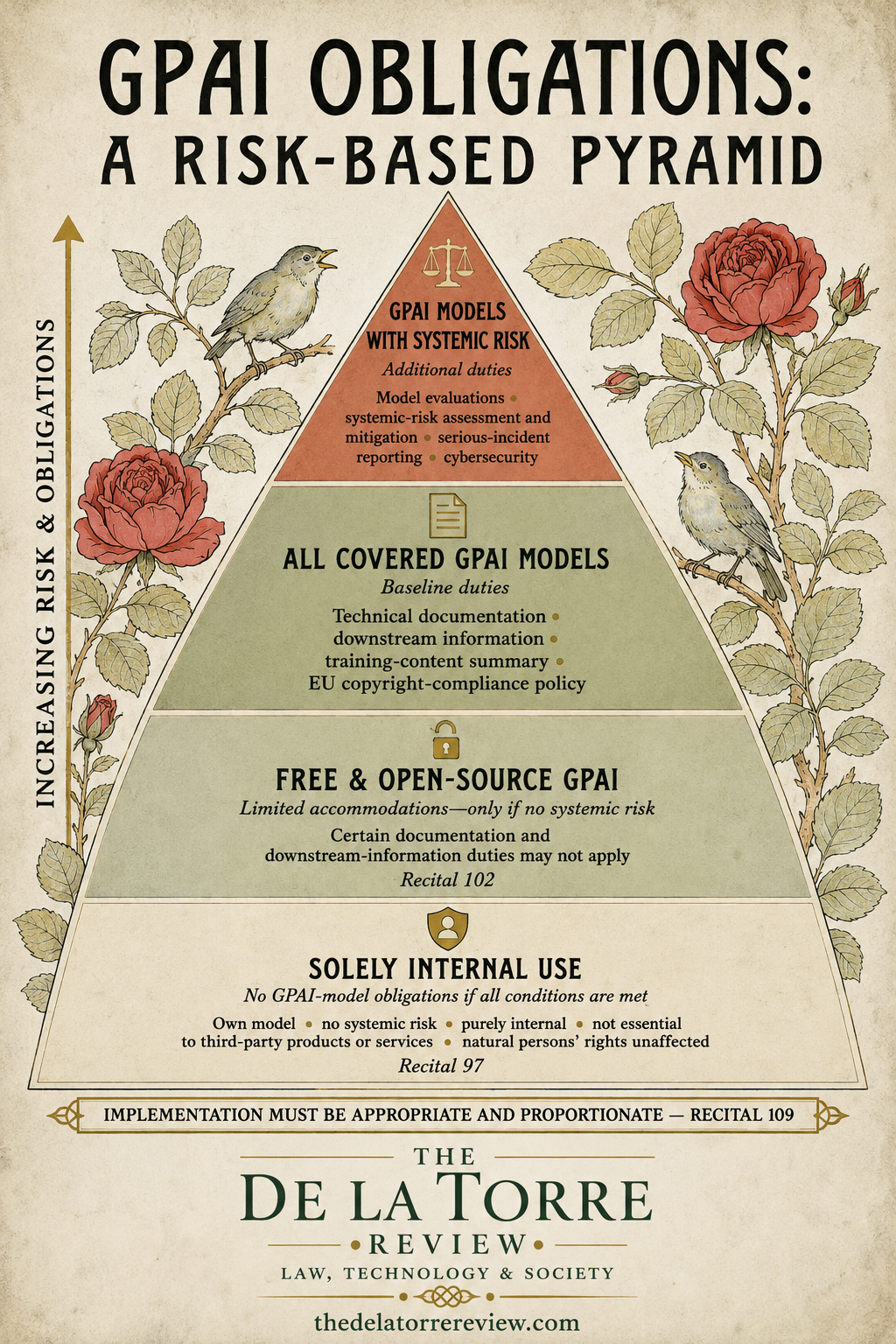
As a general rule, the EU AI Act regulates AI systems, not AI models. The principal exception is general-purpose AI (GPAI) models, which are subject to a separate set of obligations under the Act.
That distinction matters because an AI model and an AI system are not the same thing.
- An AI model is the underlying computational component developed through training. It provides capabilities but generally requires additional elements—such as a user interface, input and output controls, or other software components—to become an operational AI system.
- An AI system, by contrast, is the functional product or application that uses those capabilities to generate outputs for particular objectives.
The Act generally regulates AI systems according to their intended purposes and uses, including through rules for prohibited practices, high-risk AI systems, and certain systems subject to transparency obligations. GPAI models sit outside that basic structure and are governed by their own framework, with additional obligations for GPAI models with systemic risk.
The Separate Framework for General-Purpose AI Models (GPAI)
The principal exception to the general rule that the Act regulates AI Systems is the Act’s separate framework for general-purpose AI models, or GPAI models.
Under Article 3(63), a GPAI model is an AI model that:
- displays significant generality;
- can competently perform a wide range of distinct tasks; and
- can be integrated into a variety of downstream systems or applications.
GPAI models are also sometimes described as foundation models because they can provide the foundation for multiple AI systems.
Large language models will typically qualify as GPAI models because they can perform many different tasks and support numerous downstream applications.
A GPAI model must also be distinguished from a general-purpose AI system. A general-purpose AI system is an AI system based on a GPAI model that can serve a variety of purposes, either through direct use or through integration into other AI systems. (Article 3(66); Recital 100)
For a detailed analysis of GPAI model classification, provider and downstream responsibilities, open-source accommodations, systemic risk, and compliance deadlines, see General-Purpose AI Models Under the EU AI Act: Classification, Obligations, and Systemic Risk. The European Commission also provides current guidance for GPAI-model providers
Compliance at the model level does not determine the legal classification of every downstream system.
The Act regulates two layers separately:
- GPAI-model providers are subject to model-level requirements concerning documentation, downstream information, copyright compliance, training-content transparency, and regulatory cooperation. Developers of GPAI models with systemic risk face additional evaluation, risk-management, incident-reporting, and cybersecurity obligations.
- Providers and deployers of downstream AI systems must separately determine how the Act’s risk-based rules apply to each resulting system based on its intended purpose and deployment context.
AI Systems Under the EU AI Act
What Is an “AI System”?
Article 3(1) defines an AI system as:
A machine-based system designed to operate with varying levels of autonomy that may exhibit adaptiveness after deployment and that, for explicit or implicit objectives, infers from its inputs how to generate outputs—including predictions, content, recommendations, or decisions—that can influence physical or virtual environments.
The principal characteristics are:
- machine-based operation;
- some degree of autonomy;
- inference from inputs;
- generation of outputs; and
- the ability of those outputs to influence physical or virtual environments.
Inference is the central feature distinguishing AI from conventional software. Software that merely executes operations entirely predetermined by humans generally falls outside the definition. Inference, however, can involve machine learning or logic- and knowledge-based techniques. Certain expert systems may therefore qualify.
An AI system need not operate without human involvement. Nor must it adapt after deployment: the definition says that a system may exhibit adaptiveness, making that characteristic optional.
The Commission’s nonbinding Guidelines on the Definition of an AI System provide additional guidance.
Practice Tip: Look Beyond the Label: Software marketed as “AI” may fall outside the definition if it only executes predetermined operations. Conversely, software not marketed as AI may qualify if it uses inference and otherwise satisfies Article 3(1).
A. The Risk-Based Structure of the AI Act: AI Systems
Once a technology qualifies as an AI system, the next step is determining which requirements apply.
The Act is commonly visualized as a risk pyramid. This is useful, but the categories are not always mutually exclusive. For example, a high-risk system may also be subject to Article 50 transparency requirements.
A.1. Prohibited AI Practices: Article 5 prohibits specified practices involving, among other things:
- harmful manipulation or exploitation of vulnerabilities;
- social scoring;
- certain criminal-risk assessments;
- untargeted facial-image scraping;
- certain emotion-recognition and biometric-categorization uses; and
- real-time remote biometric identification for law enforcement, subject to narrow exceptions.
These prohibitions apply only when the particular statutory conditions are satisfied.
A.2. High-Risk AI Systems: High-risk systems are permitted but subject to extensive requirements. Under Article 6, an AI system generally becomes high-risk through one of two routes:
- It is a product—or safety component of a product—covered by specified EU legislation and subject to third-party conformity assessment; or
- Its intended purpose falls within a use case listed in Annex III, such as certain uses involving biometrics, critical infrastructure, education, employment, essential services, law enforcement, migration, or justice.
Article 6(3) provides a limited exception for some Annex III systems that do not pose a significant risk of harm or materially influence decision-making. Systems that profile natural persons in an Annex III context remain high-risk.
High-risk providers face requirements involving risk management, data governance, documentation, logging, transparency, human oversight, accuracy, robustness, cybersecurity, conformity assessment, registration, and post-market monitoring.
A.3. AI Systems Subject to Transparency Requirements: Article 50 imposes targeted duties in specified circumstances, including:
- informing people that they are interacting with AI;
- marking synthetic content in a machine-readable and detectable format;
- informing people exposed to emotion-recognition or biometric-categorization systems; and
- disclosing deepfakes and certain AI-generated public-interest text.
These obligations may apply to providers or deployers and can overlap with high-risk requirements.
A.4. Other AI Systems: Systems that are neither prohibited nor high-risk are sometimes described as minimal-risk systems, although this is not a formal statutory category. They generally avoid the high-risk conformity regime but may remain subject to:
- AI literacy under Article 4;
- applicable Article 50 transparency duties;
- voluntary codes of conduct under Article 95; and
- other laws governing privacy, consumer protection, discrimination, cybersecurity, intellectual property, or product safety.
The AI System Supply Chain
Another fundamental feature of the AI Act is that it does not regulate only the company that originally develops an AI system. Instead, it identifies different operators throughout the AI supply chain. The relevant roles include:
- Providers develop an AI system or GPAI model, or have one developed, and place it on the market or put it into service under their own name or trademark.
- Deployers use an AI system under their own authority. Commercial organizations and public authorities can therefore be deployers. Individuals using AI purely for personal, non-professional purposes are generally excluded from this role.
- Importers are EU-established actors that place on the EU market an AI system bearing the name or trademark of a person established outside the EU.
- Distributors make AI systems available on the EU market without being the provider or importer.
- Product manufacturers can assume provider responsibilities where an AI system forms part of a regulated product or serves as its safety component in the circumstances specified by the Act.
- Authorized representatives are EU-established persons appointed by non-EU providers to perform specified functions and interact with authorities on their behalf.
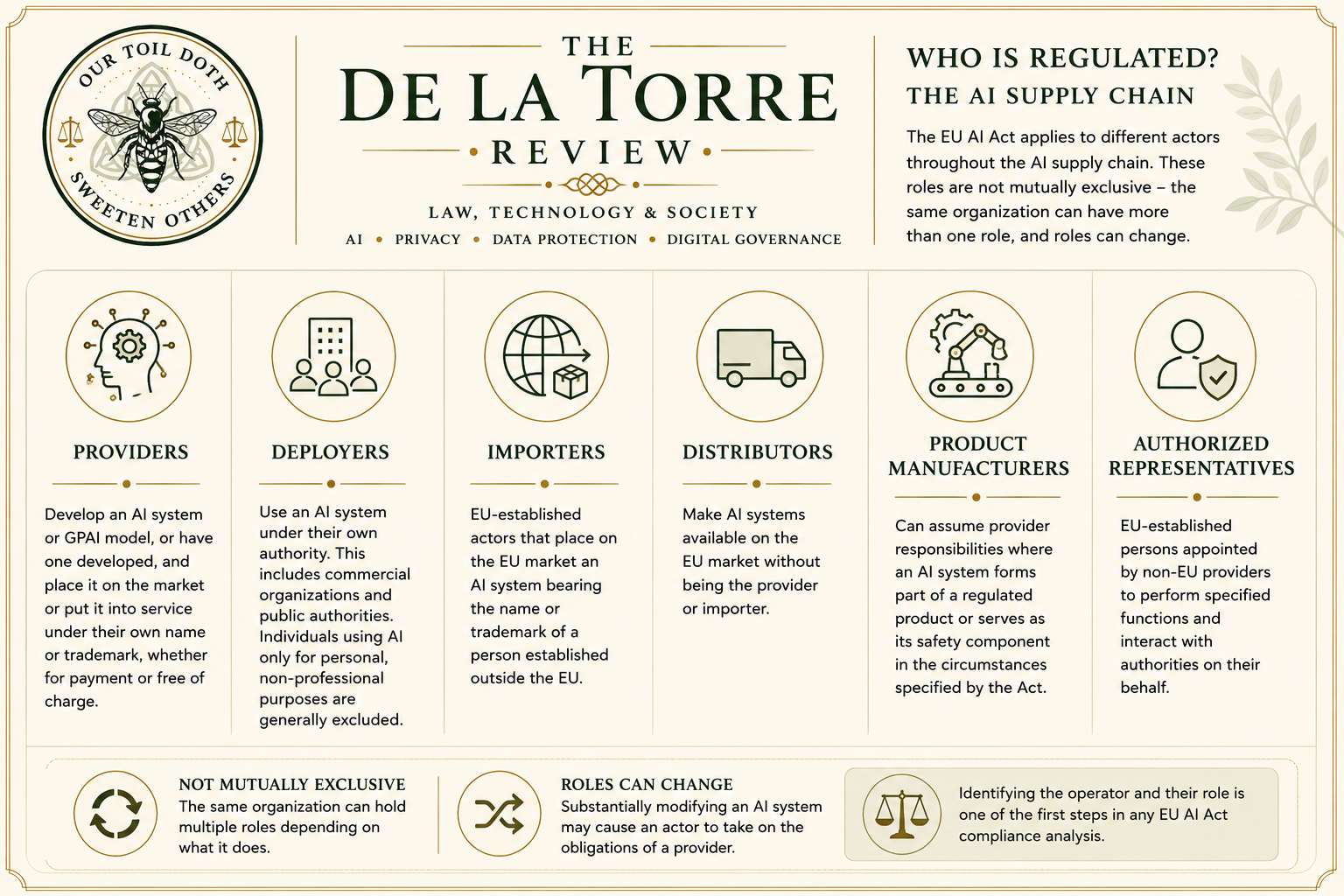
These roles are not mutually exclusive. Depending on what an organization does, the same person or company can potentially occupy more than one role. The classification can also change . For example, someone who substantially modifies an AI system may assume the obligations of a provider.
- For more see: Who Is Regulated Under the EU AI Act? Understanding Providers, Deployers, Importers, Distributors and Other Operators
A Practical Way to Think About AI Act Compliance
The structure of the Act suggests a sequence of questions for analyzing an AI product or use case:
- Is the technology an AI system or GPAI model covered by the Act?
- Does an exclusion apply?
- Does the Act apply territorially?
- What role does each organization occupy—provider, deployer, importer, distributor, manufacturer or authorized representative?
- Is the AI practice prohibited?
- If permitted, is the system high-risk?
- Does it trigger specific transparency requirements?
- Is a GPAI model involved, and if so, what GPAI obligations apply?
- What operational, documentation, conformity, monitoring or other obligations follow from that classification?
The important point is that “Does the AI Act apply?” is only the beginning of the analysis. Once the answer is yes, the system's classification, intended purpose, operator roles and place in the supply chain determine the obligations that follow.
What Is Outside the AI Act?
The Act is broad, but it does contain exclusions.
The slides identify exclusions or special treatment for:
- AI used for military, defense and national security purposes;
- certain scientific research and R&D-only AI;
- certain pre-market testing, other than real-world testing;
- certain free and open-source AI, subject to important limitations;
- certain high-risk products governed through other EU legislation; and
- certain operators subject to limited exemptions.
The open-source exception is described as narrow. It does not simply mean that open-source AI is outside the Act in every circumstance.
How Is the EU AI Act Enforced?
The AI Act combines national enforcement with EU-level governance and coordination.
This institutional structure matters because the text of the AI Act establishes the rules, while institutions determine how those rules are implemented, interpreted, updated and enforced in practice.
At the EU level, the framework includes the European Commission and AI Office, together with other EU-level governance bodies. At Member State level, national competent and market-surveillance authorities play important enforcement roles. The Act also provides individuals with a mechanism to lodge complaints with national authorities.
As with the GDPR, enforcement therefore involves interaction between EU institutions and national authorities rather than a single centralized regulator.
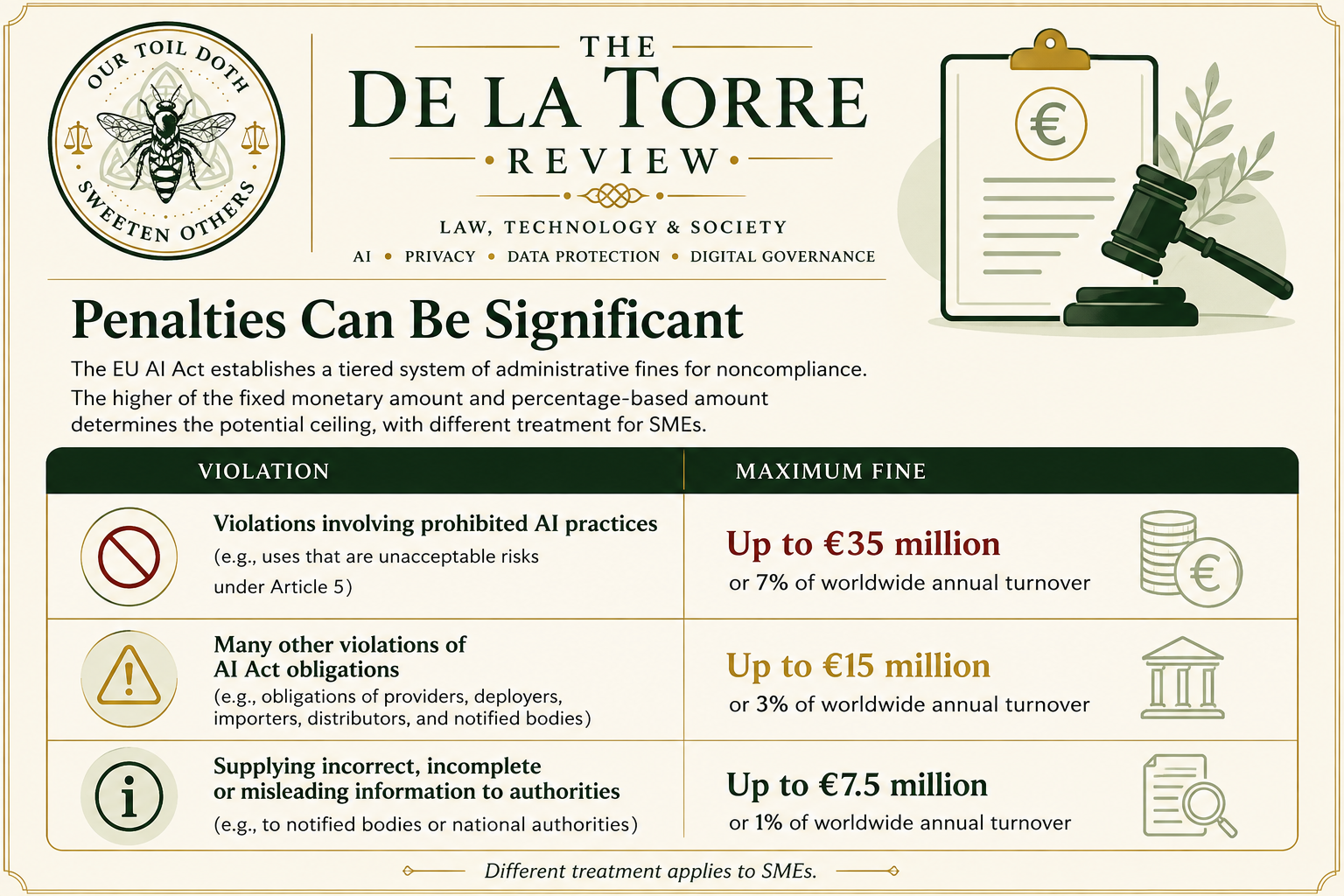
The financial consequences of noncompliance can be substantial.
Generally, the higher of the fixed monetary amount and percentage-based amount determines the potential ceiling, while different treatment applies to SMEs.
The highest penalties therefore correspond to the practices the Act considers unacceptable risks.