
Digital Rights Ireland: Why Communications Metadata Can Reveal a Life
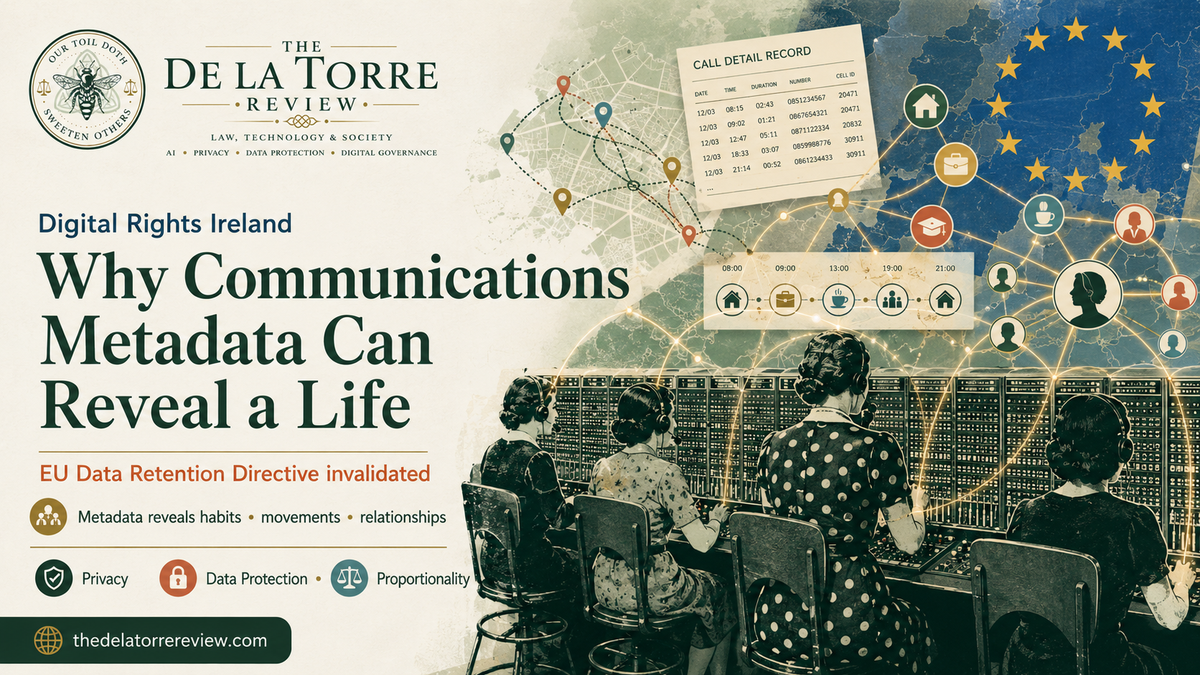
In Digital Rights Ireland, the CJEU invalidated the EU Data Retention Directive, finding that indiscriminate retention of communications metadata seriously interfered with privacy and data protection rights without adequate limits, safeguards, or independent oversight.
Joined Cases C-293/12 and C-594/12 | Court of Justice of the European Union | Grand Chamber | 8 April 2014
Practice takeaways: (1) Metadata can be deeply revealing. The absence of content does not mean the absence of serious privacy risk. (2) Retention is processing—and an interference. A system does not become privacy-relevant only when someone accesses or analyzes the stored data. (3) A legitimate objective is necessary but insufficient. Usefulness does not establish strict necessity. (4) Broad surveillance demands precise law. The more extensive and automated the processing, the stronger the need for clear scope limits and minimum safeguards. (5) Access controls need independent oversight. Objective criteria and prior judicial or independent administrative review were central missing protections. (6) Retention periods require justification. A range written into law is not enough if it is not tied to objective criteria. (7) Security is part of proportionality. Safeguards must reflect volume, sensitivity, and risk—not only cost.
The Court of Justice of the European Union invalidated the Data Retention Directive because it required sweeping retention of communications metadata without the limits and safeguards demanded by the EU Charter of Fundamental Rights. The case established a foundational proposition for modern surveillance law: metadata may exclude the content of a communication and still reveal an extraordinarily detailed picture of a person’s private life.
The short version
Directive 2006/24 required providers of publicly available electronic communications services and public communications networks to retain broad categories of traffic and location data for between six and 24 months. The purpose was to make those data available to national authorities for the investigation, detection, and prosecution of serious crime.
The Directive did not authorize retention of the content of communications. But the Court emphasized that the retained data—such as telephone numbers, IP addresses, the time and duration of communications, and the location of mobile equipment—could, when considered together, support very precise conclusions about a person’s habits, movements, relationships, activities, and social environment.
That was enough to trigger serious scrutiny under Articles 7 and 8 of the Charter of Fundamental Rights of the European Union. The Court accepted that fighting serious crime is a legitimate objective and that data retention can be useful to that end. What it rejected was a system of generalized retention that affected practically the entire European population without requiring any connection between the persons whose data were retained and a threat to public security.
Why the case matters
Digital Rights Ireland is a foundational EU surveillance decision because it links the architecture of a data-retention regime—not only the government’s later use of data—to fundamental-rights scrutiny. Collection and retention are not neutral holding stages. They are interferences in their own right, and the seriousness of the interference grows with the scale, duration, linkability, and inferential power of the data.
The judgment also shows how necessity operates as a design constraint. A legitimate purpose such as fighting serious crime does not authorize the broadest technically useful system. Legislation must identify objective limits, constrain access, differentiate retention where appropriate, ensure independent oversight, and provide security protections proportionate to the volume and sensitivity of the data.
For privacy professionals, the case offers a broader governance lesson.
- Metadata should not be assessed field by field in isolation.
- Organizations should evaluate what apparently ordinary data can reveal when aggregated across time, location, devices, and relationships—and build access, retention, security, and oversight rules around that cumulative risk.
Key holding
The obligation to retain communications data is itself an interference with the right to respect for private life under Article 7 of the Charter (Right to Privacy.) Government access to those data is a separate, additional interference. Because retention also constitutes the processing of personal data, the Directive interfered with the right to protection of personal data under Article 8 (Right to Data Protection.)
Under Article 52(1) of the Charter, limitations on Charter rights must be provided for by law, respect the essence of the rights, pursue a recognized objective of general interest or protect the rights and freedoms of others, and comply with proportionality. In this context, compliance with proportionality required the interference to be strictly necessary.
The Court concluded that Directive 2006/24 exceeded the limits imposed by proportionality and was invalid.
Why metadata mattered
The Directive covered data needed to identify the source and destination of a communication, its date, time, duration, and type, the equipment used, and the location of mobile equipment. It included, among other things, subscriber names and addresses, calling and called telephone numbers, and IP addresses.
The Court did not treat those data as trivial merely because they were not the words spoken, the message sent, or the webpage viewed. Taken as a whole, communications metadata can disclose who interacts with whom, how often, from where, and over what period. From those patterns, it may be possible to infer where a person lives, where the person travels, what activities the person undertakes, and which personal and social relationships shape the person’s life.
This remains one of the case’s most important lessons: the privacy significance of data depends not only on the sensitivity of each individual field, but also on what the fields reveal when combined.
Metadata may exclude the content of a communication and still reveal an extraordinarily detailed picture of a person’s private life.
The Court’s Charter analysis
1. Retention and access were separate interferences
The Court held that requiring providers to retain data relating to a person’s private life and communications interfered with Article 7 (Right to Privacy.) It did not matter whether the information was considered sensitive or whether the person had suffered a concrete inconvenience. Access by competent national authorities constituted a further interference. The required processing also interfered with Article 8 (Right to Data Protection.)
The Court described the interference as wide-ranging and particularly serious. Retaining and later using the data without informing subscribers or registered users was likely to create the feeling that their private lives were subject to constant surveillance.
2. The Directive did not impair the essence of the rights
The Court distinguished between a serious interference and an impairment of the essence of a right. It held that the essence of Article 7 (Right to Privacy) was not adversely affected because the Directive did not permit acquisition of the content of electronic communications as such. The essence of Article 8 (Right to Data Protection) was not adversely affected because the Directive required certain data-protection and data-security principles, including appropriate technical and organizational measures against accidental or unlawful destruction, loss, or alteration.
This did not save the Directive. It meant only that the measure was not invalid at the threshold. The Court still had to determine whether the interference satisfied the remaining requirements of Article 52(1), especially necessity and proportionality.
3. Fighting serious crime was a legitimate objective
The Court accepted that the Directive pursued an objective of general interest: contributing to the fight against serious crime and, ultimately, to public security. It also accepted that retained communications data can be a valuable tool in criminal investigations and that retention may be appropriate for achieving that objective.
Appropriateness, however, was not the end of the analysis. A measure may be useful and still go further than is strictly necessary.
4. The Directive was not strictly necessary
The Directive failed because its breadth was not matched by sufficiently clear limits and safeguards. The defects identified by the Court included:
- Indiscriminate scope. The retention obligation covered all persons, all electronic communications, and all covered traffic data without differentiation, limitation, or exception. It applied even where there was no evidence suggesting that the person concerned had any connection, however indirect or remote, with serious crime.
- No relationship to a threat. The Directive did not limit retention by time period, geographic area, category of persons, or another objective factor capable of connecting the data to the prevention, detection, or prosecution of serious crime.
- Insufficient access rules. It did not establish substantive and procedural conditions governing national authorities’ access to and use of the data. Nor did it define objective criteria limiting access and use to what was strictly necessary.
- No required prior independent review. Access was not made dependent on prior review by a court or an independent administrative body empowered to ensure that access and use remained strictly necessary.
- Undifferentiated retention periods. Although the Directive permitted retention for six to 24 months, it did not require the selected period to be based on objective criteria related to the data, the persons concerned, or the usefulness of the data to the objective pursued.
- Inadequate security guarantees. The Directive did not provide safeguards adapted to the quantity and sensitivity of the retained data or the risk of unlawful access. It also allowed providers to consider economic costs when selecting security measures and did not ensure irreversible destruction when the retention period ended.
- No EU-storage requirement. Because the Directive did not require the data to be retained within the European Union, it did not fully guarantee the independent supervision expressly required by Article 8(3) of the Charter.
Considering these deficiencies together, the Court held that the EU legislature had exceeded the limits imposed by proportionality under Articles 7, 8, and 52(1) of the Charter.
What the Court did—and did not—decide
The Court declared Directive 2006/24 invalid. It did not merely criticize how particular Member States had implemented it. The problem was embedded in the EU measure itself: the Directive imposed a broad retention obligation without laying down the clear rules, objective criteria, and minimum safeguards necessary to constrain access, use, retention, and security.
The Court recognized that the retention scheme could affect freedom of expression under Article 11 because awareness of surveillance may influence how people use electronic communications. But after finding the Directive invalid under Articles 7, 8, and 52(1), it held that there was no need to examine validity under Article 11. Accordingly, Digital Rights Ireland is principally a privacy and data-protection judgment, not a holding that Article 11 was violated.
The case also should not be described as an EU criminal prosecution. It arose through preliminary references concerning the validity of an EU directive. Although the European Union has defined competences in areas of judicial cooperation in criminal matters, criminal law remains mainly a national issue "outside EU law". The narrower comparison is that Digital Rights Ireland reviewed EU legislation under the Charter, whereas a U.S. Fourth Amendment case generally asks whether government conduct amounts to an unreasonable search or seizure in a particular constitutional setting.
The Advocate General’s opinion
Advocate General Pedro Cruz Villalón reached the same essential conclusion that the Directive was incompatible with the Charter, but his route and proposed remedy differed in notable respects.
The Advocate General focused heavily on the “quality of the law.” In his view, the EU legislature could not impose the retention obligation while leaving the fundamental guarantees governing access and use almost entirely to Member States. His non-exhaustive list of missing safeguards included a more precise definition of serious crime, access controlled by judicial or other independent authorities, case-by-case review, special protection for situations involving professional confidentiality, deletion after the data were no longer useful, and later notice to affected persons when notice would no longer jeopardize the investigation.
He also separately concluded that the two-year upper limit for retention was not adequately justified. Unlike the Court, however, he proposed suspending the effects of invalidity for a reasonable period so the EU legislature could correct the defects. The Court did not adopt that proposed suspension; it simply declared the Directive invalid.
Conclusion
Digital Rights Ireland did not hold that communications metadata may never be retained. It held that generalized retention cannot be justified merely by invoking the importance of fighting serious crime. When a system reaches practically everyone and can reconstruct the patterns of private life, EU law demands clear limits, strict necessity, independent control, and safeguards capable of matching the power of the data.
To put more simply: it may be “just metadata,” but metadata can still tell the story of a life.
Sources and Additional Resources
Sources
CJEU judgments, Advocate General opinions, and related case materials are available through InfoCuria, the Court of Justice of the European Union's official case-law database. Cases can be located by searching the case name or case number. Digital Rights Ireland involved Joined Cases C-293/12 and C-594/12.
Search CJEU case law on InfoCuria
- Court of Justice of the European Union, Grand Chamber, Joined Cases C-293/12 and C-594/12, Digital Rights Ireland Ltd and Others**, Judgment of 8 April 2014, ECLI:EU:C:2014:238.
- Opinion of Advocate General Pedro Cruz Villalón, Joined Cases C-293/12 and C-594/12, delivered 12 December 2013, ECLI:EU:C:2013:845.
Related reading from The de la Torre Review
- “Ireland v. Parliament: The EU Had Power to Require Data Retention—But That Wasn’t the End of the Story.” Five years before Digital Rights Ireland, the Court considered the validity of the same Data Retention Directive—but answered a different question. In Ireland, the Court held that the Directive could properly be adopted as an internal-market measure because it principally harmonized retention obligations imposed on communications providers. Crucially, the Court expressly left open whether those obligations violated fundamental rights. Digital Rights Ireland answered that unresolved question and invalidated the Directive. Read the Article.
- “Promusicae: When an IP Address Becomes a Person.” An earlier CJEU decision examining the link between IP addresses, subscriber identification, and personal data in the context of civil copyright enforcement. It provides useful background for understanding how technical communications data can become information about an identifiable individual. Read the article.
- “Rijkeboer: When the Right of Access Reaches Into the Past.” An earlier CJEU decision illustrating the opposite side of the retention problem. While Digital Rights Ireland warns against unjustified retention, Rijkeboer warns against deleting records so quickly that data-protection rights become ineffective. Together, the cases illustrate how proportionality operates in both directions. Read the Article.
- “Tele2: When Copyright Enforcement Meets Communications Privacy.” Building on Promusicae, the Court confirmed that Member States may permit disclosure of subscriber data for civil copyright enforcement, but must preserve a fair balance between privacy, intellectual property, and other fundamental rights and respect proportionality. Read the article
- Schecke: Transparency Does Not Automatically Trump Data Protection — An earlier application of the Charter’s necessity and proportionality requirements, holding that even a legitimate public-interest objective does not automatically override Articles 7 and 8 and that less intrusive alternatives must be considered. Joined Cases C-92/09 and C-93/09, Schecke and Eifert, paras. 74–86. Read the Article
- “Ministerio Fiscal: Not All Access to Communications Data Is Equally Intrusive.” A later CJEU judgment distinguishing between different levels of interference with privacy depending on the communications data sought. It helps trace the Court's development from the broad metadata retention addressed in Digital Rights Ireland to more limited requests for subscriber-identification data. Read the article.



Comments ()