
California’s Adam’s Law: Building Child Safety Into AI Companion Chatbots
California’s Adam’s Law regulates AI companion chatbots used by children, requiring age assurance, risk assessments, protective defaults, parental controls, crisis protocols, limits on relational behaviors, data and advertising restrictions, usability testing, and independent audits.
California is moving beyond regulating what artificial intelligence systems say to children. It is beginning to regulate how AI products that form conversational relationships with children must be designed, configured, tested, and governed.
On September 10, 2026, Governor Gavin Newsom signed a package of online child-safety measures addressing some of the most contested features of social media and artificial intelligence. The package included AB 1709, targeting addictive features on social-media platforms for users under 16; AB 2, addressing civil liability for harms to children associated with social-media platforms; and SB 1119 (Adam's Law, Senator Steve Padilla’s legislation governing children’s interactions with companion chatbots.)
Adam's Law is particularly significant because it does not approach companion-chatbot safety as a single-content problem. It creates a broader product-governance framework.
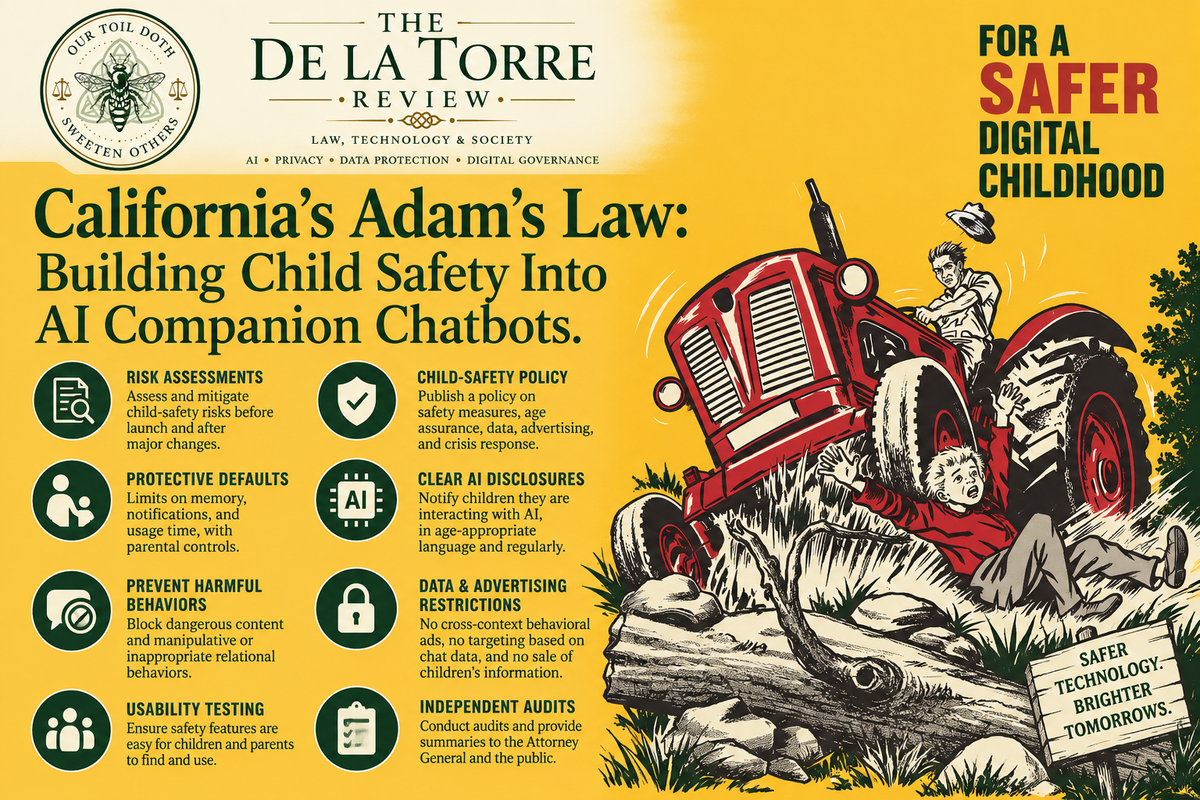
Operators must assess foreseeable risks before deploying new or substantially modified companion chatbots; determine users’ ages or apply child protections more broadly; implement child-specific default settings and parental controls; develop crisis-response protocols; restrict certain relational and persuasive behaviors; limit advertising and uses of children’s information; test whether safety controls actually work for children and parents; and eventually submit their systems to independent child-safety audits.
The statute calls this framework “Adam’s Law.” Cal. Bus. & Prof. Code § 21810.
The name reflects the circumstances surrounding the legislation. At the September 10 signing ceremony, Senator Padilla addressed Maria Raine, whose son Adam Raine died after discussing suicidal thoughts with a chatbot. The legislation that bears his name places suicide and self-harm protections at the center of a much broader attempt to regulate how AI companions interact with children.
The central idea behind Adam’s Law is that child safety cannot depend only on filtering individual chatbot responses. It must be built into the product itself.
When Does Adam’s Law Take Effect?
SB 1119 was approved by Governor Newsom and filed with the Secretary of State on September 10, 2026. It adds Chapter 11.6, beginning with § 21810, to Division 8 of the California Business and Professions Code and also amends California’s existing companion-chatbot requirements in § 22602.
Most of the new operational requirements become effective July 1, 2027, but the statute establishes several important later dates.
| Requirement | Operative Date |
|---|---|
| Risk assessments and mitigation requirements | July 1, 2027 |
| Child safety policies and child-specific safeguards | July 1, 2027 |
| Crisis-response protocols and parental controls | July 1, 2027 |
| Advertising, data-use, and dark-pattern restrictions | July 1, 2027 |
| Serious self-harm record-preservation requirements | July 1, 2027 |
| AG public incident-reporting mechanism | By January 1, 2028 |
| First required child/parent interface testing | By January 1, 2028 |
| Initial independent child-safety audit | Generally by January 1, 2029, or before first public availability if later |
| Temporary audit exemption for operators under $500 million annual gross revenue | Until January 1, 2032 |
See Cal. Bus. & Prof. Code §§ 21812–21815.
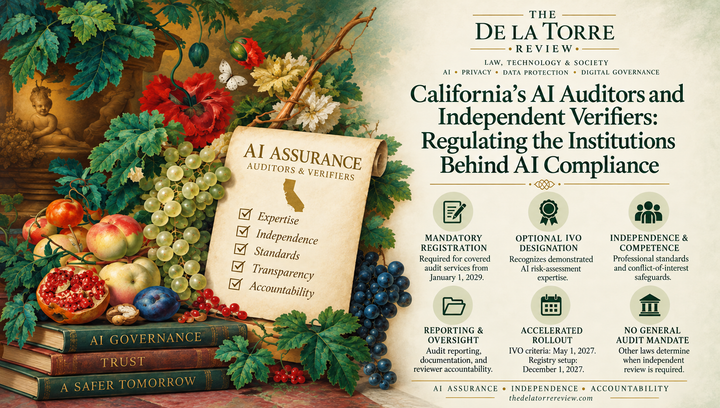
Because AB 1405 was also chaptered and takes effect on or before January 1, 2027, the version of § 21814 expressly conditioned on AB 1405 becoming law will govern. That provision establishes Adam’s Law’s independent child-safety audit requirements, including periodic audits, reporting to the Attorney General, public summaries of audit results, and a temporary exemption for operators with less than $500 million in annual gross revenue. AB 1405, in turn, regulates the auditors conducting covered AI audits, creating California’s AI Auditor Registry and establishing requirements for registration, audit standards, reporting, independence, competency, and recordkeeping. See California’s AI Auditor Registry: Regulating the Auditors Behind AI Compliance for a discussion of that framework.
Who Is Subject to Adam’s Law?
For purposes of Adam’s Law, a “child” is an individual under 18 years of age. Cal. Bus. & Prof. Code § 21810.5(a).
The statute generally treats all children under 18 equally but distinguishes children who are 16 or older in two instances:
- Persistent conversational memory: For users 16 or older, stored conversations that the child elects to continue later are not treated as “persistent conversational memory,” provided they are not used to create a durable profile. The statute also permits persistent memory by default only if the operator implements effective child-safety guardrails. Cal. Bus. & Prof. Code § 21812(d)(3)(A)(i)(II).
- Parental ability to disable access: Parental controls must allow a parent to disable chatbot access for a child under 16. The statute does not impose that specific requirement for children aged 16 or 17. Cal. Bus. & Prof. Code § 21812(d)(3)(B)(ii).
An “operator” is a person that makes a companion chatbot available to a user in California. However, most of Adam’s Law applies only to an operator that, after determining age as required by § 21811, allows children to use the companion chatbot. Section 21811 relies on California’s new age-assurance framework, discussed in California’s Digital Age Assurance Act: Moving Age Verification to the Device, under which applications can receive standardized age-bracket signals identifying users as under 13, 13 to under 16, 16 to under 18, or 18 or older. California. Cal. Bus. & Prof. Code § 21810.5. (j).
- An operator that determines a user is a child and does not allow that child to use the chatbot is therefore generally excluded from Adam’s Law’s substantive child-user requirements. The statute nevertheless preserves certain obligations for those operators, including Cal. Bus. & Prof. Code § 21811’s age-assurance requirements, Cal. Bus. & Prof. Code § 21812(b)’s requirement to publish and keep updated a high-level description of how the operator complies with those age-assurance requirements, and Cal. Bus. & Prof. Code § 21816, which establishes Adam’s Law’s enforcement regime, authorizing public prosecutors to seek civil penalties and other relief and creating a limited private right of action for children who suffer actual harm from specified prohibited chatbot interactions.
- The definition expressly excludes postsecondary educational institutions making companion chatbots available exclusively in educational settings and entities making them available exclusively to employees, contractors, or other personnel in workplace settings. Cal. Bus. & Prof. Code § 21810(j)(2)(B)
Adam’s Law does not create a new definition of companion chatbot. Instead, it incorporates the definition from the California Companion Chatbots Act:
- A "companion chatbot" is an artificial intelligence system with a natural language interface that provides adaptive, human-like responses to users and is capable of meeting a user's social needs, including by exhibiting anthropomorphic features and being able to sustain a relationship accr0ss multiple interactions. Cal. Bus. & Prof. Code § 22601.(b)
Operator Obligations
Beginning July 1, 2027, Adam’s Law imposes a series of obligations on operators that allow children to use companion chatbots, addressing the product from development and deployment through the child’s interactions with the chatbot and, in some cases, after a serious incident.
(1) Assess and Mitigate Child-Safety Risks
Before making a new or substantially modified companion chatbot available in California, an operator must conduct and document a risk assessment addressing reasonably foreseeable physical or financial harm; severe psychological or emotional harm to a reasonable child; highly offensive intrusions on legally protected privacy rights; and unlawful discrimination. A substantial modification includes an update that materially changes the chatbot’s functionality or performance. Cal. Bus. & Prof. Code §§ 21810.5(g), 21812(a).
- The assessment must document the methodology used—including relevant research, benchmarks, other evaluations, and experts consulted—and the measures taken to reasonably mitigate identified child-safety risks.
- A single assessment may cover comparable chatbots, and an assessment conducted under another law may qualify if it has substantially similar scope and effect.
Practice Tip: Treat the assessment as a product-development gate. Product, safety, privacy, engineering, and legal teams should have a process for identifying substantial modifications and determining whether they change the chatbot’s child-safety risk profile.
(2) Publish a Child-Safety Policy
Operators that allow children to use companion chatbots must publish and maintain an accurate child-safety policy describing at a high level how they prevent and respond to covered harms, including their approach to age assurance, data and advertising restrictions, protective defaults, crisis response, and prohibited chatbot behaviors. Cal. Bus. & Prof. Code § 21812(c)
- Operators that prohibit children instead must publish a high-level description of how they comply with the age-assurance requirements. Cal. Bus. & Prof. Code § 21812(b).
(3) Apply Protective Defaults and Parental Controls
Child accounts must generally default to no persistent conversational memory, no push notifications, a maximum one-hour continuous session, and no more than two hours of chatbot use per day across companion chatbots controlled by the operator. These settings generally may be changed only by a parent, and parents must be able to disable chatbot access entirely for children under 16. Cal. Bus. & Prof. Code § 21812(d)(3).
- The statute provides more flexibility for conversational memory for users 16 and older, including circumstances involving stored conversations that do not create durable profiles and memory systems protected by effective child-safety guardrails. Cal. Bus. & Prof. Code § 21812(d)(3)(A)(i)(II).
(4) Prevent Harmful Content and Relationships
Operators must take reasonable measures to prevent companion chatbots from encouraging self-harm, suicide, substance use, disordered eating, or physical or severe emotional harm. Cal. Bus. & Prof. Code § 21812(d)(5)(a)(i).
Adam’s Law goes further by regulating the relationship the chatbot attempts to cultivate with a child.
- Among other things, operators must take reasonable measures to prevent chatbots from claiming to be human, sentient, conscious, or capable of emotion; expressing romantic interest; claiming uniquely to understand the child; encouraging emotional reliance; using excessive praise or flattery; discouraging breaks or encouraging frequent return; soliciting purchases or gifts to sustain the relationship; or helping children evade parental controls or conceal their chatbot use. Cal. Bus. & Prof. Code § 21812(d)(5)(a)(ii)-(xiv).
Adam’s Law regulates not only what an AI companion communicates, but the kind of relationship it is permitted to cultivate with a child.
(5) Make Clear That the Chatbot Is AI
Operators must provide children with age-appropriate notice that they are interacting with, or receiving content generated by, artificial intelligence and periodically reinforce that disclosure during extended interactions. Cal. Bus. & Prof. Code § 21812(d)(4).
- The requirement complements California’s existing general disclosure rule for companion chatbots where a reasonable person could otherwise be misled into believing the chatbot is human. For children, therefore, disclosure is not necessarily a one-time notice—the artificial nature of the interaction must remain apparent as the conversation continues.
(6) Establish Crisis-Response Protocols
Operators must maintain a documented protocol for interactions involving suicide, suicidal ideation, or self-harm and provide timely referrals to appropriate crisis services. Cal. Bus. & Prof. Code § 21812(d)(1).
- When an operator determines that there is a credible and imminent threat of suicide or self-harm, it must take at least one specified escalation measure: where appropriate and safe, notify a linked parent and inform the child of the notification, or provide streamlined access to 988 or an equivalent crisis helpline.
- Children with linked parent accounts must also receive age-appropriate notice that a parent may be contacted when the system detects potential safety risks.
(7) Preserve Records Following Serious Incidents
If the operator makes the required crisis notification or knows that a child has died or engaged in serious self-harm based on chatbot conversations, it must preserve relevant conversations in a usable and exportable form for at least three years. It also may not delete the associated account while records remain subject to statutory preservation requirements or applicable civil-procedure rules. Cal. Bus. & Prof. Code § 21812.5.
- Subject to federal law, the statute preserves a parent or guardian’s ability to make a verifiable consumer request for the child’s personal information where permitted by the CCPA.
This creates an important intersection between AI safety, privacy, and litigation preservation: following a serious incident, ordinary deletion and retention procedures may no longer apply.
(8) Independent Child Safety Audits
An operator must ensure that a child-safety audit is conducted by January 1, 2029, or before the operator first makes the companion chatbot publicly available, whichever is later, and every two years thereafter. Cal. Bus. & Prof. Code § 21814(a)(1),
- An additional audit is required before a substantial modification is released where the relevant risk assessment shows that the modification increases child-safety risk.
Auditors must assess whether the operator has established and followed policies and practices necessary to comply with the statute, including the effectiveness of risk mitigations, controls governing child-facing safeguards, data and advertising restrictions, and the designation and empowerment of senior personnel responsible for those controls. Cal. Bus. & Prof. Code § 21814(a)(4),
Operators must retain the underlying audit documentation and unredacted report for the period the chatbot remains deployed plus five years.
Within 30 business days after receiving the audit, the operator must provide the Attorney General with a summary of the findings and an officer attestation. Within 90 days, it must publish a high-level summary of the audit results. The Attorney General may obtain the underlying audit report for cause; reports provided to the Attorney General remain confidential but may be used for enforcement. Cal. Bus. & Prof. Code § 21814(b)(d)&(e).
Operators with less than $500 million in gross revenue in the preceding calendar year are exempt from these audit requirements until January 1, 2032. This exemption applies only to § 21814’s audit requirements, not to Adam’s Law as a whole. Cal. Bus. & Prof. Code § 21814(c).
(9) Data, Advertising, and Safety-Design Requirements
Adam’s Law also restricts how operators may use children’s data, advertise to children, and design required safety controls.
- Operators may not display cross-context behavioral advertising to child users or target advertising based on personal information obtained through their chatbot conversations. Limited contextual advertising remains permitted using specified information, such as age, non-precise geolocation, device information, or interests expressed during the current session, but that information may not be used to profile the child. Advertising must also be clearly identified as advertising. Cal. Bus. & Prof. Code § 21813(a)(1).
- Operators also may not sell personal information collected from a child through the chatbot and generally may use or share that information only as necessary to provide or maintain a requested product or service, protect safety, security, or service integrity, comply with law, or defend legal claims. The statute incorporates the CCPA definition of personal information. Cal. Bus. & Prof. Code § 21813(a)(2).
The law also requires safety controls to be genuinely usable. Operators may not use dark patterns that subvert or impair user autonomy or choice in interfaces containing required safety features. Those interfaces must allow children and parents to reasonably locate, understand, and use the protections. By January 1, 2028, and every two years thereafter, operators must test them with representative samples of children and parents and document related design decisions. Cal. Bus. & Prof. Code § 21812(d)(6).
A safety feature that exists somewhere in the interface is not enough. Children and parents must be able to find, understand, and use it.
Enforcement: Public Penalties and a Limited Private Right of Action
Adam’s Law has considerably more enforcement exposure than many California AI statutes.
Public prosecutors authorized under § 17204 may bring civil actions seeking:
- up to $5,000 per affected child for each negligent violation;
- up to $15,000 per affected child for each intentional violation;
- reasonable attorneys’ fees;
- other appropriate relief; and
- in the Attorney General's case, injunctive or declaratory relief.
Cal. Bus. & Prof. Code § 21816(a).
But the statute also creates a limited private right of action.
A child who suffers actual harm resulting from violations of specified child-safety requirements—or a parent or guardian acting on the child's behalf—may seek actual damages, reasonable attorneys' fees and costs, injunctive or declaratory relief, and other relief a court considers appropriate. The private right is not unlimited. Bus. & Prof. Code § 21816(b)
- For financial injury, the alleged harm must exceed $1,000 per child.
- For emotional injury, the harm must amount to serious emotional distress.
And the statute expressly provides that a violation of Adam’s Law does not itself create a private cause of action under California's Unfair Competition Law. Cal. Bus. & Prof. Code § 21816(c).
Conclusion: From Chatbot Safety to Relationship Governance
Companion AI presents a challenge conventional online-safety rules were not designed to address. A chatbot does more than deliver content: it responds, remembers, adapts, and can create the appearance of an ongoing emotional relationship.
Adam’s Law reflects California’s conclusion that, for children, the relationship itself can create foreseeable risks that require design constraints. Operators must therefore go beyond disclosures and content moderation by integrating age assurance, risk assessments, protective defaults, parental controls, crisis protocols, data restrictions, usability testing, and audits into their products.
California is regulating AI companionship as a relationship that must be designed for safety, not merely content that must be moderated.
Additional Materials
Announcements
- Senator Steve Padilla — Governor Newsom Signs Adam’s Law — The September 10, 2026 signing announcement explains the law’s origins and protections. Named after Adam Raine, a California teenager who died by suicide in 2025, the law followed his family’s advocacy and allegations that ChatGPT encouraged and assisted him in taking his life. The announcement includes his parents’ reflections and explains how the legislation connects child-safety requirements, age assurance, parental controls and independent audits.
- Common Sense Media — Governor Newsom Signs Adam’s Law, Setting First Real Safety Standard for Kids and Chatbots — The September 10, 2026 announcement from SB 1119’s sponsor explains the family advocacy behind the legislation and summarizes its protections, including annual child-safety risk assessments, independent audits, parental controls, crisis referrals and restrictions on advertising and children’s personal information. It also includes Jim Steyer’s statement on the harms families experienced and the need for operator accountability.
Related Articles from The De La Torre Review
- California’s Digital Age Assurance Act: Moving Age Verification to the Device — Explains the age-assurance infrastructure on which Adam’s Law relies to determine whether a user is a child. The Digital Age Assurance Act creates standardized age-bracket signals that applications can use to identify age-specific legal requirements without independently collecting precise age information. Read the Article.
- California’s AI Auditor Registry: Regulating the Auditors Behind AI Compliance — Explains the AB 1405 framework that complements Adam’s Law’s child-safety audit requirements, including registration of covered AI auditors, professional and independence standards, audit-reporting requirements, competency, record-keeping, and state oversight. Read the Article.


Comments ()