California’s AI Auditors and Independent Verifiers: Regulating the Institutions Behind AI Compliance
Who audits the AI auditors? California pairs mandatory auditor registration with optional independent-verifier designation to strengthen expertise, independence, and accountability.

This article addresses California’s complementary AI Auditor Registry and independent verification organization frameworks, enacted through AB 1405 and SB 813 in 2026, respectively. It also incorporates Executive Order N-9-26, which accelerates implementation of both frameworks.
California’s latest wave of technology legislation is not limited to regulating what online platforms and AI systems may do. It is also beginning to regulate the compliance infrastructure surrounding those systems.
That development comes as California continues to expand its regulation of artificial intelligence and online safety. In September 2026, Governor Gavin Newsom signed a package of 13 digital-safety bills addressing issues ranging from addictive social-media features to companion chatbots and AI-generated child sexual exploitation material. The package followed a broader shift toward state regulation of social media and AI, as lawmakers increasingly rely on risk assessments, testing, audits, and other forms of independent review as regulatory tools.
Two less visible—but potentially important—pieces of that infrastructure are California’s AI Auditor Registry and its independent verification organization framework, both enacted September 9, 2026.
- AB 1405 adds Government Code §§ 11549.80–11549.86, establishing registration and professional requirements for providers of covered AI audits. Beginning January 1, 2029, a person may not offer, sell, or conduct a covered AI audit without registration.
- SB 813 adds Government Code §§ 8898–8898.4, creating a separate process through which the Government Operations Agency may designate qualified AI auditors as independent verification organizations, or IVOs. Registration and designation serve different functions: registration regulates participation in the covered-audit market, while IVO designation recognizes demonstrated expertise in assessing AI risks and identifying the metrics and methodologies supporting those assessments.
California’s complementary auditor and verifier frameworks regulate the institutions behind AI assurance: who conducts covered audits, how reviewers demonstrate expertise, and how their independence and accountability are maintained.
When Do the Auditor and IVO Frameworks Take Effect?
The statutes establish different implementation deadlines. Executive Order N-9-26, issued September 18, 2026, directs the Government Operations Agency to complete key administrative steps earlier.
| Requirement | Statutory date | Agency deadline under EO |
|---|---|---|
| Publish IVO application requirements, procedures, and criteria | January 1, 2028 | May 1, 2027 |
| Establish registry, fees, and misconduct-reporting mechanism | January 1, 2029 | December 1, 2027 |
| Begin issuing registration numbers and publishing registry information | January 1, 2029 | December 1, 2027 |
| Require registration to offer, sell, or conduct covered AI audits | January 1, 2029 | Unchanged by the order |
See Gov. Code §§ 8898.1, 11549.82–11549.82.5; Executive Order N-9-26, paragraphs 1–2.
Beginning January 1, 2029, a person may not offer, sell, or conduct a covered AI audit unless registered with the Government Operations Agency. Cal. Gov. Code § 11549.82.5.
- Earlier administrative implementation should not be confused with an earlier statutory registration mandate. The executive order accelerates agency preparation; the prohibition on unregistered covered AI audits remains scheduled for January 1, 2029.
- Existing audit obligations also continue on their own schedules. AB 1405 expressly provides that it must not impede, delay, or otherwise affect audits required by statutes or regulations becoming operative before its requirements. Gov. Code § 11549.86(a).
- The executive order also requests recommendations on possible mandatory IVO oversight of frontier developers; those recommendations are not themselves an audit mandate.
Existing or earlier-effective audit requirements do not have to wait for the registry.
Who Is Subject to the Requirements?
The registry framework revolves around two definitions: “AI auditor” and “covered AI audit.” SB 813 uses the same covered-audit definition but a separate definition of AI auditor for its IVO framework.
(1) AI Auditor
An “AI auditor” is broadly defined as a person, partnership, or corporation that assesses an AI system or model on behalf of a third party. Cal. Gov. Code § 11549.80(c).
- The statute uses California’s now-familiar definition of artificial intelligence: an engineered or machine-based system that varies in its level of autonomy and that can, for explicit or implicit objectives, infer from inputs how to generate outputs capable of influencing physical or virtual environments. Cal. Gov. Code § 11549.80(b). As discussed in California Defines AI: AB 2885 and Its Impact, this technology-neutral definition focuses on AI systems, rather than particular technologies or models, and has increasingly become part of California’s common statutory vocabulary for AI regulation.
For the IVO framework, SB 813 defines an AI auditor as a person, partnership, academic institution, nonprofit, or corporation conducting a covered audit on behalf of a third party. Gov. Code § 8898(c)–(d).
(2) Covered AI Audit
A covered AI audit is:
an audit conducted to assess internal controls, processes, or systems implemented for an AI system or model that are necessary for compliance with state law.
Cal. Gov. Code § 11549.80(d).
- That definition substantially narrows the statute's reach. AB 1405 does not purport to require every consultant, researcher, red-team provider, technical evaluator, or AI-assurance firm to register merely because it evaluates an AI system. The mandatory-registration rule applies when the person offers, sells, or conducts a covered AI audit—that is, an audit of controls, processes, or systems necessary for compliance with California law.
- A covered audit need not necessarily be expressly mandated by another statute. An organization may commission an audit voluntarily to assess controls necessary for compliance with California law. Conversely, an assessment conducted solely for research, benchmarking, or another purpose is not automatically covered merely because it evaluates an AI system. Gov. Code § 11549.80(d).
Practice Tip: Do not assume that every third-party AI assessment is a “covered AI audit.” When engaging an outside evaluator, identify what the assessment is testing and whether it is being performed to assess controls, processes, or systems necessary for compliance with California law. That characterization may determine whether the auditor must be registered beginning in 2029.
What Obligations Are Imposed?
AB 1405 creates a framework that operates at two levels. First, California must establish and maintain a public registry. Second, auditors conducting covered AI audits must satisfy substantive requirements concerning their qualifications, methodology, reports, independence, records, and professional conduct.
(1) What California Must Do
AB 1405 sets January 1, 2029 as the statutory deadline for establishing the public AI Auditor Registry. Executive Order N-9-26 directs the California Government Operations Agency to establish the registry and begin specified administrative actions by December 1, 2027. Cal. Gov. Code § 11549.82; Executive Order N-9-26, paragraph 2.
But the registry is more than a directory. The Agency must also establish an online mechanism through which natural persons can report misconduct by registered AI auditors. Misconduct reports generally must be retained for as long as the auditor remains registered plus 10 years and may be shared with other state agencies as necessary for enforcement. Cal. Gov. Code § 11549.82(a)(3), (b)(3)–(4).
The Agency may investigate alleged violations and obtain information reasonably necessary to determine whether an auditor has violated the statute. A violation may result in removal from the registry and referral to the Attorney General or another appropriate enforcement authority. Before removal, however, the auditor must receive written notice of the basis for the proposed action and a reasonable opportunity to cure or contest it. Cal. Gov. Code § 11549.84(a).
- A different process applies to CPAs, public accountants, and qualifying accounting firms in good standing. If the Agency determines that such an auditor has violated the statute, it must notify both the auditor and the California Board of Accountancy. The Board then investigates under its existing procedures and reports its findings and any resulting action to the Agency. Cal. Gov. Code § 11549.84(b).
The result is a registry that serves both transparency and oversight: organizations can identify registered auditors and review information about their services, credentials, applicable areas of California law, and audit methodologies, while the state can receive misconduct reports, investigate potential violations, and take or refer enforcement action.
(2) What AI Auditors Must Do
Beginning January 1, 2029, persons offering, selling, or conducting covered AI audits must register. To register, an AI auditor must provide specified information, including its business and contact information, the California laws or regulations under which it conducts covered audits, relevant certifications and accreditations, a description of its services, and a standard operating procedure identifying applicable audit standards and explaining the basis for claims about the accuracy, reliability, or validity of its protocols. Cal. Gov. Code § 11549.83(a).
- The standard operating procedure may rely on standards from organizations such as ISO, NIST, auditing and assurance standard-setters, professional accountancy bodies, or California governmental agencies, and reasonable redactions are permitted to protect trade secrets. Auditors must update the Agency within 90 days of a change that materially affects the accuracy or completeness of published registration information. Cal. Gov. Code § 11549.83(a)(6), (b).
- Beginning January 1, 2029, a person may not offer, sell, or conduct a covered AI audit unless registered with the Government Operations Agency. Cal. Gov. Code § 11549.82.5.
Registration also comes with substantive professional obligations. A registered AI auditor must:
- conduct covered audits in accordance with widely recognized industry standards appropriate to the system or model, to the extent such standards are available. Cal. Gov. Code § 11549.83(c);
- provide the auditee with the required audit report, documenting the audit’s scope, results, supporting basis, identified deficiencies and appropriate corrective measures, compliance with applicable internal safety standards, limitations, and a signed statement of compliance. Cal. Gov. Code § 11549.83(d);
- retain information provided to the auditee and documentation supporting the audit results for at least 10 years. Cal. Gov. Code § 11549.83(e);
- maintain independence from the auditee and avoid financial, business, employment, or other relationships that could reasonably impair independence or objectivity. Cal. Gov. Code § 11549.83(f)(1)(A);
- not audit its own work, including systems, processes, controls, assessments, or other subject matter that it materially designed, developed, implemented, or operated for the auditee. Cal. Gov. Code § 11549.83(f)(1)(B);
- maintain appropriate employment-related independence, including prohibiting audit participants from seeking or accepting employment with the auditee during the audit and generally excluding individuals who materially worked on the audited subject matter for the auditee during the preceding 12 months. Cal. Gov. Code § 11549.83(f)(1)(C)–(D);
- exercise independent, objective, and impartial professional judgment and ensure that the audit team collectively has the knowledge, skills, abilities, and specialized expertise necessary to competently perform the audit. Cal. Gov. Code § 11549.83(f)(1)(E)–(F);
- comply with any additional professional standards concerning independence, objectivity, integrity, competence, or professional conduct adopted by the Agency. Cal. Gov. Code § 11549.83(f)(1)(G);
- protect employees who report suspected noncompliance by not restricting disclosures to the Attorney General or Labor Commissioner, preventing reports through the state misconduct mechanism, or retaliating against employees for making protected reports. Cal. Gov. Code § 11549.83(g); and
- clearly and conspicuously display its registration number on advertising offering or soliciting covered AI audit services. Cal. Gov. Code § 11549.83.5.
Practice Tip: An audit has limited value if the auditor is not meaningfully independent. Organizations using outside AI-governance consultants should therefore distinguish between advisory, implementation, and independent audit roles early in the engagement, because a consultant that materially designs or implements a control may be unable to independently audit that same work.
The statute does not prescribe a single AI audit methodology. It requires registered auditors to use widely recognized industry standards appropriate to the system or model, to the extent appropriate standards are available.
The framework moves AI auditing away from a purely contractual service model and toward a regulated assurance function.
What Must an AI Audit Report Contain?
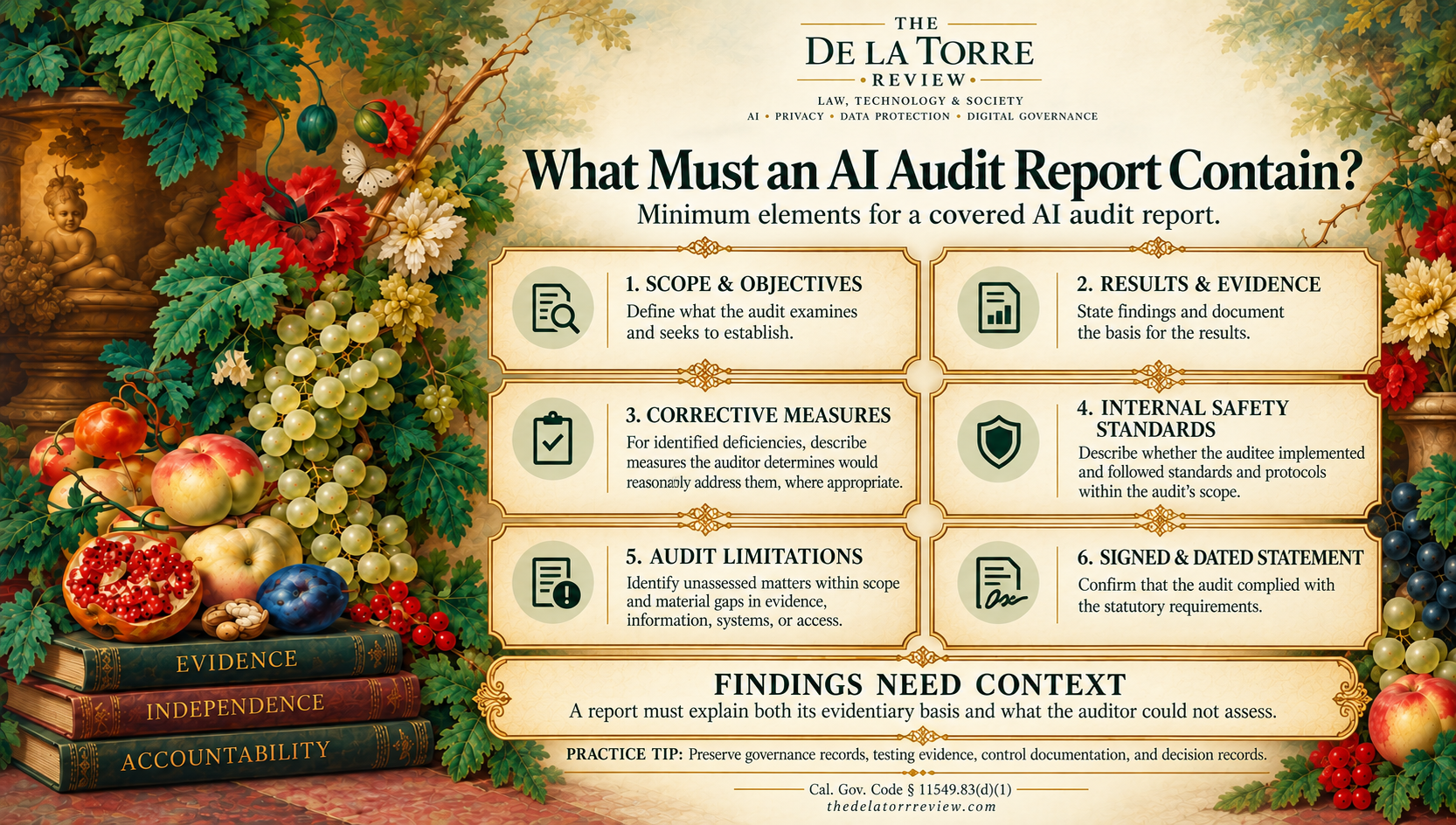
A registered auditor conducting a covered AI audit must provide the auditee with a report that includes, at minimum:
- the scope and objectives of the audit;
- the results and documentation necessary to demonstrate the basis for those results;
- for identified deficiencies, any technical, operational, or governance measures the auditor determines would reasonably address them, where appropriate;
- whether the auditee implemented and adhered to internal safety standards and protocols within the audit's scope;
- the limitations of the audit, including matters within scope that were not assessed and material gaps in evidence, information, systems, or access; and
- a signed and dated statement that the audit was conducted in accordance with AB 1405.
Cal. Gov. Code § 11549.83(d)(1).
The requirement to identify audit limitations is particularly notable. An audit report cannot simply state its findings. It must identify what the auditor could not assess and material deficiencies in the information or access supporting the review.
Practice Tip: Organizations preparing for covered AI audits should treat auditability as part of AI governance. An auditor must be able to explain the evidentiary basis for its findings and identify gaps in access or documentation. Maintaining governance records, testing evidence, control documentation, system information, and decision records may therefore become important not only for substantive compliance but also for obtaining a meaningful audit.
Special Treatment for Accountants and Accounting Firms
Registered AI auditors holding qualifying licenses or authorization to practice public accountancy—and firms holding valid permits from the California Board of Accountancy—may be deemed to satisfy audit-report and independence requirements when they comply with applicable professional standards. Those standards include the California Accountancy Act, the AICPA Code of Professional Conduct, and applicable AICPA attestation standards. Cal. Gov. Code § 11549.83(d)(2), (f)(2).
AI assurance work may be performed by professionals already subject to established accountancy regulation.
This is not a blanket exemption from AB 1405. Rather, the statute recognizes existing professional frameworks as satisfying particular requirements when the statutory conditions are met.
How Does This Framework Interact With California’s Other AI Laws?
The framework becomes particularly important as California increasingly uses independent audits as a compliance mechanism. The law does not itself require companies to audit their AI systems; instead, it regulates audits of controls, processes, or systems necessary for compliance with state law.
Adam’s Law provides an immediate example. As discussed in California’s Adam’s Law: Building Child Safety Into AI Companion Chatbots, the law requires certain companion-chatbot operators to conduct independent child-safety audits examining their policies, controls, testing, and compliance with statutory protections for children. Adam’s Law determines when an audit is required and what it must examine; AB 1405 regulates the auditor conducting that covered audit. Indeed, because AB 1405 was chaptered, the version of Adam’s Law expressly conditioned on its enactment governs.
How Do Registration and IVO Designation Fit Together?
Independent Verification Organizations: A Separate Designation Framework
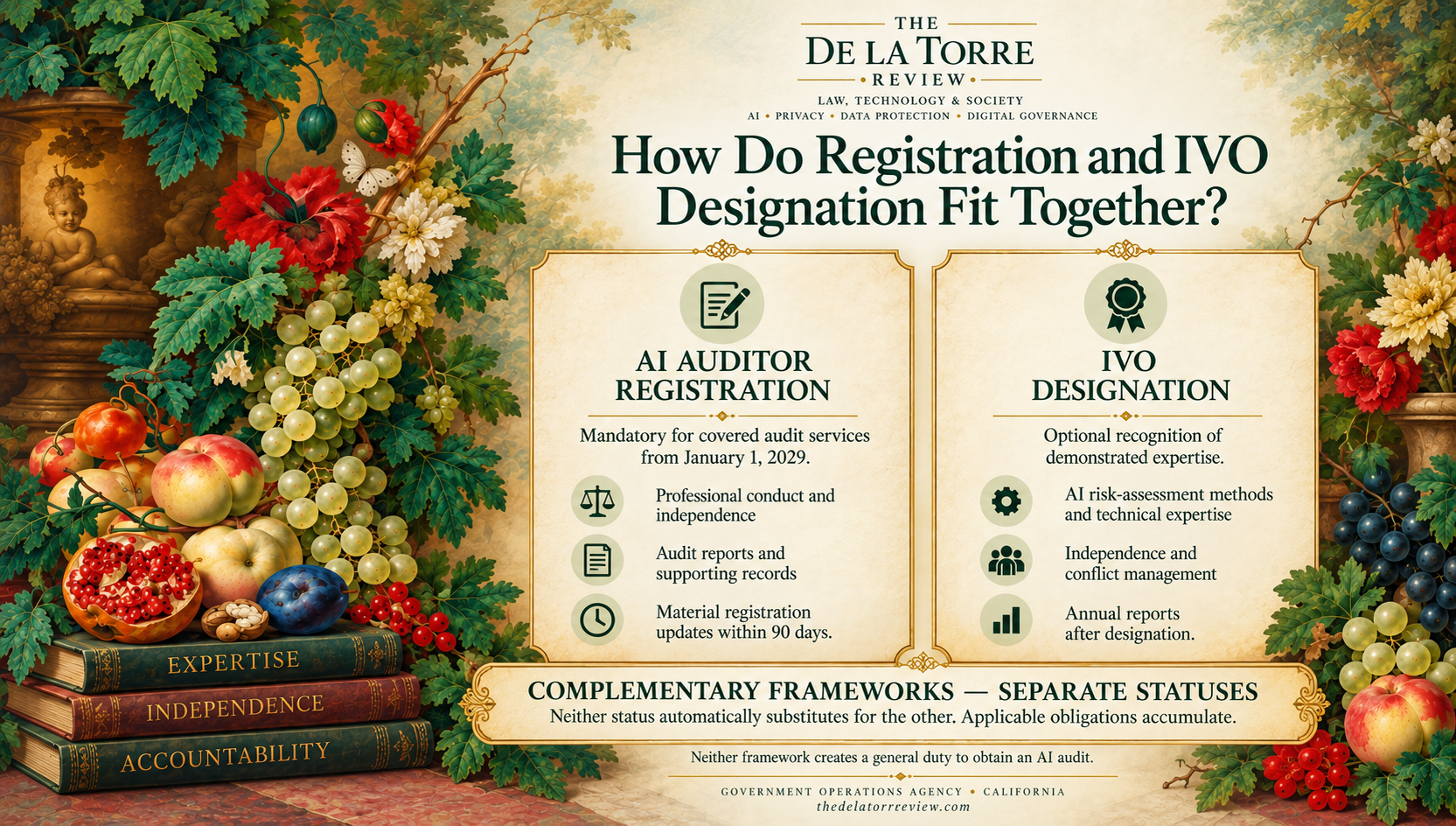
SB 813 establishes a complementary framework for independent verification organizations. An IVO is an AI auditor designated by the Government Operations Agency as having demonstrated expertise in assessing AI-system or model risks and identifying the metrics and methodologies supporting those assessments. Gov. Code § 8898(e).
The agency must develop application requirements and designation criteria, publish them, and establish procedures for suspending or terminating designation. Applications must address qualifications, the designation criteria, proposed benchmarks and methodologies, and documentation needed to verify the application. Gov. Code § 8898.1(a)–(d).
Competence and Independence: In developing designation criteria, the agency must consider risk-assessment expertise, sufficient technical personnel, management of conflicts of interest, and independence from the assessed party.
- An IVO may receive reasonable market-rate compensation, but may not accept payment terms contingent on assessment results. The criteria must also address operational or management dependence and freedom from the assessed party’s control over conclusions or recommendations. Gov. Code § 8898.1(c)(2).
Reporting and Oversight: Designated IVOs must report annually to the agency and Legislature, beginning no sooner than 12 months after initial designation. Reports must summarize standards and methodologies, relevant changes to governance or funding, and changes to application information.
- Permitted redactions protect specified interests, including trade secrets and cybersecurity. IVOs must explain redactions to the extent permitted by the concerns justifying them and retain the unredacted information for five years. Gov. Code § 8898.3.
- Suspension or termination procedures must consider deficient standards, material misrepresentations, impaired independence, inadequate documentation, questionable integrity or competence, and cybersecurity lapses. Gov. Code § 8898.1(b).
What Designation Does—and Does Not—Establish: SB 813 does not generally require AI developers, deployers, or operators to hire an IVO or undergo a covered audit. Nor does the framework endorse an AI system or establish liability solely for failing to comply with an identified standard.
- In litigation alleging harm from AI development, modification, or use, an audit performed under an identified standard is relevant evidence, but not conclusive. Gov. Code § 8898.4.
Registration and IVO designation are separate statuses. Neither statute expressly makes one substitute for the other. An organization operating under both frameworks should expect to satisfy both sets of applicable requirements. SB 813 directs the agency, where practicable, to minimize duplication and accept materials satisfying substantially similar requirements, but does not establish automatic reciprocal recognition. Gov. Code § 8898.1(h).
PRACTICE TIP: Distinguish registration from IVO designation when selecting a reviewer. Confirm the status required for the engagement and evaluate the reviewer’s relevant expertise, independence, methodology, and access to evidence.
Executive Order N-9-26: Potential Further Frontier-AI Oversight
Beyond accelerating implementation, Executive Order N-9-26 directs the Government Operations Agency, consulting with the Governor’s Office of Emergency Services and national experts, to submit recommendations by November 16, 2026 on the feasibility and potential effectiveness of amendments that would:
- require large frontier developers to embed designated IVOs onsite for periodic audits and evaluations;
- require independent verification of frontier AI companies’ required safety frameworks, transparency reports, and risk assessments;
- require a frontier-model “kill switch,” with its effectiveness verified on an ongoing basis by an IVO; and
- expand critical-safety-incident reporting to include loss-of-control incidents.
These are subjects for recommendations, not obligations imposed on AI companies by the order itself. They nevertheless indicate how the new verification infrastructure could support future mandatory oversight. See Executive Order N-9-26, paragraph 3.
Conclusion: Making AI Assurance Accountable
California is building oversight of both AI auditors and independent verifiers. The AI Auditor Registry establishes registration and professional requirements for covered audit providers; the IVO framework creates optional designation based on demonstrated expertise.
Neither law generally requires every AI system to undergo an audit. Other applicable laws determine when independent review is mandatory. These frameworks address a related question: whether the institutions performing that review have the competence, independence, methods, and accountability needed to make it meaningful.
Organizations commissioning reviews should distinguish covered audits from other assessments, registration from designation, and administrative implementation dates from the January 1, 2029 registration mandate.
California’s auditor registry and independent-verifier framework form part of its emerging AI governance infrastructure: as the state increasingly relies on third parties for independent assurance, it is establishing standards for their expertise, independence, and accountability—and answering the inevitable question: who audits the auditors?
Other Resources and Recommended Reading
- California Government Operations Agency — The agency administering both frameworks. Cal GovOps is responsible for establishing and administering the AI Auditor Registry, publishing registration information, receiving misconduct reports, and overseeing registered AI auditors.
- NIST AI Risk Management Framework — A widely recognized framework for managing AI risks. AB 1405 expressly contemplates NIST and other recognized standards as potential sources for auditors’ standard operating procedures and methodologies.
- International Organization for Standardization (ISO) — Artificial Intelligence — International AI standards relevant to governance, risk management, and assurance. AB 1405 expressly recognizes ISO standards as a potential basis for AI audit methodologies.
- AI Auditor Registry legislation — Registration and professional requirements for covered AI auditors.
- Independent Verification Organization legislation — IVO designation, qualification criteria, reporting, and limitations.
- Executive Order N-9-26 — Accelerated administrative implementation and recommendations for potential additional frontier-AI oversight.
Related The De La Torre Review Articles
- California’s Adam’s Law: Building Child Safety Into AI Companion Chatbots — Examines SB 1119’s requirements for companion chatbots used by children, including independent child-safety audits. Adam’s Law provides an immediate example of the substantive AI laws whose audit requirements interact with AB 1405: Adam’s Law determines when and what must be audited, while AB 1405 regulates the auditor performing a covered audit. Read the Article.
- California Defines AI: AB 2885 and Its Impact — Explains the technology-neutral definition of artificial intelligence that has become part of California’s common statutory vocabulary and that AB 1405 uses in defining the systems and models within its audit framework. Read the Article.
- California’s Digital Age Assurance Act: Moving Age Verification to the Device — Examines another component of California’s emerging digital-governance infrastructure: a standardized system for communicating age information to applications so that age-specific legal protections can be implemented without unnecessary collection of precise age data. Read the Article.
Comments ()