
California’s Constitutional right to privacy
California's constitutional right to privacy is one of the broadest in the United States. This article explores its origins, scope, key court decisions, threshold legal tests, limits, comparison with EU privacy law, and practical guidance for analyzing constitutional privacy claims.
“All people are by nature free and independent and have inalienable rights. Among these are enjoying and defending life and liberty, acquiring, possessing, and protecting property, and pursuing and obtaining safety, happiness, and privacy”
Cal. Const. Art. I, § 1.
In California, privacy is an inalienable right (i.e., it cannot be "sold") recognized under Article I, Section 1 of the California Constitution.
California's constitutional right to privacy is broader than its federal counterpart because it protects individuals not only against invasions of privacy by state and federal government entities, but also against violations by other individuals and private companies.[2] The right is also self-executing, meaning that it provides Californians with a direct judicial cause of action to enforce its protections.[3]
Origins and Purpose of California's Constitutional Right to Privacy
California's constitutional right to privacy was adopted by voter initiative in November 1972.
Like Proposition 24, California's constitutional right to privacy was enacted through the initiative process. As a result, it must be interpreted and applied in a manner consistent with the intent of the voters.[4]
Although the concept of privacy encompasses an extraordinarily broad range of interests, the primary purpose behind the initiative was considerably more focused. According to the ballot pamphlet supporting its adoption,[5] the principal objective was to protect Californians against unnecessary governmental surveillance and the excessive collection and maintenance of personal records.[6]
The California Supreme Court has distilled the ballot pamphlet materials into three key principles that guide interpretation of the constitutional right to privacy:[7]
- The amendment targets four principal privacy harms. Specifically, it is intended to address: (i) governmental "snooping" and the secret collection of personal information; (ii) the unnecessary or excessive collection and retention of personal information by government agencies and private businesses; (iii) the improper use of information that was lawfully collected for a specific purpose, including its use for unrelated purposes or disclosure to third parties; and (iv) the absence of adequate safeguards to ensure the accuracy of personal records.[8]
- The right to privacy is not absolute. The amendment does not prohibit every intrusion into an individual's privacy. Rather, any intrusion must be justified by a compelling interest.
- The amendment is self-executing. In other words, the constitutional provision itself creates a legally enforceable right to privacy that may be asserted directly by every Californian.
Limits of California's Constitutional Right to Privacy
California's constitutional right to privacy is not absolute.
A plaintiff asserting a violation of the California constitutional right to privacy must establish three threshold elements:[9]
- a legally protected privacy interest;
- a reasonable expectation of privacy under the circumstances; and
- conduct by the defendant constituting a serious invasion of privacy.
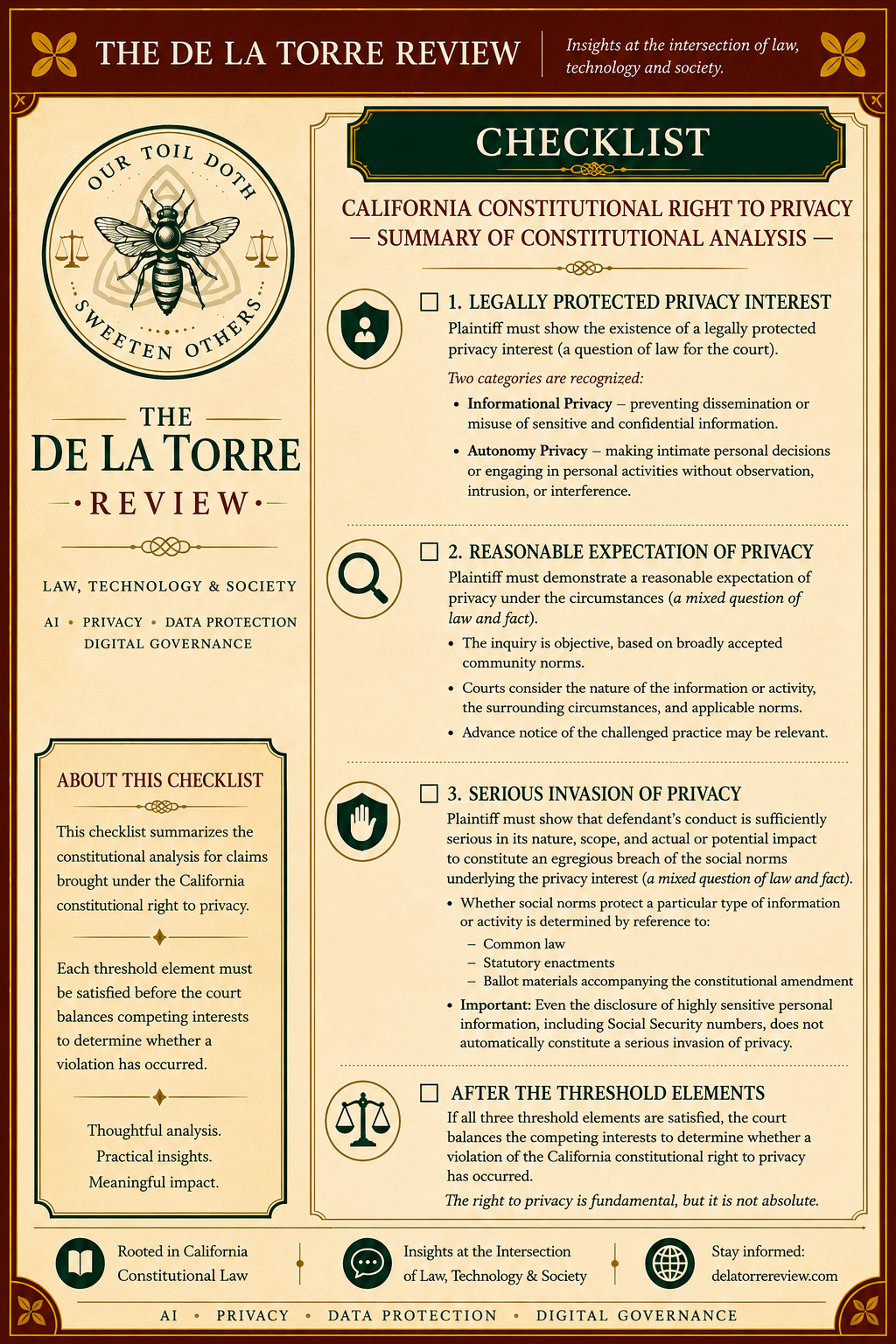
Whether a legally protected privacy interest exists is a question of law for the court to decide. By contrast, whether the plaintiff had a reasonable expectation of privacy under the circumstances and whether the defendant's conduct constitutes a sufficiently serious invasion of privacy are mixed questions of law and fact.[10]
These three elements serve as threshold requirements for a valid constitutional privacy claim.[11] If the plaintiff satisfies them, the court then balances the competing interests to determine whether a violation has occurred. This balancing analysis reflects the principle that California's constitutional right to privacy, while fundamental, is not absolute.[12]
Under the first element of the test, a plaintiff must establish the existence of a legally protected privacy interest.
The California Constitution recognizes only two categories of legally protected privacy interests:
- interests in preventing the dissemination or misuse of sensitive and confidential information[13] (commonly referred to as informational privacy); and
- interests in making intimate personal decisions or engaging in personal activities without observation, intrusion, or interference[14] (commonly referred to as autonomy privacy).
Under the second element, a plaintiff must demonstrate a reasonable expectation of privacy under the circumstances. A reasonable expectation of privacy is an objective entitlement grounded in broadly based and widely accepted community norms.[15] Accordingly, the inquiry is objective rather than subjective. The plaintiff's expectations alone are not determinative. Instead, courts consider the nature of the information or activity at issue, the surrounding circumstances, and the applicable community norms, which may include whether the plaintiff received advance notice of the challenged practice.[16]
California law imposes an additional, significant third threshold requirement. To be actionable, an invasion of privacy must be sufficiently serious in its nature, scope, and actual or potential impact to constitute an egregious breach of the social norms underlying the privacy interest at issue.[17] Absent such a showing, the defendant's conduct does not constitute a serious invasion of privacy within the meaning of the California Constitution.[18]
Whether established social norms protect a particular type of information or activity is determined by reference to the traditional sources of California privacy law, including the common law, statutory enactments, and the ballot materials accompanying the initiative that added the constitutional right to privacy.[19] Notably, even the disclosure of highly sensitive personal information, including Social Security numbers, does not automatically constitute an egregious breach of social norms under California law.[20]
The Impact of Proposition 8 on California's Constitutional Right to Privacy
The scope of California's constitutional right to privacy has been narrowed in one important respect through a subsequent voter initiative.
In June 1982, California voters approved Proposition 8, commonly known as the Victims' Bill of Rights. Among other changes to the California Constitution and statutory framework, Proposition 8 added the Right to Truth-in-Evidence provision,[21] which states that "relevant evidence shall not be excluded in any criminal proceeding." The measure survived constitutional challenges and applies only to crimes committed on or after its effective date.
Following the adoption of Proposition 8, the California Supreme Court revisited its prior privacy jurisprudence and concluded that the scope of the exclusionary rule under the California Constitution is, for practical purposes, coextensive with the exclusionary rule under the Fourth Amendment to the U.S. Constitution. As a result, evidence that is admissible under the Fourth Amendment generally may not be excluded in California criminal proceedings based solely on the broader privacy protections provided by the California Constitution.
California's Constitutional Right to Privacy and EU Privacy Law
The closest EU counterpart to California's constitutional right to privacy is the right to respect for private and family life recognized in Article 7 of the Charter of Fundamental Rights of the European Union. The principal EU legislative instrument governing privacy is the ePrivacy Directive (Directive 2002/58/EC). Although both legal systems recognize privacy as a fundamental right, the EU constitutional framework is broader and more comprehensive than its California counterpart. At the same time, EU law does not recognize an exclusionary rule comparable to that applied in the United States, under which evidence obtained in violation of the Fourth Amendment may be excluded from criminal proceedings. This reflects the fact that criminal law and the law of evidence generally fall outside the scope of EU law.[22]
In addition to protecting the right to private life under Article 7, the Charter separately recognizes the right to the protection of personal data in Article 8. The principal legislative instrument implementing that right is the General Data Protection Regulation (GDPR).
The EU right to data protection overlaps, to some extent, with California's constitutional protection of informational privacy. The overlap, however, is only partial. Under California law, only sensitive or confidential information gives rise to a constitutionally protected informational privacy interest.[23] By contrast, the GDPR generally applies to all personal data, regardless of whether the information is sensitive or confidential. As a result, much of the personal data protected under EU law does not receive constitutional protection under California's right to privacy.
This distinction is unsurprising. Unlike the European Union, neither California nor any other U.S. jurisdiction has recognized a constitutional right to the protection of personal data.
Constitutional Privacy in Other U.S. States
Several state constitutions provide constitutional protections for the right to privacy. In some states, these protections mirror the Fourth Amendment to the U.S. Constitution governing searches, seizures, and government surveillance, while including more explicit references to privacy (shown in italics). In other states, broader constitutional provisions have been interpreted by courts as establishing privacy rights or other related protections.
Alaska (citation art. I, § 22): The right of the people to privacy is recognized and shall not be infringed. The legislature shall implement this section.
Arizona (citation art. II, § 8): No person shall be disturbed in his private affairs, or his home invaded, without authority of law.
Florida (citation art. I, § 23 and citation art. I, § 12):
- Right to Privacy: Every natural person has the right to be let alone and free from governmental intrusion into the person's private life, except as otherwise provided herein. This section shall not be construed to limit the public's right of access to public records and meetings as provided by law.
- Searches and Seizures: The right of the people to be secure in their persons, houses, papers, and effects against unreasonable searches and seizures, and against the unreasonable interception of private communications by any means, shall not be violated.
Hawaii (citation art. I, §§ 6 and 7):
- Section 6 – Right to Privacy: The right of the people to privacy is recognized and shall not be infringed without the showing of a compelling state interest. The legislature shall take affirmative steps to implement this right.
- Section 7 – Searches, Seizures, and Invasion of Privacy: The right of the people to be secure in their persons, houses, papers, and effects against unreasonable searches, seizures, and invasions of privacy shall not be violated; and no warrants shall issue but upon probable cause, supported by oath or affirmation, and particularly describing the place to be searched and the persons or things to be seized or the communications sought to be intercepted.
[Am. Const. Con. 1968 and election Nov. 5, 1968; ren. and am. Const. Con. 1978 and election Nov. 7, 1978.]
Illinois (citation art. I, § 6): Section 6 – Searches, Seizures, Privacy, and Interceptions: The people shall have the right to be secure in their persons, houses, papers, and other possessions against unreasonable searches, seizures, invasions of privacy, or interceptions of communications by eavesdropping devices or other means. No warrant shall issue without probable cause, supported by affidavit, particularly describing the place to be searched and the persons or things to be seized.
Louisiana (citation art. I, § 5): Every person shall be secure in his person, property, communications, houses, papers, and effects against unreasonable searches, seizures, or invasions of privacy. No warrant shall issue without probable cause, supported by oath or affirmation, and particularly describing the place to be searched, the persons or things to be seized, and the lawful purpose or reason for the search. Any person adversely affected by a search or seizure conducted in violation of this Section shall have standing to raise its illegality in the appropriate court.
Montana (citation art. II, § 10): The right of individual privacy is essential to the well-being of a free society and shall not be infringed without the showing of a compelling state interest.
New Hampshire (citation art. 2-b): Right to Privacy: An individual's right to live free from governmental intrusion into private or personal information is natural, essential, and inherent. (New Hampshire's provision was approved by ballot measure in November 2018.)
South Carolina (citation art. I, § 10): The right of the people to be secure in their persons, houses, papers, and effects against unreasonable searches and seizures and unreasonable invasions of privacy shall not be violated. No warrants shall issue except upon probable cause, supported by oath or affirmation, and particularly describing the place to be searched, the person or thing to be seized, and the information to be obtained.
Washington (citation art. I, § 7)): Invasion of Private Affairs or Home Prohibited: No person shall be disturbed in his private affairs, or his home invaded, without authority of law.
Michigan and Missouri have amended their constitutions to provide explicit constitutional protection against unreasonable searches and seizures of electronic communications and electronic data.
Missouri became the first state to do so when voters approved Amendment 9 in August 2014, amending Article I, Section 15 of the Missouri Constitution to expressly protect electronic communications and electronic data from unreasonable searches and seizures. Michigan followed in November 2020, when voters approved Proposal 20–2,, amending its constitution to require a warrant before the search or seizure of electronic data or electronic communications.
Footnotes
[1] Hooser v. Superior Court (App. 4 Dist. 2000) 101 Cal.Rptr.2d 341, 84 Cal.App.4th 997; Garstang v. Superior Court(App. 2 Dist. 1995) 46 Cal.Rptr.2d 84, 39 Cal.App.4th 526.
[2] San Francisco Apartment Assn. v. City and County of San Francisco (N.D. Cal. 2015) 142 F. Supp. 3d 910; Ortiz v. Los Angeles Police Relief Assn. (App. 2 Dist. 2002) 120 Cal.Rptr.2d 670, 98 Cal.App.4th 1288; Alfaro v. Terhune (App. 3 Dist. 2002) 120 Cal.Rptr.2d 197, 98 Cal.App.4th 492; Chantiles v. Lake Forest II Master Homeowners Assn. (App. 4 Dist. 1995) 45 Cal.Rptr.2d 1, 37 Cal.App.4th 914; Hill v. National Collegiate Athletic Assn. (1994) 26 Cal.Rptr.2d 834, 7 Cal.4th 1, 865 P.2d 633; Barbee v. Household Automotive Finance Corp. (App. 4 Dist. 2003) 6 Cal.Rptr.3d 406, 113 Cal.App.4th 525; Conservatorship of Wendland (2001) 110 Cal.Rptr.2d 412, 26 Cal.4th 519, 28 P.3d 151; People v. Martinez (App. 6 Dist. 2001) 105 Cal.Rptr.2d 841, 88 Cal.App.4th 465.
[3] San Francisco Apartment Assn. v. City and County of San Francisco (N.D. Cal. 2015) 142 F. Supp. 3d 910; Four Navy SEALs v. Associated Press (S.D. Cal. 2005) 413 F. Supp. 2d 1136.
[4] Hill v. National Collegiate Athletic Assn. (1994) 26 Cal.Rptr.2d 834, 7 Cal.4th 1, 865 P.2d 633.
[5] California courts have long recognized that the ballot arguments presented to voters may be considered when interpreting legislative measures and constitutional amendments adopted through the initiative process. See Carter v. Com. on Qualifications, etc. (1939) 14 Cal.2d 179, 185, 93 P.2d 140; Beneficial Loan Society, Ltd. v. Haight (1932) 215 Cal. 507, 515, 11 P.2d 857; Story v. Richardson (1921) 186 Cal. 162, 165-166, 198 P. 1057; In re Quin (1973) 35 Cal.App.3d 473, 483-486, 110 Cal.Rptr. 881.
[6] The statement prepared by the proponents of the initiative, as published in the official ballot pamphlet, begins:
"The proliferation of government snooping and data collecting is threatening to destroy our traditional freedoms. Government agencies seem to be competing to compile the most extensive sets of dossiers of American citizens. Computerization of records makes it possible to create 'cradle-to-grave' profiles of every American. [¶] At present there are no effective restraints on the information activities of government and business. This amendment creates a legal and enforceable right of privacy for every Californian." (Italics in original.)
The statement continues:
"The right of privacy is the right to be left alone. It is a fundamental and compelling interest. It protects our homes, our families, our thoughts, our emotions, our expressions, our personalities, our freedom of communion, and our freedom to associate with the people we choose. It prevents government and business interests from collecting and stockpiling unnecessary information about us and from misusing information gathered for one purpose in order to serve other purposes or to embarrass us."
It further states:
"Fundamental to our privacy is the ability to control circulation of personal information." (Italics in original.)"This is essential to social relationships and personal freedom. The proliferation of government and business records over which we have no control limits our ability to control our personal lives. Often we do not know that these records even exist, and we are certainly unable to determine who has access to them."
The statement also explains:
"Even more dangerous is the loss of control over the accuracy of government and business records of individuals. Obviously, if the person is unaware of the record, he or she cannot review the file and correct inevitable mistakes. … [¶] The average citizen … does not have control over what information is collected about him. Much is secretly collected. …"
The argument concludes:
"The right of privacy is an important American heritage and essential to the fundamental rights guaranteed by the First, Third, Fourth, Fifth, and Ninth Amendments to the U.S. Constitution. This right should be abridged only when there is a compelling public need. …"
White v. Davis, 13 Cal. 3d 757, 775. See also People v. B & I News, Inc. (Super. Ct. App. Dep't 1984) 211 Cal.Rptr. 346, 164 Cal.App.3d Supp. 1.
[7] White v. Davis, 13 Cal. 3d 757, 775.
[8] See also Lewis v. Superior Court (2017) 220 Cal.Rptr.3d 319, 397 P.3d 1011; Latchman v. Regents of the University of California (App. 4 Dist. 2007) 70 Cal.Rptr.3d 147, 158 Cal.App.4th 187.
[9] Willard v. AT&T Communications of California, Inc. (App. 2 Dist. 2012) 138 Cal.Rptr.3d 636; Tom v. City and County of San Francisco (App. 1 Dist. 2004) 16 Cal.Rptr.3d 608; Leonel v. American Airlines, Inc. (9th Cir. 2005) 400 F.3d 702; Norman-Bloodsaw v. Lawrence Berkeley Laboratory (9th Cir. 1998) 135 F.3d 1260; In re Facebook Internet Tracking Litigation (N.D. Cal. 2017) 2017 WL 2834113; Cahen v. Toyota Motor Corp. (N.D. Cal. 2015) 147 F. Supp. 3d 955; White v. Social Security Administration (N.D. Cal. 2015) 111 F. Supp. 3d 1041; Videckis v. Pepperdine University (C.D. Cal. 2015) 100 F. Supp. 3d 927; In re Google Inc. Privacy Policy Litigation (N.D. Cal. 2014) 58 F. Supp. 3d 968; In re Yahoo Mail Litigation (N.D. Cal. 2014) 7 F. Supp. 3d 1016; Doe v. City and County of San Francisco (N.D. Cal. 2011) 835 F. Supp. 2d 762; Carter v. County of Los Angeles (C.D. Cal. 2011) 770 F. Supp. 2d 1042; Trujillo v. City of Ontario(C.D. Cal. 2006) 428 F. Supp. 2d 1094; Four Navy SEALs v. Associated Press (S.D. Cal. 2005) 413 F. Supp. 2d 1136; Egan v. Schmock (N.D. Cal. 2000) 93 F. Supp. 2d 1090; Hansen v. California Department of Corrections (N.D. Cal. 1996) 920 F. Supp. 1480; Lewis v. Superior Court (2017) 220 Cal.Rptr.3d 319, 397 P.3d 1011; Julian v. Mission Community Hospital (App. 2 Dist. 2017) 218 Cal.Rptr.3d 38.
[10] 420 Caregivers, LLC v. City of Los Angeles (App. 2 Dist. 2012) 163 Cal.Rptr.3d 17.
[11] Leonel v. American Airlines, Inc. (9th Cir. 2005) 400 F.3d 702; In re Yahoo Mail Litigation (N.D. Cal. 2014) 7 F. Supp. 3d 1016; Low v. LinkedIn Corp. (N.D. Cal. 2012); In re iPhone Application Litigation (N.D. Cal. 2012) 844 F. Supp. 2d 1040; Association for Los Angeles Deputy Sheriffs v. Los Angeles Times Communications LLC (App. 2 Dist. 2015) 191 Cal.Rptr.3d 564, 239 Cal.App.4th 808; Lewis v. Superior Court (App. 2 Dist. 2014) 172 Cal.Rptr.3d 491, 226 Cal.App.4th 933; Weaver v. Superior Court (App. 4 Dist. 2014) 168 Cal.Rptr.3d 864, 224 Cal.App.4th 746; 420 Caregivers, LLC v. City of Los Angeles (App. 2 Dist. 2012) 163 Cal.Rptr.3d 17, 219 Cal.App.4th 1316.
[12] Once the threshold elements have been established, courts balance the countervailing interests supporting the challenged conduct against the resulting intrusion on the plaintiff's privacy. See Norman-Bloodsaw v. Lawrence Berkeley Laboratory (9th Cir. 1998) 135 F.3d 1260; Hansen v. California Department of Corrections (N.D. Cal. 1996) 920 F. Supp. 1480; People v. Harris (App. 4 Dist. 2017) 222 Cal.Rptr.3d 781; and Mathews v. Harris (App. 2 Dist. 2017) 212 Cal.Rptr.3d 547. The plaintiff may rebut the defendant's showing of countervailing interests by demonstrating that feasible and effective alternatives existed that would have achieved the same objectives with a lesser impact on privacy. See Norman-Bloodsaw v. Lawrence Berkeley Laboratory (9th Cir. 1998) 135 F.3d 1260; Mathews v. Harris (App. 2 Dist. 2017) 212 Cal.Rptr.3d 547.
[13] See Hooser v. Superior Court (App. 4 Dist. 2000) 101 Cal.Rptr.2d 341, 84 Cal.App.4th 997, third headnote (recognizing that private or sensitive information, including financial affairs, political affiliations, medical history, and sexual relationships, constitutes a legally protected informational privacy interest).
[14] Hill v. National Collegiate Athletic Assn. (1994) 26 Cal.Rptr.2d 834, 7 Cal.4th 1, 865 P.2d 633; In re Yahoo Mail Litigation (N.D. Cal. 2014) 7 F. Supp. 3d 1016; Mathews v. Harris (App. 2 Dist. 2017) 212 Cal.Rptr.3d 547; 420 Caregivers, LLC v. City of Los Angeles (App. 2 Dist. 2012) 163 Cal.Rptr.3d 17, 219 Cal.App.4th 1316; Tom v. City and County of San Francisco (App. 1 Dist. 2004) 16 Cal.Rptr.3d 608, 120 Cal.App.4th 674; Gilbert v. City of San Jose (App. 6 Dist. 2003) 7 Cal.Rptr.3d 692, 114 Cal.App.4th 606; Department of Fair Employment & Housing v. Superior Court(App. 5 Dist. 2002) 121 Cal.Rptr.2d 615, 99 Cal.App.4th 896; TBG Insurance Services Corp. v. Superior Court (App. 2 Dist. 2002) 117 Cal.Rptr.2d 155, 96 Cal.App.4th 443; People ex rel. Lockyer v. Superior Court (App. 4 Dist. 2000) 99 Cal.Rptr.2d 646; Cahen v. Toyota Motor Corp. (N.D. Cal. 2015) 147 F. Supp. 3d 955; Pettus v. Cole (App. 1 Dist. 1996) 57 Cal.Rptr.2d 46, 49 Cal.App.4th 402.
[15] In re Yahoo Mail Litigation (N.D. Cal. 2014) 7 F. Supp. 3d 1016.
[16] In re Yahoo Mail Litigation (N.D. Cal. 2014) 7 F. Supp. 3d 1016.
[17] In re Yahoo Mail Litigation (N.D. Cal. 2014) 7 F. Supp. 3d 1016.
[18] See Lewis v. Superior Court (App. 2 Dist. 2014) 172 Cal.Rptr.3d 491, 226 Cal.App.4th 933.
[19] Hill v. National Collegiate Athletic Assn. (1994) 7 Cal.4th 1, 35.
[20] White v. Social Security Administration (N.D. Cal. 2015) 111 F. Supp. 3d 1041. See also In re iPhone Application Litigation (N.D. Cal. 2012) 844 F. Supp. 2d 1040 (holding that the alleged disclosure of mobile device users' unique device identifiers, personal data, and geolocation information did not constitute an egregious breach of social norms and therefore did not violate the users' right to privacy under the California Constitution). By contrast, see Richards v. County of Los Angeles (C.D. Cal. 2011) 775 F. Supp. 2d 1176 (holding that the covert videotaping of employees in a dispatch room by the Los Angeles County Department of Public Works constituted an egregious breach of social norms because employees were recorded while engaging in personal activities, the surveillance was continuous, and it continued after the stated objective had been achieved).
[21] Cal. Const. art. I, § 28(d). The provision states:
"Except as provided by statute hereafter enacted by a two-thirds vote of the membership in each house of the Legislature, relevant evidence shall not be excluded in any criminal proceeding, including pretrial and post-conviction motions and hearings, or in any trial or hearing of a juvenile for a criminal offense, whether heard in juvenile or adult court. Nothing in this section shall affect any existing statutory rule of evidence relating to privilege or hearsay, or Evidence Code Sections 352, 782, or 1103. Nothing in this section shall affect any existing statutory or constitutional right of the press."
[22] La Quadrature du Net v. Premier ministre (Joined Cases C-511/18, C-512/18 & C-520/18).
[23] See, e.g., Cahen v. Toyota Motor Corp. (9th Cir. 2017) 2017 WL 6525501 (holding that plaintiffs failed to state a claim under the California constitutional right to privacy because, although they alleged that vehicle manufacturers collected data from their vehicles and shared it with third parties, they did not plausibly allege that the data at issue was sensitive or individually identifiable. The court further held that plaintiffs failed to allege facts demonstrating that the collection and storage of non-identifiable driving history and vehicle performance data caused an actual injury.)




Comments ()