
California’s Workplace ADS Rules: A New Layer Beyond CCPA ADMT Requirements
California’s workplace ADS law adds human corroboration, employee access and notice duties for automated discipline and termination. Explore prohibitions, exceptions and overlap with CCPA ADMT rules.
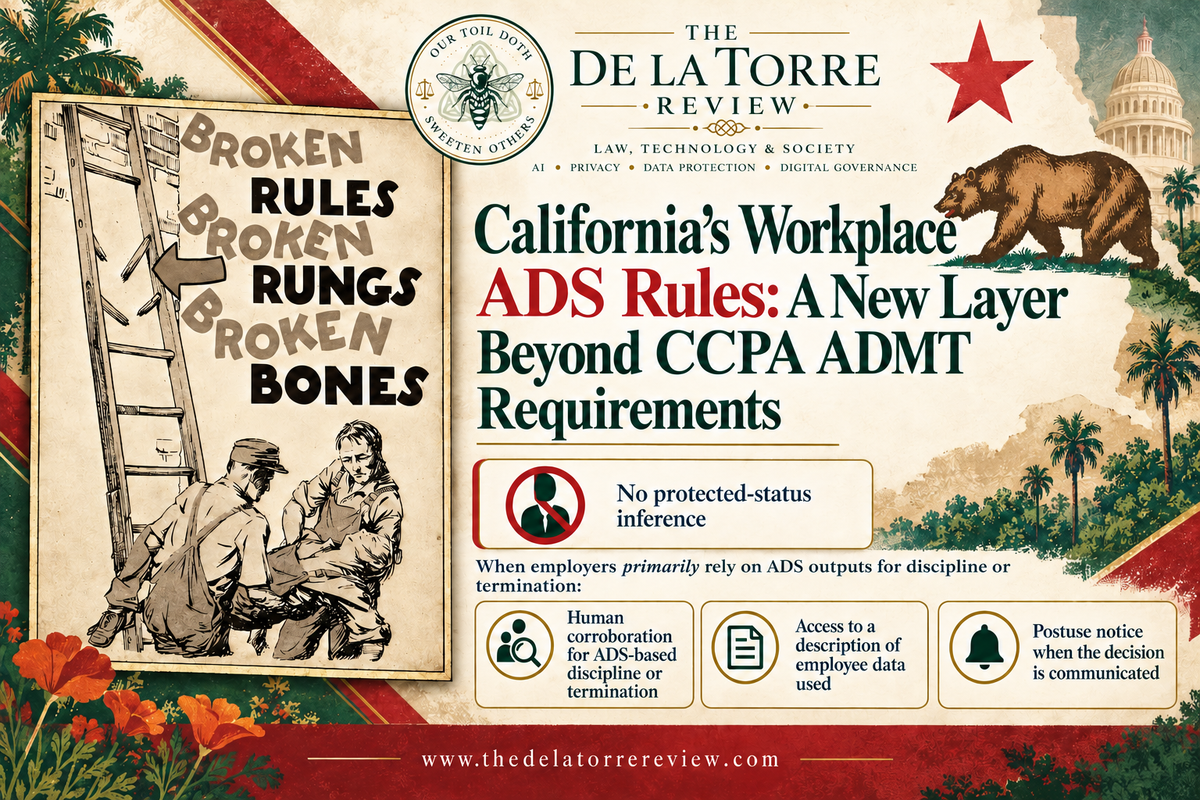
California’s SB 947 establishes rules for how employers use automated decision systems in the workplace. Its central discipline and termination provisions require human corroboration when employers primarily rely on an automated output, give affected employees information about that reliance, and allow them to request a description of their own data used by the system.
The law also prohibits particular uses of these systems, including inferring protected status and predicting and taking adverse action against workers for exercising legal rights. It protects employees from retaliation for invoking the new safeguards.
Signed by Governor Newsom on September 30, 2026, SB 947 adds Part 5.5.5, “Automated Decision Systems in the Workplace,” to Division 2 of the California Labor Code. For employers, the practical question is how an automated score or recommendation influences an employment decision and whether the surrounding process meets the law’s requirements.
See SB 947, Chapter 859, Statutes of 2026.
Practice Tip: These workplace requirements overlap with the CCPA’s automated decisionmaking technology rules, which may also apply to employment decisions. Employers subject to both must assess each framework separately: SB 947 can cover systems that assist human decisionmaking, while the CCPA rules focus on technology that replaces or substantially replaces it. SB 947 expressly preserves applicable CCPA obligations. See Cal. Lab. Code § 1526.4. For the privacy framework, see Requirements for Automated Decision-making Technology (ADMT) Under the CCPA.
When Does SB 947 Become Operative
The new workplace requirements become operative on July 1, 2027. The operative date applies to the part as a whole, including its prohibited uses, human-review requirements, employee-data descriptions, notices and enforcement provisions. See Cal. Lab. Code § 1526.7.
Practice Tip: Use the implementation period to identify systems that influence employment decisions, determine when managers primarily rely on their outputs, and establish a process for corroboration, notices and employee requests before July 1, 2027.
What Is Regulated?
Employers
An employer includes a person who directly or indirectly, through an agent or otherwise, employs someone or exercises control over their wages, hours or working conditions. “Employ” means to engage, suffer or permit someone to work, and an employee is any person employed by an employer. The definition contains no minimum workforce threshold. See Cal. Lab. Code § 1520(d)(1)–(3).
- The law expressly includes labor contractors, farm labor contractors and foreign labor contractors, as defined in the statutes it cross-references.
- It also covers public employers, including state government, local governments, special and transit districts, California State University, community college districts and school districts. The University of California is included upon agreement by the regents.
- SB 947 expressly applies to charter cities.
See Cal. Lab. Code § 1520(d)(3); SB 947, § 2.
The statute assigns duties to employers. An employer should therefore assess its use of a vendor’s system rather than assuming that purchasing an external product transfers responsibility for compliance to the vendor.
Practice Tip: Include systems used by contractors or agents in the review when their outputs influence decisions about workers. The employer definition expressly reaches indirect employment and control over working conditions.
Automated Decision Systems (ADMT)
An automated decision system, or ADS, is a computational process derived from machine learning, statistical modeling, data analytics or artificial intelligence that produces simplified output, such as a score, classification or recommendation. That output must be used to assist or replace human discretionary decisionmaking and materially impact natural persons. See Cal. Lab. Code § 1520(c).
- The definition reaches systems that assist a human decisionmaker. A manager’s participation does not, by itself, remove a system from scope. It also reaches qualifying statistical and analytics tools, even where the product is not marketed as AI.
- The definition excludes spam email filters, firewalls, antivirus software, identity and access management tools, calculators, databases, datasets and other compilations of data. A database’s exclusion does not necessarily exclude a separate analytical process that uses its contents to generate a consequential recommendation.
Comparison with the CCPA: Both definitions focus on how technology influences decisions about people.
- SB 947 covers qualifying systems that assist or replace human discretionary decisionmaking and materially impact individuals.
- The CCPA’s ADMT definition requires processing personal information to replace or substantially replace human decisionmaking.
A system supporting meaningful human judgment may therefore qualify as an ADS under SB 947 while falling outside the CCPA’s ADMT definition. See Cal. Lab. Code § 1520(c); CalPrivacy Rules 11 CCR § 7001(e).
ADS output is defined broadly to include information, data, assumptions, predictions, scores, recommendations, decisions or conclusions generated by the system. See Cal. Lab. Code § 1520(a).
Example: A system analyzes performance information, assigns a productivity score and recommends which employees should be disciplined. Its role in assisting discretionary decisions with material consequences may bring it within the ADS definition. An ordinary database storing personnel records is expressly excluded from that definition.
Employee Data
Employee data includes information that identifies, relates to or describes an employee, regardless of how it is collected, inferred or obtained. Inferred assessments and third-party information may therefore fall within the definition alongside information provided directly by the employee. See Cal. Lab. Code § 1520(d)(4).
- Employee data will generally also qualify as personal information under the CCPA, but employees are “consumers” under that law only if they are California residents. SB 947 contains no equivalent residency restriction and expressly includes statutorily defined foreign labor contractors as employers, illustrating that its coverage turns on employment relationships rather than California residency. Their inclusion does not, by itself, establish that the law applies to work performed outside California. See Cal. Civ. Code § 1798.140(i), (v); and Cal. Lab. Code § 1520(d)(3)(D).
Artificial Intelligence (AI)
The statute also uses California’s technology-neutral definition of artificial intelligence. As discussed in California Defines AI AB 2885 and Its Impact, that formulation focuses on autonomy, inference, objectives and outputs. SB 947’s operative workplace rules, however, turn on the separate ADS definition. See Cal. Lab. Code § 1520(b)–(c).
What Uses of Automated Decision Systems Are Regulated?
(1) Prohibited Activities
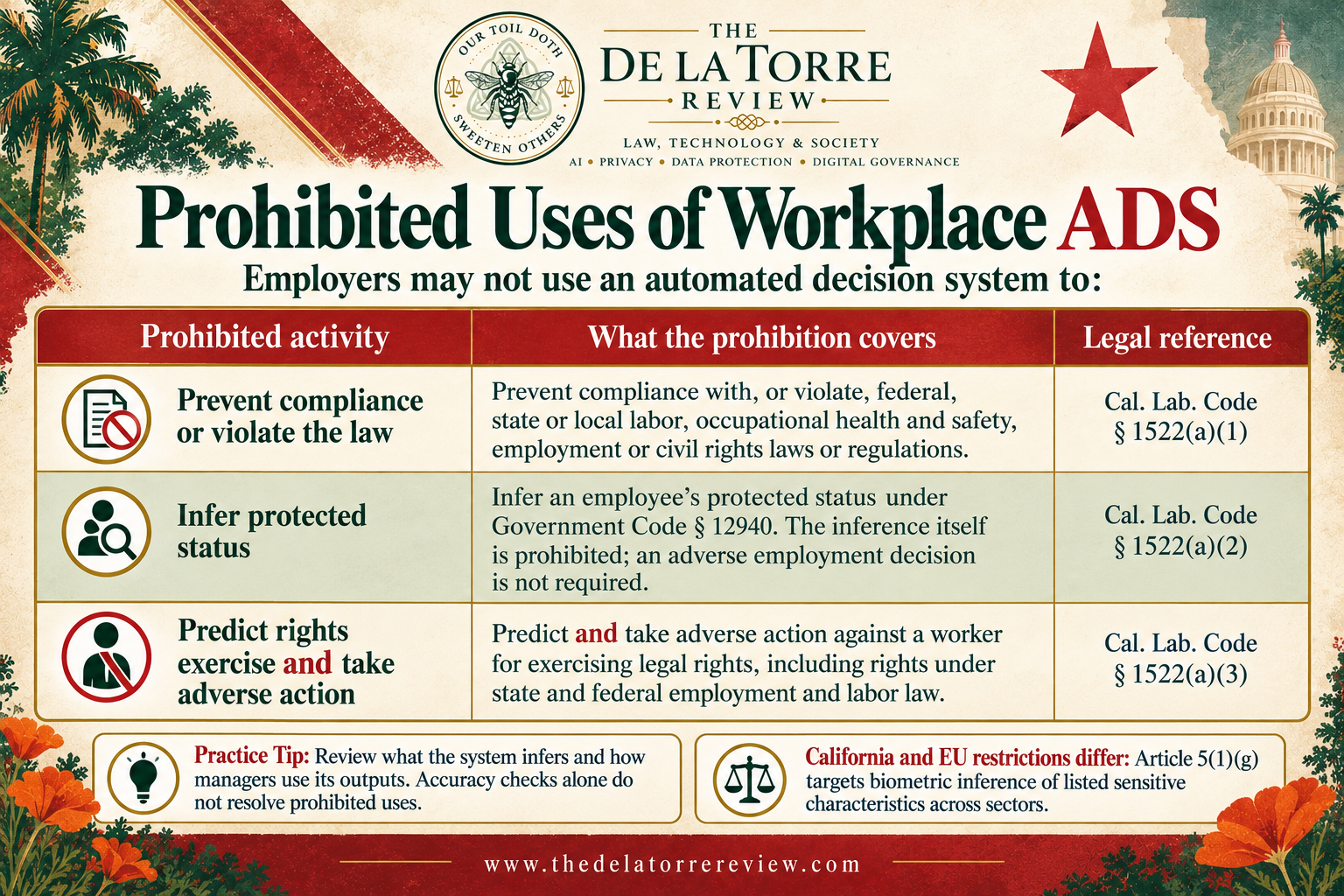
Section 1522(a) prohibits employers from using an ADS to:
- Prevent compliance with, or violate, federal, state or local labor, occupational health and safety, employment or civil rights laws or regulations.
- Infer an employee’s protected status under Government Code § 12940.
- Predict and take adverse action against a worker for exercising legal rights, including rights under state and federal employment and labor law.
Practice Tip: Review what a system is designed or configured to infer, as well as what managers do with its outputs. A model that predicts protected activity or protected status raises questions that a general accuracy review will not resolve.
See Cal. Lab. Code § 1522(a)(1)–(3). Cal. Gov. Code § 12940.
The protected-status prohibition concerns using an ADS to infer protected status. It should not be reduced to a rule against discriminatory outcomes.
Practice Tip: Assess California and EU restrictions separately. SB 947 prohibits employers from using an ADS to infer an employee’s protected status, whether from biometric data, communications or other information. Article 5(1)(g) of the EU AI Act applies across sectors but specifically targets biometric inference of listed sensitive characteristics. The lists differ: inferring disability or protected age may implicate SB 947 without triggering the EU prohibition. Neither requires a subsequent adverse employment decision; human review does not cure a prohibited inference. See also, Prohibited AI Practices Under the EU AI Act: Inferring Sensitive Characteristics From Biometrics.
(2) Restricted Activity: Discipline and Termination Decisions
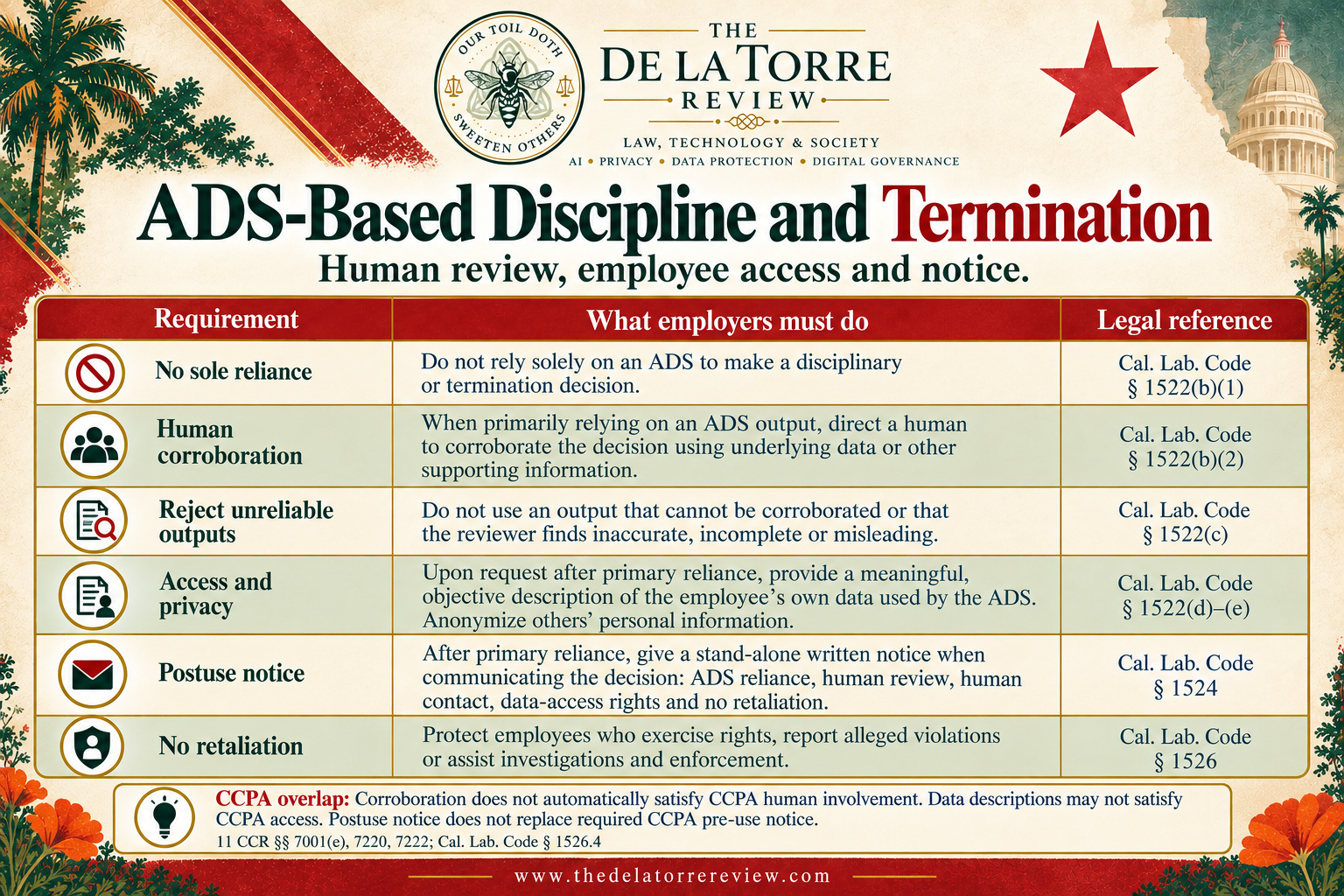
Employers cannot rely solely on an ADS when making a disciplinary or termination decision. The statute permits ADS assistance subject to its requirements.
See Cal. Lab. Code § 1522(b)(1).
2.(a) Human Corroboration: When an employer primarily relies on an ADS output to make a disciplinary or termination decision, it must direct a human to corroborate the decision.
- The reviewer may use the data collected or used to produce the output, or other relevant "corroborating or supporting information".
- Corroborating or supporting information includes: supervisory or managerial evaluations; personnel files; employee work product; peer reviews; and witness interviews, which may include relevant online customer reviews.
See Cal. Lab. Code § 1522(b)(2).
The law does not require a particular job title for the reviewer or prescribe a numerical threshold for “primarily” relying on an output. Employers must assess how the system actually contributes to the decision.
Example: A system flags an employee for termination because of unusually low recorded output. A human reviewer examines the underlying records and discovers that completed work was attributed to another employee. If the reviewer concludes that the ADS output is inaccurate, the employer cannot use that output to make the termination decision.
If the employer cannot corroborate the ADS output, or the human reviewer concludes that it is inaccurate, incomplete or misleading, the employer must not use the output to make a disciplinary or termination decision. See Cal. Lab. Code § 1522(c).
Practice Tip: Give reviewers access to supporting evidence and a way to stop reliance on an unreliable output. Document what they reviewed, what corroborated the proposed decision, and whether they identified inaccuracies or missing context. These records can help demonstrate compliance; the statute does not prescribe a specific review form.
SB 947’s corroboration requirement overlaps with, but differs from, the CCPA’s human involvement standard for automated decisionmaking.
Practice Tip: Do not assume that SB 947 corroboration satisfies the CCPA’s human involvement standard. SB 947 requires evidentiary support for an ADS-based disciplinary or termination decision. The CCPA additionally requires a reviewer who understands the output, analyzes relevant information and has authority to make or change the decision. Assess both standards separately; a manager’s approval click alone establishes neither.
2(b) Access: When an employer has primarily used an ADS to make a disciplinary or termination decision, the employee may request a meaningful, objective description of their own data used by the ADS, and the employer must provide it. See Cal. Lab. Code § 1522(d).
- This provision concerns a description of employee data. It does not expressly require disclosure of source code, model weights or a complete technical explanation of the algorithm. It also does not specify a response deadline or create an express appeal procedure within this part.
Practice Tip: Arrange access to relevant input data and inferred employee information before deploying a vendor’s system. An employer may struggle to provide a meaningful description if its contract or technical setup gives it access only to a final score.
Privacy Safeguard: The description must anonymize personal information belonging to customers, other employees or other individuals. An employer must provide meaningful information about the affected employee without exposing identifiable information about others. See Cal. Lab. Code § 1522(e).
Access under SB 947 is unlikely, by itself, to satisfy CCPA access because it requires only a description of the employee’s own data used by the ADS. General CCPA access can require disclosure of the specific pieces of personal information, rather than a description, and reaches information beyond the inputs used for the disciplinary or termination decision. Where the CCPA’s ADMT rules apply, the response must also explain the system’s purpose, logic, outcome and how its output influenced the decision—information SB 947 does not expressly require. See Cal. Civ. Code § 1798.110; CalPrivacy ADMT Rules at 11 CCR § 7222(b).
2 (c) Notice: An employer that primarily relied on an ADS to make a disciplinary or termination decision must give the affected employee a written postuse notice at the time it informs the employee of the decision. The notice is mandatory; it does not depend on the employee first requesting information. See Cal. Lab. Code § 1524(a).
- The notice must be a separate, stand-alone communication written in plain language. It must use the language in which routine communications and other information are provided to employees and be delivered through a simple, easy-to-use method, such as email, a hyperlink or another written format.
The notice must explain:
- That the employer primarily relied on an ADS to make the disciplinary or termination decision.
- That a human reviewed the decision and corroborated the ADS output.
- Contact information for a human the employee can contact for more information about the decision and the right to access a description of their own data used by the ADS.
- That retaliation for exercising rights under the part is prohibited.
See Cal. Lab. Code § 1524(b)(1)–(4).
Practice Tip: Build the notice into the decision workflow. A general handbook statement that the employer uses AI will not satisfy the requirement for a separate communication when the employee is informed of the covered decision.
The postuse notice requirement is tied to primary reliance in discipline and termination. This section does not establish a general advance-notice obligation for every workplace use of an ADS.
Practice Tip — CCPA Overlap: Build notice into both stages of the workflow. Where both laws apply, SB 947’s postuse notice cannot substitute for the CCPA’s pre-use notice, and an earlier CCPA notice cannot replace SB 947’s separate communication when the employee is informed of the disciplinary or termination decision. See Cal. Lab. Code §§ 1524, 1526.4; CalPrivacy ADMT Rules at 11 CCR § 7220.
2 (d) Protection Against Retaliation: Employers may not discharge, threaten to discharge, demote, suspend, discriminate or retaliate against employees for using or attempting to use their rights under the law. Protection also covers complaints to the Labor Commissioner, allegations of violations, cooperation in investigations or prosecutions, and actions invoking or assisting enforcement. See Cal. Lab. Code § 1526.
- An employee requesting a data description or reporting an alleged violation is therefore exercising a protected right. The required notice must expressly tell the employee that retaliation is prohibited.
Enforcement and the Employer Burden of Demonstrating Compliance
The Labor Commissioner may enforce the law through investigations, citations and civil actions, and may order appropriate temporary relief to mitigate a violation or preserve the status quo while an investigation or hearing proceeds. Public prosecutors may also enforce the part under the referenced Labor Code procedures. See Cal. Lab. Code § 1526.1(a)–(b).
- The law includes a burden-shifting provision in civil actions or administrative proceedings concerning § 1522(b) or (c). Once the specified ADS use has been demonstrated, the employer must show either that it did not primarily rely on an ADS or that it complied with §§ 1522 and 1524. See Cal. Lab. Code § 1526.1(c).
- An employer that violates the part is subject to a $500 civil penalty per violation. In the civil actions authorized by § 1526.1(a) or (b), the statute also identifies temporary or preliminary injunctive relief, punitive damages, reasonable attorney’s fees and costs, and other remedies. See Cal. Lab. Code § 1526.1(d)–(e).
The law does not expressly grant employees a standalone private right of action.
Practice Tip: Keep records sufficient to show how the ADS influenced the decision, what human corroboration occurred, what notice was delivered, and how employee requests were handled. The employer’s ability to demonstrate compliance matters under the express burden-shifting rule.
How SB 947 Interacts With Other Laws
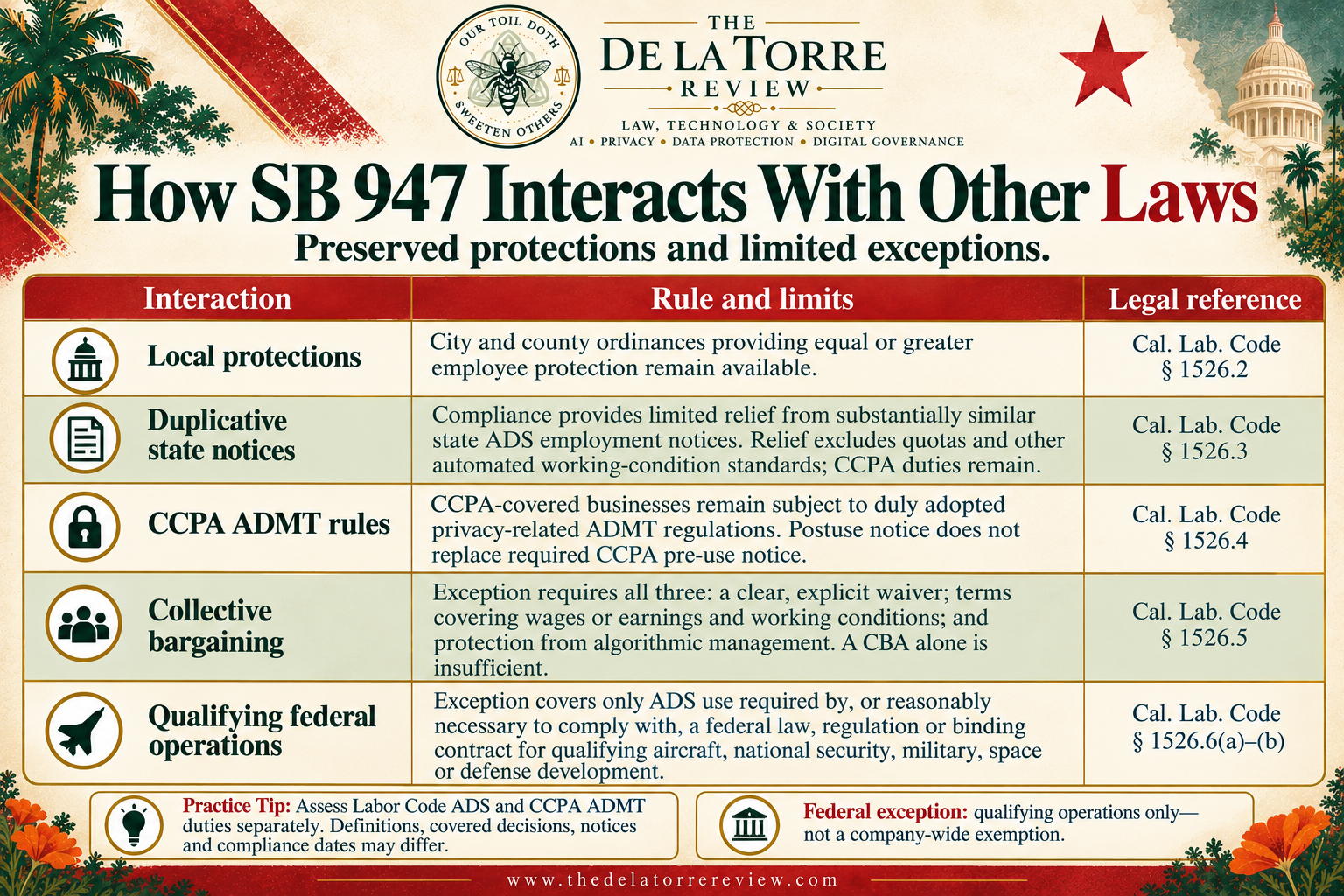
(1) Stronger Local Protections Remain Available: SB 947 does not preempt city, county or city-and-county ordinances providing equal or greater protection to covered employees. See Cal. Lab. Code § 1526.2.
(2) Relief From Duplicative State Notices Is Limited: An employer complying with this part’s notice requirements need not comply with substantially similar notice provisions under other state laws concerning ADS used for employment decisions, subject to the CCPA provision discussed below. This relief does not apply to quotas as defined in Labor Code § 2100 or other automated standards applied to employees’ working conditions. See Cal. Lab. Code § 1526.3.
(3) CCPA Automated Decisionmaking Regulations Are Expressly Preserved: An employer that is a business subject to the CCPA remains subject to privacy-related automated decisionmaking technology regulations duly adopted by the California Privacy Protection Agency under the specified Civil Code authorities. SB 947 expressly preserves those obligations despite its provision addressing duplicative notices. See Cal. Lab. Code § 1526.4, and CalPrivacy ADMT Rules
Practice Tip: Assess Labor Code ADS duties and CCPA ADMT duties separately. Do not assume that their definitions, covered decisions, notices or compliance dates are identical, or that the SB 947 postuse notice satisfies every privacy notice requirement.
For more on the CCPA ADMT Rules, see: Requirements for Automated Decision-making Technology (ADMT) Under the CCPA.
(3) A Collective Bargaining Agreement Must Meet Specific Conditions: The law does not apply to parties covered by a collective bargaining agreement only if the agreement:
- Explicitly waives the part in clear and unambiguous terms.
- Expressly provides for wages or earnings, working conditions and other terms and conditions of work.
- Provides protection from algorithmic management.
Union representation or the existence of a collective bargaining agreement alone does not establish the exception.
See Cal. Lab. Code § 1526.5.
(4) The Federal Exception Applies Only to Qualifying Operations: The law does not apply to ADS use to the extent that the use is required by, or reasonably necessary to comply with, a federal statute, regulation or binding federal contract relating to aircraft development for the national airspace, or development of products or services for national security, military, space or defense purposes.
The exception applies only to operations covered by the qualifying federal requirement. It is not a blanket exemption for every activity of an aerospace company or federal contractor. See Cal. Lab. Code § 1526.6(a)–(b).
Preparing for Workplace ADS Compliance
SB 947 makes the employer’s decision process central to compliance. Employers should identify qualifying systems, map prohibited uses, establish human corroboration when the system is primarily relied upon, and prepare the employee-facing notice and data-description processes.
The same review should address the systems’ practical limits. A vendor’s output may omit information needed for corroboration. A manager may be unable to inspect the underlying data. A termination workflow may deliver the decision before anyone prepares the required notice. Each problem requires a process or contractual solution before the operative date.
Practice Takeaway: Employers should be able to explain what role the system played, what evidence supported the decision, and what information was provided to the employee. SB 947’s requirements connect those questions to human review, transparency, privacy and enforceable workplace rights.
Additional Resources
Legal Authorities
- SB 947 2026 Employment and Automated Decision Systems — The chaptered legislation adding Cal. Lab. Code §§ 1520–1526.7. Section 1520 defines the covered systems and actors; §§ 1522 and 1524 establish prohibited uses, corroboration, employee-data access and notice duties; §§ 1526–1526.7 address retaliation, enforcement, other laws, exceptions and the operative date.
- California Government Code Section 12940 — Employment discrimination provisions referenced by SB 947’s prohibition on using an ADS to infer an employee’s protected status. See Cal. Lab. Code § 1522(a)(2).
- California Labor Code Section 2100 — Defines quotas for California’s warehouse quota framework. SB 947 excludes these quotas and other automated working-condition standards from its relief concerning substantially similar state notices. See Cal. Lab. Code § 1526.3.
- California Consumer Privacy Act and Regulations — Official statutory and regulatory materials, including adopted ADMT regulations. SB 947 preserves applicable privacy-related ADMT duties for employers subject to the CCPA. See Cal. Lab. Code § 1526.4; Cal. Civ. Code §§ 1798.185 and 1798.199.40(b).
Agency Guidance and Enforcement
- California Labor Commissioner — The agency authorized to investigate and enforce SB 947 through the procedures identified in Cal. Lab. Code § 1526.1(a).
- California Privacy Protection Agency — The agency responsible for the CCPA regulations expressly preserved by Cal. Lab. Code § 1526.4. Its materials should be reviewed alongside the workplace ADS requirements.
Related The De La Torre Review Articles
- California Defines AI: AB 2885 and Its Impact — Explains the technology-neutral AI definition used in California legislation, including SB 947, and distinguishes it from the separate statutory ADS test. Read the Article.
- California’s AI Transparency Act: Building Provenance Into AI-Generated Content — Examines California’s separate provenance and content-transparency framework, illustrating how duties vary according to the technology’s use and the regulated actor. Read the Article.
- Prohibited AI Practices Under the EU AI Act: Emotion Recognition at Work and School — Examines the EU’s workplace emotion-recognition prohibition and its exceptions, providing a comparative perspective on restrictions governing workplace AI. Read the Article.
- Requirements for Automated Decision-making Technology (ADMT) Under the CCPA — Explains the CCPA’s ADMT framework, including human involvement, pre-use notices, opt-out rights and access to explanations of automated decisions. These requirements overlap with California’s workplace ADS duties and remain expressly preserved under Cal. Lab. Code § 1526.4. Read the Article.


Comments ()