GDPR Records of Processing Activities (ROPAs) Explained: A Practical Guide to Article 30
A practical guide to GDPR Records of Processing Activities (ROPAs), explaining Article 30 requirements for controllers and processors, the limited small-business exemption, what a ROPA should contain, and how data mapping and documentation support accountability and compliance.
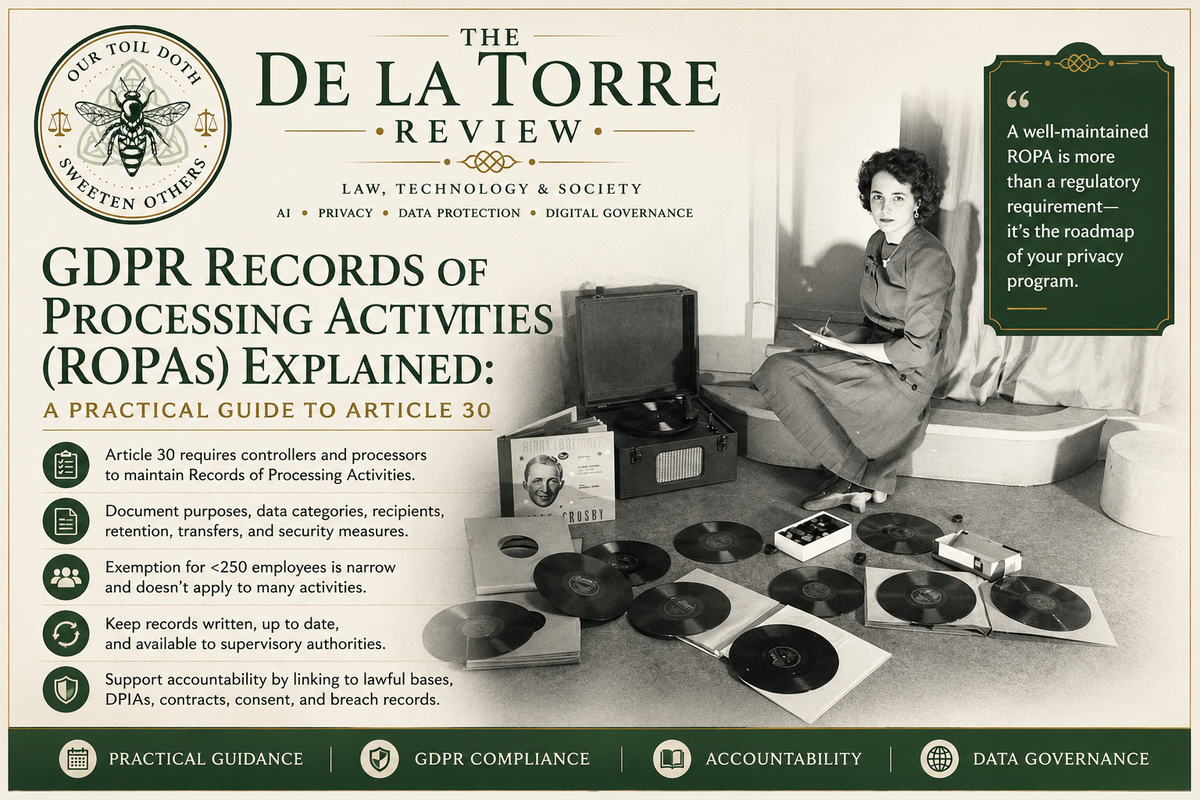
Key Points: (1) Article 30 GDPR requires controllers and processors to maintain Records of Processing Activities (ROPAs). (2) Controller and processor ROPAs have different requirements, reflecting their respective roles in processing personal data. (3) A ROPA should document key information about processing, including purposes, data categories, recipients, retention, international transfers, and security measures. (4) The exemption for organizations with fewer than 250 employees is narrow and does not apply to many routine processing activities. (5) ROPAs must be in writing, kept sufficiently detailed and up to date, and made available to supervisory authorities upon request. (6) Data mapping and information audits can help organizations identify and document their processing activities. (7) A ROPA can go beyond Article 30’s minimum requirements by linking processing activities to lawful bases, DPIAs, contracts, consent records, breach records, and other compliance documentation.
One of the GDPR’s core accountability requirements is that organizations understand and document how they process personal data. Article 30 gives practical effect to this principle by requiring controllers and processors to maintain Records of Processing Activities (ROPAs).
A ROPA is, in practical terms, an organization’s structured inventory of its personal data processing. It documents important aspects of processing—including why personal data is processed, whose data is involved, what categories of personal data are used, who receives the data, how long it is retained, whether it is transferred internationally, and what security measures protect it.
A well-maintained ROPA is more than a regulatory requirement—it can serve as a central tool for GDPR accountability and privacy governance.
Maintaining this record matters for more than satisfying Article 30. A well-designed ROPA can serve as a foundation for an organization’s broader privacy program. It can help organizations identify compliance gaps, manage retention, assess international transfers, understand relationships with processors and other recipients, conduct data protection impact assessments (DPIAs), respond to data subject requests, and demonstrate compliance with the GDPR’s accountability principle.
Article 30 requires the ROPA to be in writing, including in electronic form. The information should also be sufficiently granular and meaningful to provide a useful description of the processing rather than merely repeating broad or generic statements about the organization’s use of personal data.
What Should a ROPA Include and How Should Organizations Maintain It?
What Must Controllers and Processors Include in Their ROPAs?
Article 30 establishes separate—but related—record-keeping obligations for controllers and processors.
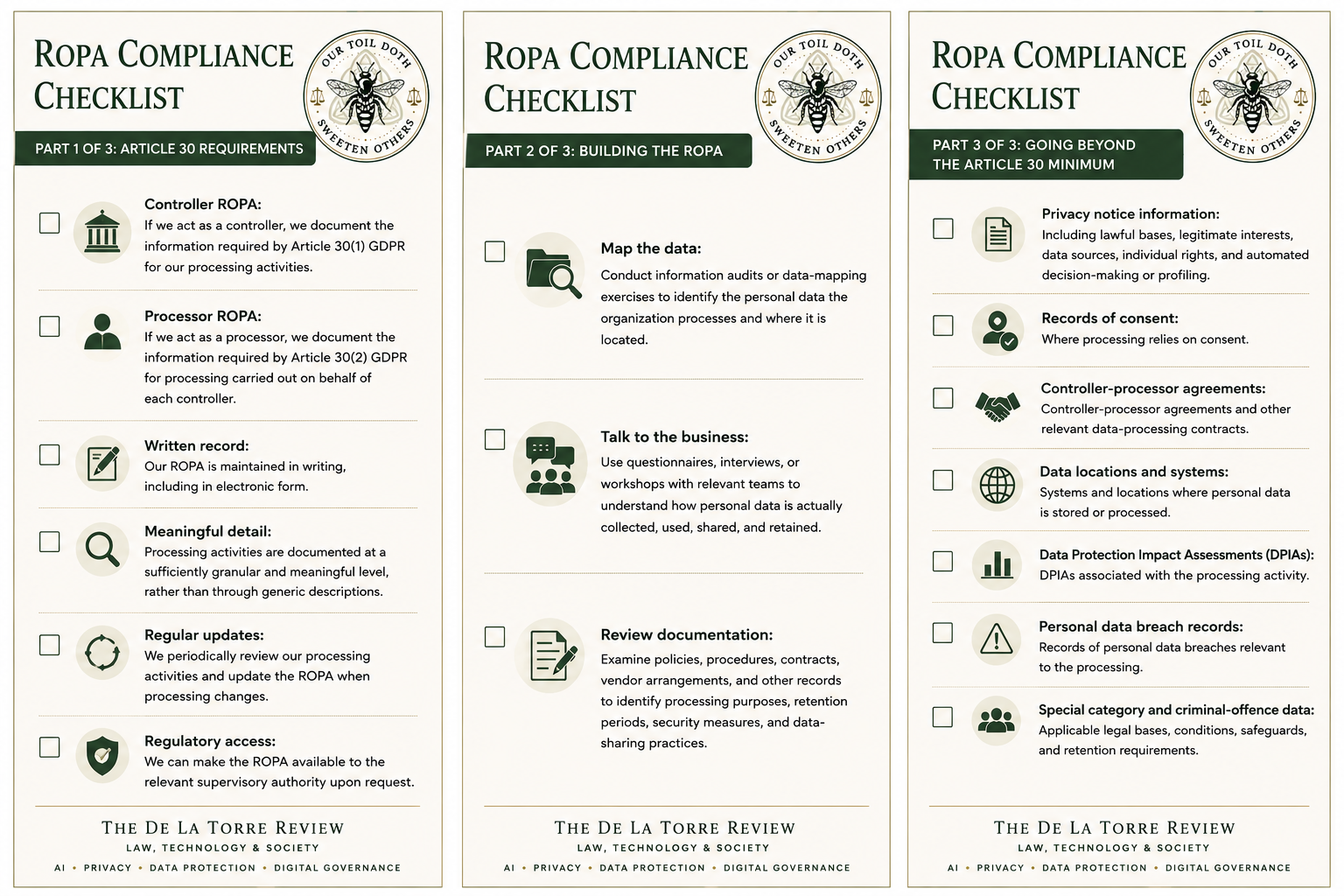
A controller must maintain a record of the processing activities under its responsibility. Under Article 30(1), the record must include:
- the name and contact details of the controller and, where applicable, any joint controller, representative, and Data Protection Officer (DPO);
- the purposes of the processing;
- the categories of data subjects and personal data;
- the categories of recipients to whom personal data has been or will be disclosed, including recipients in third countries or international organizations;
- where applicable, information about international transfers, including the relevant third country or international organization and certain safeguards used for transfers relying on Article 49(1);
- where possible, the envisaged time limits for erasure of different categories of data; and
- where possible, a general description of the technical and organizational security measures referred to in Article 32(1).
Processors have their own recordkeeping obligation. Under Article 30(2), a processor must maintain a record of the categories of processing activities it carries out on behalf of each controller. This includes information identifying the processor and the controllers for which it acts, the categories of processing performed for each controller, applicable international transfers, and, where possible, a general description of relevant technical and organizational security measures.
How to Build and Maintain a ROPA
A ROPA should be based on an accurate understanding of how personal data actually moves through the organization. An information audit or data-mapping exercise can provide a useful starting point by identifying what personal data the organization processes, where it is stored, how it is collected, and which systems and business functions use it.
Organizations can gather this information in several ways, including questionnaires sent to relevant business functions, interviews or workshops with key stakeholders, and reviews of policies, procedures, contracts, vendor arrangements, and other documentation. The objective is to develop a sufficiently detailed picture of each processing activity—including its purpose, the data involved, recipients, retention periods, international transfers, and applicable safeguards.
Going Beyond the Minimum Article 30 Requirements
Article 30 establishes the minimum information that must appear in a ROPA, but organizations can use the record as a broader privacy governance and accountability tool. Rather than maintaining separate and disconnected compliance records, a ROPA can incorporate—or link to—other documentation associated with the same processing activity.
Depending on the organization and the processing involved, this additional information may include:
- the lawful basis for processing and, where applicable, the legitimate interests relied upon;
- information needed for privacy notices, including applicable individual rights, the source of personal data, and the existence of automated decision-making or profiling;
- records of consent, where consent is the applicable lawful basis;
- relevant controller-processor agreements and other data-processing contracts;
- the systems and locations where personal data is stored or processed;
- applicable Data Protection Impact Assessments (DPIAs);
- records relating to personal data breaches; and
- documentation supporting the processing of special category data or criminal conviction and offence data, including applicable legal bases, conditions, safeguards, and retention requirements.
Taking this broader approach can turn the ROPA from a static Article 30 record into a central map of an organization’s privacy compliance program, connecting individual processing activities with the legal, operational, security, and accountability measures that govern them.
The Limited ROPA Exemption for Organizations with Fewer Than 250 Employees
Article 30(5) contains a limited exception for enterprises or organizations employing fewer than 250 people. But the exception is considerably narrower than it may initially appear. The recordkeeping obligations continue to apply where the processing is likely to result in a risk to individuals’ rights and freedoms, is not occasional, or involves special categories of personal data or personal data relating to criminal convictions and offences. As a result, being a small organization does not automatically eliminate the obligation to maintain a ROPA.
Additional Resources
GDPR
- GDPR Article 30 — Records of Processing Activities — Establishes the recordkeeping requirements applicable to controllers and processors, including the information that must be documented and the limited exemption for certain organizations with fewer than 250 employees.
- GDPR Recital 82 — Explains the role of records of processing activities in demonstrating GDPR compliance and supporting supervisory authorities in monitoring processing operations.
European Data Protection Board (EDPB) / Article 29 Working Party (WP29)
- WP29 Position Paper on Article 30(5) — WP29 issued a position paper addressing the limited Article 30(5) exemption from recordkeeping requirements for organizations employing fewer than 250 people. The position paper was subsequently endorsed by the EDPB and is particularly useful for understanding when smaller organizations must nevertheless maintain ROPAs.
Commission Nationale de l'Informatique et des Libertés (CNIL)
- La CNIL publie un nouveau modèle de registre simplifié (July 25, 2019) — CNIL guidance and a simplified ROPA model intended to help organizations, particularly smaller organizations, establish and maintain their records of processing activities.

Comments ()