
General-Purpose AI Models Under the EU AI Act: Classification, Obligations, and Systemic Risk
The EU AI Act regulates general-purpose AI at the model level. This article explains GPAI classification, provider obligations, open-source accommodations, downstream responsibilities, and the additional requirements for models that present systemic risk.

The EU Artificial Intelligence Act is often described as a risk-based law. That description is accurate—but incomplete.
Most of the Act regulates AI systems according to how they are used. An AI system used to screen job applicants, assess access to education, or determine eligibility for essential services may be classified as high-risk because of its intended purpose. Certain particularly harmful uses are prohibited altogether.
General-purpose AI, or GPAI, enters the regulatory framework at a different level. The Act imposes obligations directly on these type of AI models, before those models are incorporated into particular products or deployed for particular purposes.
The AI Act does not explain directly what AI models are. However, Recital 97 draws a clear legal distinction between an AI model and an AI system. An AI model is the underlying computational component developed through training. It contains the learned parameters and capabilities that allow it to generate outputs or perform tasks. A model may be distributed through an application programming interface (API), software library, direct download, or even a physical copy. It may also be modified or fine-tuned to create a new model.
Practice Tip: An AI model does not, by itself, constitute an AI system. As Recital 97 explains, the model requires additional components—such as a user interface, software architecture, input and output controls, or other functional tools—before it becomes an operational AI system.
For example, a large language model capable of processing and generating text may be a GPAI model. A consumer chatbot, coding assistant, hiring tool, or customer-service application built around that model is an AI system.
A single general-purpose model may become the foundation for thousands of downstream systems. The provider that develops the model may not know every future application, while downstream developers may not have access to the information needed to understand the model’s capabilities, limitations, training process, or risks.
The EU AI Act addresses that gap by regulating both layers:
- the general-purpose AI model itself; and
- the AI systems built on or incorporating that model.
What Is a General-Purpose AI Model?
Article 3(63) of the EU AI Act defines a general-purpose AI model as an AI model that:
- displays significant generality;
- can competently perform a wide range of distinct tasks;
- can be integrated into a variety of downstream systems or applications; and
- is not used exclusively for research, development, or prototyping before being placed on the market.
The definition applies regardless of how the model is placed on the market. A model does not escape classification merely because it is provided through an API, embedded in another service, distributed without charge, or released under an open-source license.
- Large language models (LLMs) are usually GPAI models because they can perform many different tasks: generating and summarizing text, translating languages, answering questions, writing software code, extracting information, and supporting other applications. Large generative models capable of flexibly producing audio, images, or video may also qualify.
- AI models that have been trained for use in a narrowly defined area (e.g. drug development or weather research) are often not GPAI models regardless of the computational power used to train them due to the lack of the required scope of applicability and, therefore, are only regulated as a component of an in-scope AI system.
GPAI models are conventionally referred to as foundation models, as these models can form the basis of many different downstream AI applications.
- The category is not limited to generative AI, however. The central question is not whether the model produces content. It is whether the model has sufficient generality to perform a broad range of distinct tasks and serve as the basis for different downstream systems.
- GPAI models are also distinct from general-purpose AI systems. A general-purpose AI system is an AI system based on a GPAI model that can serve a variety of purposes, both through direct use and through integration into other AI systems. ChatGPT, for example, is a general-purpose AI system built on one or more GPT models. (Article 3(66))
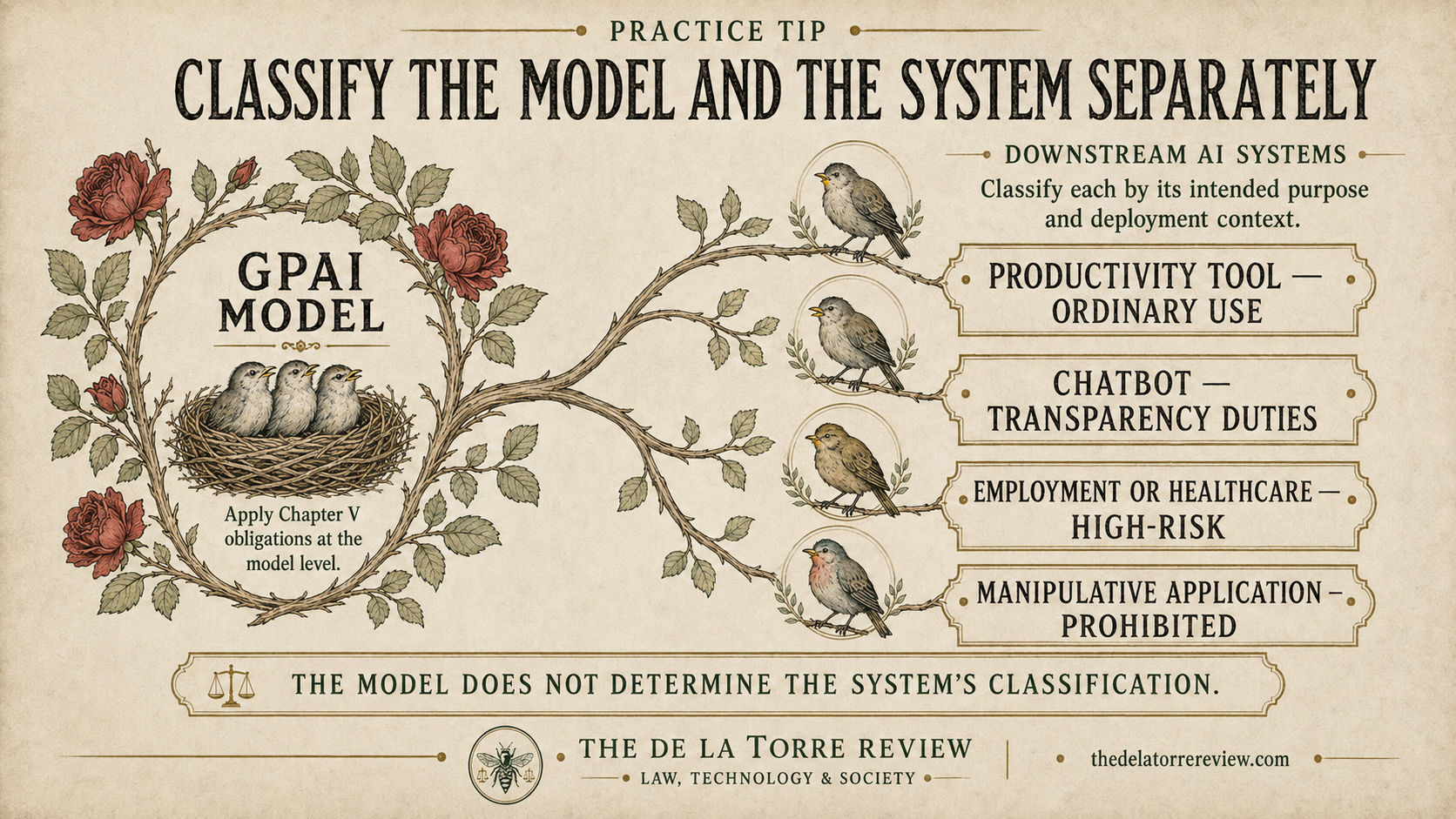
Practice Tip: Classify the Model and the System Separately: Do not assume that the classification of a GPAI model determines the classification of every application built on it. A large language model may be the regulated GPAI model, while a chatbot, coding assistant, productivity tool, or customer-service application incorporating that model may be a separately regulated AI system.
How Much Generality Is “Significant”?
The statutory definition is deliberately technology-neutral, but the Act’s recitals and the Commission’s subsequent guidance provide important indicators.
Recital 98 states that models with at least one billion parameters, trained on a large amount of data using self-supervision at scale, should generally be considered capable of displaying significant generality and competently performing a wide range of distinct tasks.
Parameter count is not the only measure, however. Model architecture, training methods, the type and quantity of training data, performance across tasks, modalities, and capacity for downstream integration may all be relevant.
The European Commission’s 2025 GPAI Guidelines provide a more operational—but still indicative—criterion. Under the Guidelines, a model will generally be treated as a GPAI model when:
- the computational resources used to train it exceed 10²³ floating-point operations, or FLOP; and
- the model can generate language, including text or audio, or can generate images or video from text.
For purposes of the Act, a “floating-point operation” is any mathematical operation or assignment involving floating-point numbers—a subset of real numbers typically represented on computers using a fixed-precision integer scaled by an integer exponent of a fixed base. The cumulative number of floating point operations, should not be confused with the unit of measurement FLOPS (floating point operations per second), which is used to measure the speed of computing. (Article 3.67)
In practical terms, the EU AI Act uses FLOPs to measure the computational work used to train a model.
This criterion is intended to help providers identify models likely to fall within the GPAI definition. It is not a substitute for the statutory test.
Practice Tip: Models below the 10²³ FLOP threshold may still qualify based on their capabilities, and a model does not necessarily fall outside the definition merely because it operates within a single modality. A sufficiently flexible text, audio, image, or video model may still perform a wide range of distinct tasks.
What Is a GPAI Model With Systemic Risk?
The Act creates an enhanced category for the most capable or consequential GPAI models: GPAI models with systemic risk.
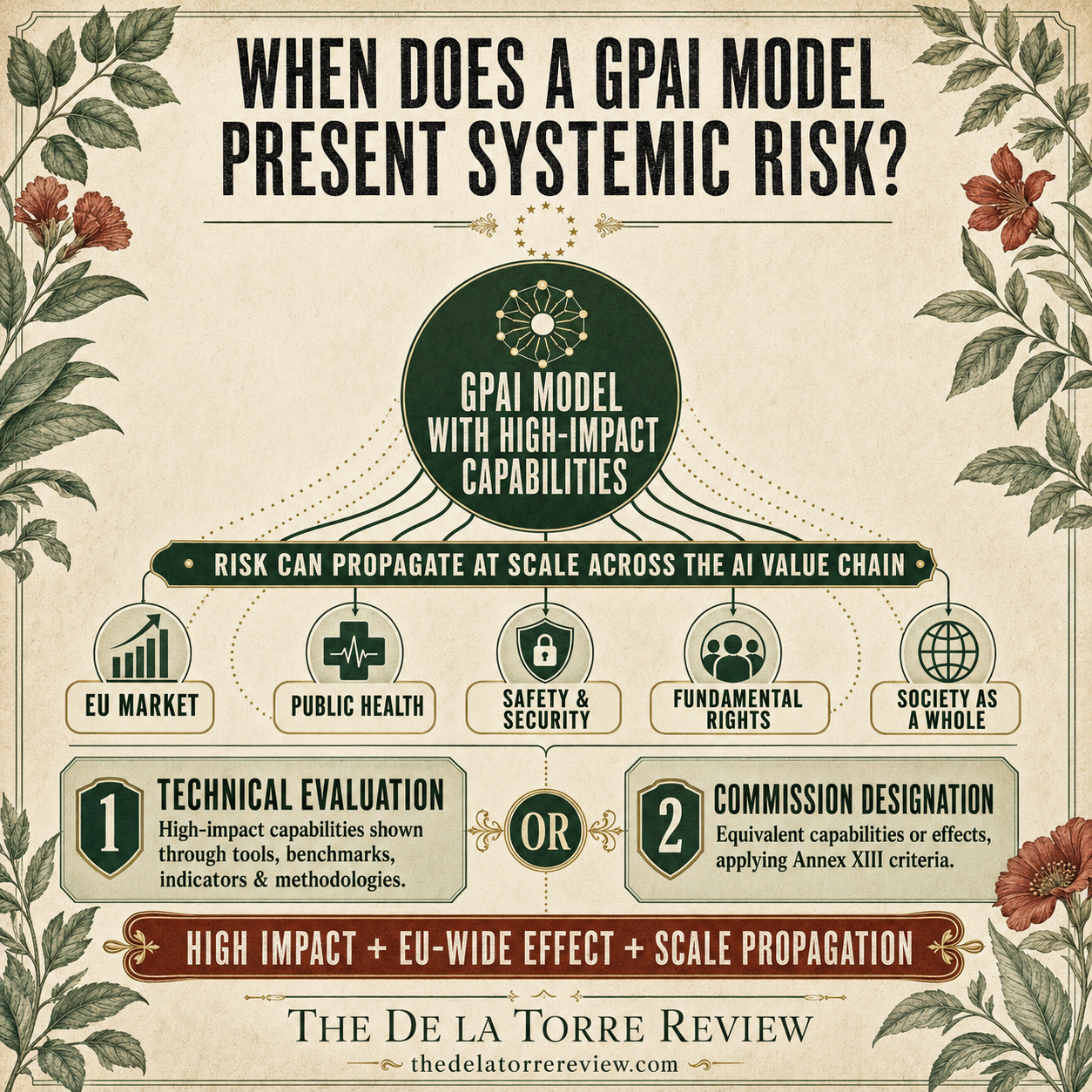
A “systemic risk” is a risk specific to the high-impact capabilities of GPAI models that has a significant impact on the EU market because of its reach or because of actual or reasonably foreseeable negative effects on public health, safety, public security, fundamental rights, or society as a whole. These risks must be capable of propagating at scale across the AI value chain. (Article 3(65))
A GPAI model is classified as presenting systemic risk when:
- it has high-impact capabilities evaluated using appropriate technical tools, benchmarks, indicators, and methodologies; or
- the European Commission determines that it has capabilities or effects equivalent to those of a high-impact model, taking into account the criteria in Annex XIII.
In both cases, the notion of "high-impact capabilities" should cover capabilities that match or exceed those of the most advanced GPAI models (Article 3(64))
The Act creates a rebuttable presumption of high-impact capabilities when the cumulative compute used to train the model exceeds 10²⁵ FLOP. (Article 51(2))
A GPAI model with high-impact capabilities is classified as presenting systemic risk.
When the 10²⁵ FLOP threshold creates a presumption of high-impact capabilities, the provider must notify the Commission but may submit substantiated arguments that the model exceptionally does not present systemic risk because of its particular characteristics.
The 10²⁵ FLOP rebuttable presumption is different from the Commission’s 10²³-FLOP indicative criterion for identifying a GPAI model. The thresholds serve different purposes:
| Threshold | Function |
|---|---|
| More than FLOP, combined with specified generative capabilities | Commission guideline indicating that a model is likely to qualify as GPAI |
| More than FLOP used for training | Statutory presumption that a GPAI model has high-impact capabilities |
The Commission may also designate a model as presenting systemic risk even when it does not meet the 10²⁵-FLOP threshold. (Article 52(4); Recital 113)
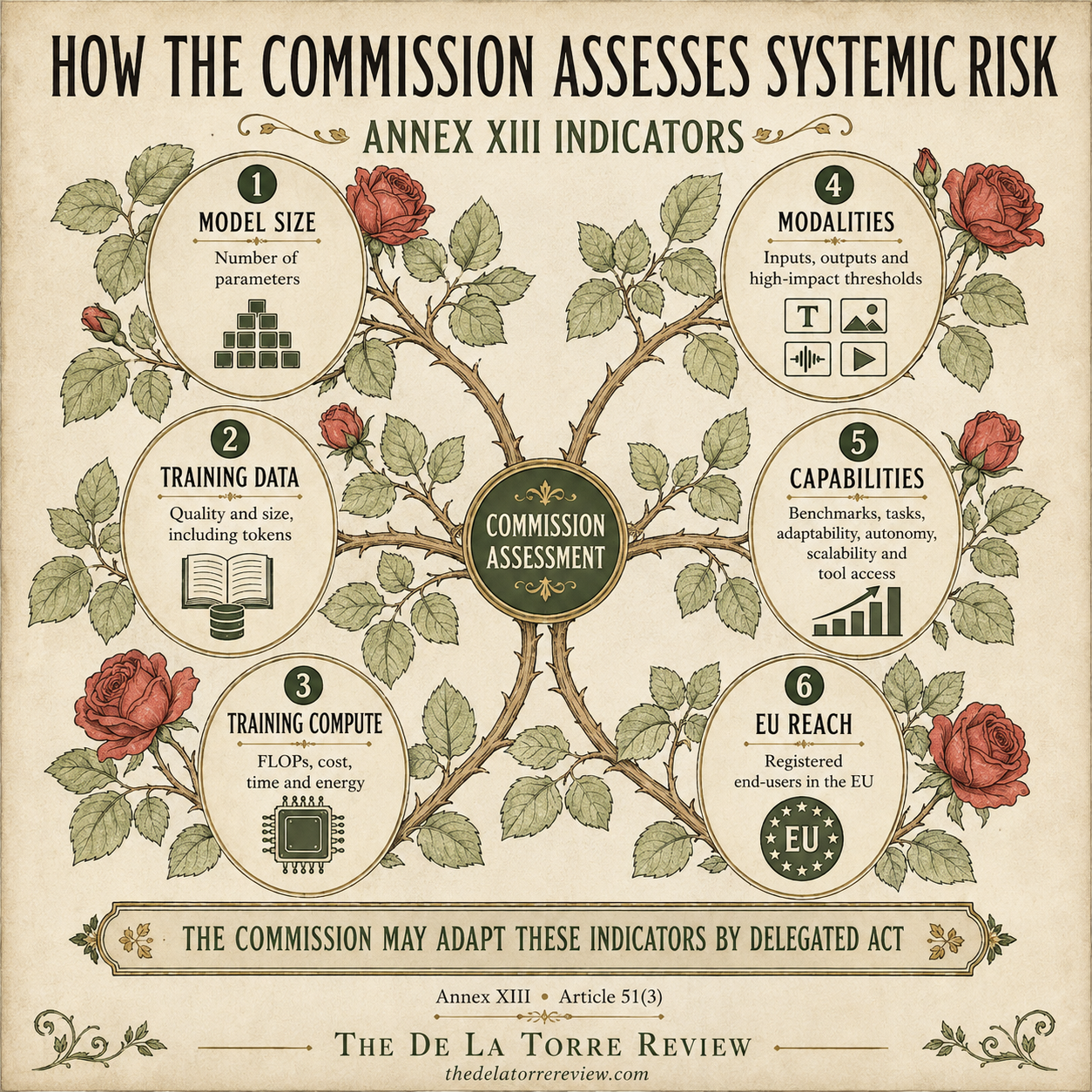
The following criteria must be taken into account by the Commission when determining whether a GPAI model has capabilities or an impact equivalent to those of a model with high-impact capabilities under Article 51(1)(a):
- the number of parameters of the model (for relevant parameters, see the requirements for systemic risk and classification of GPAI model above);
- the quality or size of the dataset, for example as measured through tokens;
- the amount of computation used to train the model, measured in FLOP or indicated through a combination of other variables, such as the estimated training cost, training time, or energy consumption;
- the model’s input and output modalities—such as text-to-text, text-to-image, or multimodal operation—the state-of-the-art thresholds for determining high-impact capabilities for each modality, and the specific types of inputs and outputs (e.g. biological sequences, such as DNA, as input data in a medical GPAI model);
- benchmarks and evaluations of the model’s capabilities, including the number of tasks it can perform without additional training, its adaptability to new and distinct tasks, its autonomy and scalability, and the tools to which it has access; and
- whether the model has a high impact on the EU internal market because of its reach. Such an impact is presumed when the model has been made available to at least 10,000 registered business users established in the EU.
These criteria are established in Annex XIII. Under Article 51(3), the European Commission may adopt delegated acts to amend the applicable thresholds and supplement the relevant benchmarks and indicators in light of evolving technological developments, including algorithmic improvements and increased hardware efficiency.
Who Is a GPAI Provider?
A provider is a person or organization that develops—or has developed—a GPAI model and places it on the market under its own name or trademark.
- Provider status is only one of several potentially applicable operator classifications under the EU AI Act. The roles are functional, may overlap, and can change as an organization modifies, brands, distributes, or uses AI. For a broader analysis, see Who Is Regulated Under the EU AI Act? Understanding Providers, Deployers, Importers, Distributors and Other Operators.
The Chapter V rules apply to providers that place GPAI models on the EU market (and their representatives) even if the provider is established outside the European Union. Providing access through an API, downloadable model weights, a cloud service, or another distribution method may constitute making the model available on the EU market.
- A non-EU provider must generally appoint an authorized representative established in the EU before placing its GPAI model on the Union market.
Organizations that modify or fine-tune an existing model may also become providers of a new GPAI model. Not every modification produces a new regulated model. The Commission’s Guidelines identify the computational resources used for the modification as one relevant measure. As an indicative criterion, a downstream modifier may be treated as the provider of a new GPAI model when the compute used for the modification exceeds one-third of the compute used to train the original model.
- Even when a downstream organization does not become the provider of a new GPAI model, it may still qualify as the provider or deployer of an AI system incorporating that model. Operator status should therefore be evaluated separately for the model and each downstream system.
What Must GPAI Providers (and Their Representatives) Do?
As mentioned above, the EU AI Act distinguishes between two risk-based categories of GPAI models that are subject to the Act: GPAI models with "systemic risks" and regular GPAI models (without systemic risks.)
- Providers of covered GPAI models are generally subject to technical-documentation, downstream-information, copyright-policy, training-content-summary, and regulatory-cooperation requirements, subject to the limited accommodations discussed below.
- Providers of GPAI models with systemic risk must satisfy those baseline requirements and the additional evaluation, risk-management, incident-reporting, and cybersecurity obligations imposed by Article 55.
- Free and open-source GPAI models are considered less risky due to their particular transparency and their relevance for research and development (Recital 102.) Where they do not pose a systemic risk, the EU AI Act allows some accommodations for these models.
- When a provider’s own GPAI model does not present systemic risk and is used solely for internal processes that are not essential to providing products or services to third parties, and the rights of natural persons are not affected, the Act’s GPAI-model obligations do not apply. (Recital 97)
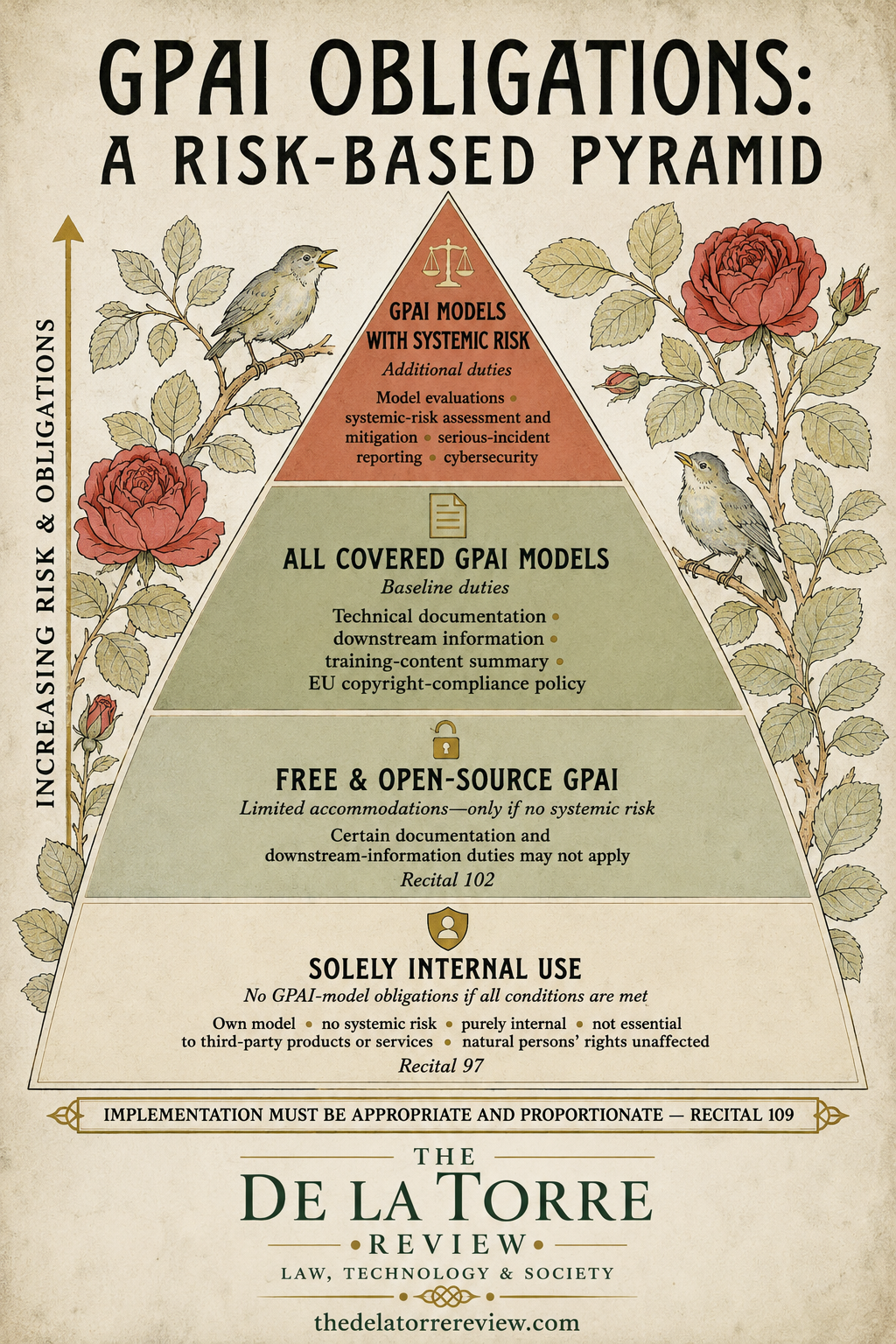
In any case, the implementation of the obligations concerning GPAI models must be appropriate and proportional. (Recital 109)
A. Baseline Obligations of GPAI Providers
Article 53 establishes baseline obligations for providers of GPAI models.
(1) Maintain technical documentation: Providers must prepare and keep current technical documentation describing the model. The documentation must address matters including the training and testing process and the results of model evaluations and must contain, at a minimum, the information set out in Annex XI. This documentation must be made available to the AI Office and national competent authorities upon request. (Article 53.1 (a))
(2) Provide information to downstream system providers: A GPAI provider must give downstream providers enough information to understand the model’s capabilities and limitations and to comply with their own obligations under the AI Act. It must contain, at a minimum, the elements set out in Annex XII. This requirement is particularly important because downstream providers may be responsible for determining whether an application is high-risk, completing conformity-assessment work, implementing human oversight, or managing risks created by a specific use. (Article 53.1 (b))
GPAI compliance is partly a value-chain obligation: upstream providers must supply information that permits downstream providers to comply.
(3) Adopt an EU copyright compliance policy: Providers must establish a policy for complying with EU copyright and related-rights law and, in particular, for identifying and complying—including through state-of-the-art technologies—with rights reservations expressed under Article 4(3) of the Copyright in the Digital Single Market Directive. (Article 53(1) (c))
Practice Tip: Copyright Compliance Requires a Process, Not a Finding of Lawfulness: Compliance with Article 53(1)(c) does not itself establish that every protected work used to train a model was lawfully obtained or used. The provision requires providers to establish and implement a policy for complying with applicable EU copyright law, including relevant rights reservations. Consistent with Recital 108, the AI Office monitors whether providers have fulfilled this obligation without conducting a work-by-work assessment of the training data’s copyright status.
(4) Publish a training-content summary: Providers must prepare and publicly release a sufficiently detailed summary of the content used to train the model. The summary must follow the AI Office’s Template for the Public Summary of Training Content. (Article 53(1) (d))
- The requirement does not compel providers to identify every individual training item. Consistent with Recital 107 and the AI Office’s template, however, the summary should provide meaningful information about the principal data collections or sets used to train the model, including relevant information about protected content and data obtained from online sources.
(5) Cooperate with regulators: GPAI providers must cooperate with the European Commission, and competent national authorities in the exercise of their statutory powers. (Article 53.(3))
Free and open-source accommodation: The technical-documentation and downstream-information requirements in Article 53(1)(a) and (b) do not apply when a model is released under a free and open-source license permitting access, use, modification, and distribution, and its parameters—including its weights, model architecture, and model-usage information—are publicly available. This accommodation does not apply to GPAI models with systemic risk. Qualifying open-source providers remain subject to the copyright-policy and public training-summary requirements. (Article 53(2))
Article 53(4) explains how providers may demonstrate compliance:
- Providers may rely on an approved code of practice until a harmonized standard is published.
- Compliance with a qualifying European harmonized standard creates a presumption of conformity to the extent the standard covers the relevant obligations.
- Providers using neither pathway must demonstrate alternative adequate means of compliance for Commission assessment.
B. Additional Obligations for Providers of GPAI Models With Systemic Risk
Providers of GPAI models with systemic risk must satisfy the general Article 53 requirements and the additional obligations in Article 55.
These providers must:
- perform model evaluations using standardized protocols and tools that reflect the state of the art, including conducting and documenting adversarial testing designed to identify and mitigate systemic risks;
- assess and mitigate possible systemic risks at the EU level—including their sources—that may arise from the model’s development, placement on the market, or use;
- track and document serious incidents and report relevant information about those incidents, together with possible corrective measures, to the AI Office without undue delay and, where appropriate, to national competent authorities; and
- ensure an adequate level of cybersecurity protection for both the GPAI model and its physical infrastructure.
Providers of general-purpose AI models with systemic risk may rely on codes of practice within the meaning of Article 56 to demonstrate compliance with the obligations set out in paragraph 1 of this Article, until a harmonized standard is published.
- Compliance with European harmonized standards grants providers the presumption of conformity to the extent that those standards cover those obligations.
- Providers of general-purpose AI models with systemic risks who do not adhere to an approved code of practice or do not comply with a European harmonised standard shall demonstrate alternative adequate means of compliance for assessment by the Commission.
When a GPAI model exceeds—or the provider becomes aware that it will exceed—the 10²⁵ FLOP training-compute threshold, the provider must notify the European Commission without delay and, in any event, within two weeks after the threshold is met or the provider becomes aware that it will be met. (Articles 51(2) and 52(1))
- The provider may submit evidence arguing that the model does not present systemic risk despite meeting the compute threshold. The Commission may accept or reject that argument based on the model’s particular characteristics.
Additional Technical Documentation for GPAI Models With Systemic Risk: As mentioned before, under Article 53(1)(a), every GPAI provider must prepare and maintain technical documentation covering the model, its training and testing processes, and the results of its evaluation. Providers of GPAI models with systemic risk must include all the generally applicable information in Section 1 of Annex XI , plus the following additional information required by Section 2:
- Evaluation strategies and results. The provider must give a detailed description of its model-evaluation strategies and the resulting findings. The documentation should be based on available public evaluation protocols and tools or, when those are not used, describe the alternative evaluation methodologies applied. It must identify:
- the evaluation criteria;
- the metrics used;
- the evaluation results; and
- the methodology used to identify the model’s limitations.
- Adversarial testing and model adaptations. Where applicable, the provider must describe in detail the measures used to conduct internal or external adversarial testing, including red teaming. The documentation must also address relevant adaptations made to the model, including alignment measures and fine-tuning.
- System architecture. Where applicable, the provider must provide a detailed description of the system architecture, explaining how the software components build upon or feed into one another and how they integrate into the overall processing structure.
These requirements create a more detailed record of how the provider evaluated the model, tested it for vulnerabilities and systemic risks, modified or aligned it in response, and structured its underlying technical components. They complement—but do not replace—the operational evaluation, risk-management, incident-reporting, and cybersecurity duties imposed by Article 55.
C. Obligations of Authorized Representatives of Non-EU GPAI Providers
Before placing a GPAI model on the EU market, a provider established outside the European Union must appoint an authorized representative established in the EU through a written mandate. The provider must give the representative the authority and information needed to perform its assigned responsibilities. (Article 54)
The representative’s mandate must authorize it to:
- verify that the provider has prepared the technical documentation required by Annex XI and fulfilled its obligations under Article 53 and, where applicable, the additional systemic-risk obligations under Article 55;
- retain a copy of the required technical documentation and the provider’s contact information for 10 years after the model is placed on the market;
- provide the AI Office, upon a reasoned request, with the information and documentation necessary to demonstrate compliance;
- cooperate with the AI Office and competent authorities in actions concerning the model, including when it is incorporated into an AI system placed on the EU market or put into service in the EU; and
- serve as a point of contact that the AI Office and competent authorities may address, either in addition to or instead of the provider, regarding compliance matters.
The representative must provide the AI Office with a copy of its mandate upon request in an official language of the EU institutions.
The role also carries an independent compliance responsibility. If the representative considers, or has reason to consider, that the provider is violating the AI Act, it must terminate the mandate and immediately notify the AI Office of both the termination and the reasons for it.
Free and Open-Source Accommodation: The representative requirement does not apply to a GPAI model released under a qualifying free and open-source license when the model’s parameters—including its weights, architecture information, and usage information—are publicly available. However, this accommodation is unavailable when the GPAI model presents systemic risk.
Practice Tip: Appoint the Representative Before Market Entry: A non-EU provider should identify and appoint its EU representative before making a covered GPAI model available on the EU market. The written mandate should expressly address document retention, regulatory cooperation, access to compliance information, and the representative’s obligation to terminate the mandate and notify the AI Office if the provider acts contrary to the AI Act.
D. Rights and Obligations of Downstream Providers of GPAI Models
A downstream provider is a provider of an AI system—including a general-purpose AI system—that integrates an AI model. The definition applies whether the organization developed the model itself or obtained it from another entity. (Article 3(68))
- Integrating a GPAI model does not automatically make the resulting application a general-purpose AI system. It qualifies as one when it can serve a variety of purposes, whether used directly or integrated into other systems. A purpose-specific application, such as an employment or medical tool, must instead be classified according to its intended purpose and capabilities. (Recital 100)
- For a broader discussion of how provider status fits within the EU AI Act’s allocation of responsibilities among providers, deployers, importers, distributors of AI Systems, and other operators, see Who Is Regulated Under the EU AI Act? Understanding Providers, Deployers, Importers, Distributors and Other Operators.
The GPAI provider’s compliance with Chapter V does not establish compliance by the downstream system.
The downstream provider is responsible for determining which requirements apply to the resulting system, including rules governing prohibited practices, high-risk systems, transparency, documentation, conformity assessment, registration, monitoring, and risk management.
- To support this analysis, the GPAI provider must give downstream providers current information about the model’s capabilities, limitations, integration requirements, and other matters specified in Annex XII, subject to appropriate protections for intellectual property and confidential information. (Article 53(1)(b))
- A downstream provider may also lodge a reasoned complaint alleging that a GPAI provider has violated the Act. (Article 89(2))
Practice Tip: Distinguish Model-Level and System-Level Roles: The EU AI Act does not impose separate obligations on deployers, importers, or distributors acting solely in relation to a GPAI model. Those roles are defined by reference to AI systems. However, an organization may incur the applicable obligations when it deploys, imports, or distributes an AI system incorporating the model. Classify the organization’s role and analyze compliance separately at the model and system levels.
Does Open Source Receive an Exemption?
As mentioned above, the EU AI Act provides limited accommodations for certain GPAI models released under a free and open-source license. The accommodation applies only when:
- the license permits access, use, modification, and distribution of the model; and
- the model’s parameters—including its weights, architecture information, and usage information—are publicly available.
When these conditions are satisfied and the model does not present systemic risk, the provider is exempt from two obligations discussed in “Obligations of Providers of GPAI Models”:
- preparing and maintaining the technical documentation required by Article 53(1)(a) and Annex XI; and
- providing the information and documentation required by Article 53(1)(b) and Annex XII to downstream providers.
A qualifying non-systemic-risk open-source provider established outside the EU is also exempt from appointing the authorized representative discussed in “Authorized Representatives of Non-EU GPAI Providers.” (Articles 53(2) and 54(6))
The accommodation does not eliminate the other applicable GPAI obligations. Open-source providers must still:
- establish the EU copyright-compliance policy described above;
- publish the required training-content summary using the AI Office’s template; and
- cooperate as necessary with the European Commission and national competent authorities.
No Accommodation for Systemic-Risk Models
The open-source accommodations do not apply when a GPAI model presents systemic risk. As discussed in “Additional Duties for Models With Systemic Risk,” the provider must comply with:
- all applicable Article 53 obligations, including technical documentation and downstream information;
- the authorized-representative requirement, when the provider is established outside the EU; and
- the additional evaluation, systemic-risk management, incident-reporting, and cybersecurity obligations imposed by Article 55.
Practice Tip: Verify the License and the Disclosures: Calling a model “open source” does not establish eligibility. Providers should confirm that the license grants all four required freedoms and that the weights, architecture information, usage information, and other required parameters are actually public. They should also document why the model does not present systemic risk before relying on the accommodations.
Compliance Deadlines: GPAI Models
The EU AI Act’s GPAI requirements apply according to the following timeline:
- August 2, 2025: The obligations for providers of GPAI models began to apply. Providers placing GPAI models on the EU market on or after this date must comply with the applicable requirements. Providers of GPAI models with systemic risk must also notify the European Commission. Providers are expected to cooperate with the AI Office, which offers compliance support, particularly to signatories of the GPAI Code of Practice.
- August 2, 2026: The European Commission’s enforcement powers began to apply. From this date, the Commission may enforce the GPAI requirements and impose fines for violations.
- August 2, 2027: Providers of GPAI models placed on the market before August 2, 2025, must bring those models into compliance.
Additional Resources
EU AI Act: Definitions and General Provisions
- Article 3(66) — General-Purpose AI System
- Article 3(67) — Floating-Point Operation
- Article 3(68) — Downstream Provider
- Article 89(2) — Downstream-Provider Complaints
- Recital 85 — Providers of GPAI Systems
- Recital 97 — GPAI Models and the Model-System Distinction
- Recital 98 — Indicators of Generality
- Recital 99 — Generative AI as a Typical GPAI Example
- Recital 100 — GPAI Systems
- Recital 102 — Free and Open-Source GPAI
- Recital 103 — Monetization
- Recital 104 — Exceptions from Transparency Obligations
- Recital 105 — Text and Data Mining
- Recital 106 — Extraterritoriality
- Recital 107 — Transparency of Training Data
- Recital 108 — Monitoring Copyright Compliance
- Recital 109 — Proportionality of Compliance
- Recital 115 — Reporting of Serious Incidents
- Recital 116 — Codes of Practice
- Recital 117 — Presumption of Conformity
- Annex XI — Technical Documentation for GPAI Providers
- Annex XII — Information for Downstream Providers
- Article 4(3) of Directive (EU) 2019/790 — Rights Reservations for Text and Data Mining
EU AI Act: GPAI Systemic Risk
- Article 3(65) — Systemic Risk
- Annex XIII — Criteria for Designating GPAI Models With Systemic Risk
- Recital 110 — Systemic Risks Associated With GPAI Models
- Recital 111 — High-Impact Capabilities and the Systemic-Risk Classification
- Recital 112 — Notification and Classification of GPAI Models With Systemic Risk
- Recital 113 — Commission Designation of GPAI Models With Systemic Risk
- Recital 114 — Duties of GPAI Providers Regarding Systemic Risks
EU AI Act: GPAI Requirements
- Article 51 — Classification of GPAI Models With Systemic Risk
- Article 52 — Procedure for GPAI Models With Systemic Risk
- Article 53 — Obligations for Providers of GPAI Models
- Article 54 — Authorized Representatives of GPAI Providers
- Article 55 — Obligations for Providers of GPAI Models With Systemic Risk
- Article 56 — GPAI Codes of Practice
- Article 101 — Fines for Providers of GPAI Models
- Article 113 — Entry Into Force and Application
European Commission Guidance and Compliance Materials
- European AI Office
- EU AI Act Implementation Timeline
- Guidelines on the Scope of Obligations for GPAI Model Providers
- GPAI Models Under the AI Act: Questions and Answers
- General-Purpose AI Code of Practice
- GPAI Code of Practice Signatories
- AI Office’s Template for the Public Summary of Training Content



Comments ()