
Jordana: Why Institutions Must Apply Access and Data Protection Rules Together
An EU official sought recruitment records to challenge his grade. In Jordana, the General Court held that the Commission could not refuse access on privacy grounds while postponing the required data-protection assessment to a separate application.
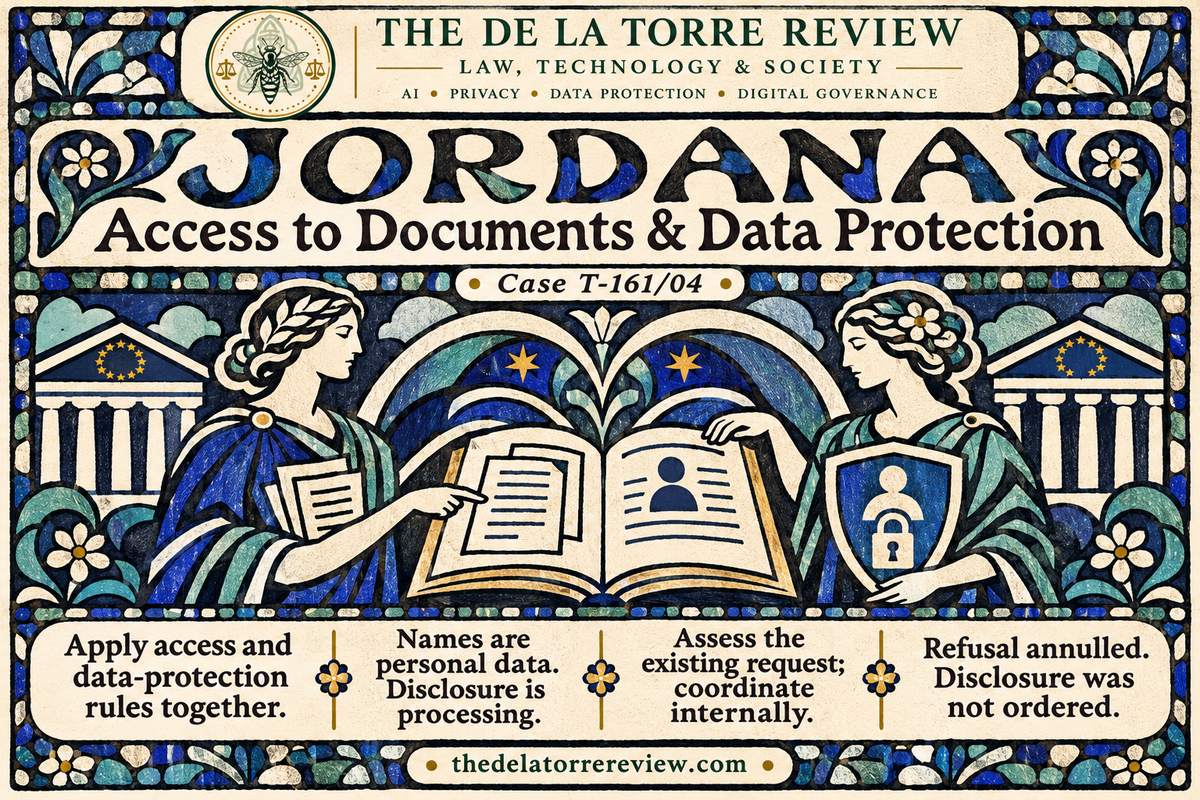
Case T-161/04 | Gregorio Valero Jordana v European Commission | General Court of the European Union | Eighth Chamber | 7 July 2011
Practice Takeaways: ① Access to documents and data protection must be applied together when requested documents contain personal data. ② Names in recruitment and appointment records are personal data; disclosing them is processing. ③ An institution cannot defer the necessary data-protection assessment by directing the requester to submit a new application to another department. ④ Internal coordination must support a response within the access regulation’s deadlines. ⑤ A refusal may explain the institution’s reasoning clearly and still apply the law incorrectly. New reasons advanced during litigation cannot replace the original justification.
Can an institution refuse access to documents because they contain personal data, then tell the requester to start again under data-protection law?
In Jordana, the General Court answered that question by examining the relationship between two regulations. Regulation (EC) No 1049/2001 governed public access to institutional documents. Regulation (EC) No 45/2001 governed the processing of personal data by EU institutions and bodies.
The Commission had treated the two frameworks as separate routes. It refused access under the first while leaving open the possibility of disclosure under the second, provided that the applicant submitted a new request to another part of the institution.
The Court held that this approach misunderstood the privacy exception in the access regulation. That exception expressly incorporated the applicable data-protection rules. The Commission had to apply those rules when deciding the existing request. (Judgment, paras. 87–88, 94–103.)
Practice Tip: When personal data are involved, the task is to apply the relevant legal frameworks within the access procedure. Referring the requester elsewhere does not complete that assessment.
What Happened
Gregorio Valero Jordana had passed an open competition for recruitment to the European Commission. In October 2003, he requested access to the competition’s reserve list of successful candidates. He also requested a French translation of a complaint concerning his classification in grade A7. The translation was subsequently provided; access to the reserve list remained disputed. (Judgment, paras. 14–18.)
The Commission refused access to the list under Article 4(1)(b) of Regulation 1049/2001, which protects privacy and the integrity of the individual. It explained that the competition notice had not informed candidates that the list would be published and that disclosure could compromise personal-data protection. (Judgment, para. 15.)
In a separate request, Valero Jordana sought individual decisions appointing officials to grade A6 from 5 October 1995 onward. He argued that the documents were indispensable to preparing litigation over his own classification and relied on Staff Regulations provisions concerning the announcement and publication of appointment decisions. The Commission also refused that request. (Judgment, paras. 17, 20–22.)
On 10 February 2004, the Commission rejected his confirmatory applications. It maintained that the documents could not be disclosed under Regulation 1049/2001, even partially, but suggested that access might be possible under Regulation 45/2001. It invited him to submit a new application to the data-protection coordinator of its Personnel and Administration Directorate-General, explaining his reasons and intended use of the data. (Judgment, paras. 24, 52–56.)
Valero Jordana brought an action for annulment. Sweden and the European Data Protection Supervisor supported his challenge. Denmark also intervened but later withdrew. The proceedings were stayed pending the Court of Justice’s decision in Commission v Bavarian Lager, after which the parties were invited to address that judgment’s implications. (Judgment, paras. 25–40.)
This was a direct challenge to a Commission decision, rather than a preliminary reference from a national court.
Why the Case Matters
Jordana addresses an administrative consequence of the framework established in Bavarian Lager: an institution handling a document request cannot separate the privacy exception from the data-protection legislation to which it refers.
The presence of personal data made Regulation 45/2001 applicable. It did not permit the Commission to postpone that regulation’s application until the requester began a second procedure. The institution had to decide the access request under the combined framework and coordinate its responsible services where necessary. (Judgment, paras. 87–88, 95–102.)
The judgment also distinguishes a decision’s explanation from its legal correctness. The Court found that the Commission had adequately explained its approach, but that the approach itself was unlawful. It then rejected the Commission’s attempt to defend the refusal through a materially different justification advanced at the hearing. (Judgment, paras. 48–59, 104–107.)
The Key Holding
The General Court annulled the Commission’s refusal of 10 February 2004.
- Article 4(1)(b) of Regulation 1049/2001 required the Commission to assess the proposed disclosure in accordance with Regulation 45/2001. By making that assessment conditional on a new application to another department, the Commission breached the access regulation and acted contrary to the requirements of good administration. (Judgment, paras. 95–103, 108.)
The Court did not order disclosure of the reserve list or appointment decisions. Its ruling concerned the unlawfulness of the refusal and the assessment the Commission was required to undertake.
The Court’s Analysis
1. The Privacy Exception Incorporated Data-Protection Law
The Court described Article 4(1)(b) as an indivisible provision. Its reference to EU data-protection legislation formed part of the test for applying the exception. Possible harm to privacy and the integrity of the individual therefore had to be examined in accordance with that legislation. (Judgment, para. 87.)
Following Bavarian Lager, the Court held that where a request under Regulation 1049/2001 sought documents containing personal data, Regulation 45/2001 applied in its entirety. The institution could not decide the request through a privacy analysis detached from the rules governing personal-data processing. (Judgment, paras. 87–88.)
This also defeated the argument that Regulation 1049/2001 alone governed the dispute. The link to data-protection law was already contained in the access exception on which the Commission relied. (Judgment, paras. 92–93.)
2. Names in Official Records Were Personal Data
The requested records identified successful competition candidates and officials appointed to a particular grade. The Court treated their first and last names as personal data within Article 2(a) of Regulation 45/2001. Communicating those data constituted processing under Article 2(b). (Judgment, paras. 90–92.)
Valero Jordana argued that identifying someone as an official did not concern that person’s private life. The Court rejected the suggestion that this removed the request from the applicable data-protection framework. Regulation 45/2001 protected individuals whose data were processed by EU institutions, including in an employment context. (Judgment, paras. 89, 93.)
Practice Tip: Information relating to professional or official activity can be personal data. That classification triggers the relevant assessment; it does not itself determine whether access must be granted or refused.
3. The Commission Could Not Require a Fresh Application
The Commission had acknowledged that data-protection law was relevant but reserved its application for a new procedure. It argued that the two regulations established separate procedures involving different decision-making authorities. The Court found no legal basis for that separation in the Commission’s submissions. (Judgment, paras. 94–96.)
The Commission also maintained that it had to respect the legal basis chosen by the requester. The Court explained that applying Regulation 45/2001 did not require substituting a different legal basis for his request. The request remained one under Regulation 1049/2001, whose privacy exception expressly required consideration of data-protection law. (Judgment, paras. 97–100.)
Directing Valero Jordana to file another application therefore failed to apply the existing request’s governing rules. It also conflicted with good administration. (Judgment, para. 100.)
An institution must apply the data-protection rules within its assessment of the access request. It cannot make that assessment depend on the requester starting again.
4. Internal Coordination Was the Institution’s Responsibility
The Court identified how the Commission should have handled the overlap. An institution receiving an application under Regulation 1049/2001 for documents containing personal data had to respond within that regulation’s deadlines and in accordance with Regulation 45/2001. Where necessary, it had to coordinate the persons or services responsible for document access and personal-data protection. (Judgment, para. 102.)
The Court pointed to Bavarian Lager as an example of the combined approach: there, the Commission had adopted a single decision relying on Article 4(1)(b) of Regulation 1049/2001 and Article 8 of Regulation 45/2001. (Judgment, para. 101.)
For institutions, the practical implication is that allocating responsibilities across departments must support the legal assessment and timely response. The requester’s application should not have to bridge an internal division of responsibilities before the institution applies the relevant law.
Practice Tip: Establish a process that brings access officials and data-protection staff together early enough to meet the access procedure’s deadlines.
5. Adequate Reasons Did Not Make the Approach Lawful
Valero Jordana separately argued that the Commission had failed to provide adequate reasons for its decision. The Court rejected that ground. The decision explained why the Commission refused access under Regulation 1049/2001 and why it considered a new application under Regulation 45/2001 appropriate. His substantive challenges also showed that he understood the reasoning. (Judgment, paras. 45–59.)
That finding did not validate the Commission’s interpretation. A decision can make its reasoning sufficiently clear for the applicant and the Court to understand while still applying the wrong legal approach.
Here, the Commission’s explanation revealed the substantive error: it had deferred the required data-protection assessment instead of carrying it out within the access procedure. (Judgment, paras. 57–59, 94–103.)
6. New Reasons During Litigation Could Not Repair the Refusal
At the hearing, the Commission argued that its refusal necessarily presupposed an assessment under Article 8 of Regulation 45/2001. It referred to the internal publicity contemplated by the Staff Regulations and to Valero Jordana’s personal career interest. It also acknowledged that the decision should have demonstrated why his reasons did not establish the necessity of the transfer under Article 8(b). (Judgment, paras. 104–105.)
The Court found that this was a new justification. The original decision had expressly left open possible disclosure under Regulation 45/2001 through another procedure. It did not show that the Commission had already applied that regulation to the requests before it. (Judgment, para. 106.)
An institution’s decision had to stand on its own reasons. An explanation already outlined in the decision could be developed or clarified during litigation, but the institution could not replace the original justification with an entirely new one. (Judgment, para. 107.)
Practice Tip: Record the applicable assessment in the decision itself. Litigation can clarify existing reasons; it cannot supply a different legal assessment that the original decision deferred.
What the Court did—and did not—decide
The Court held that the Commission had to apply the access and data-protection regulations together, assess the existing request within that framework, and arrange any necessary internal coordination. It annulled the refusal because the Commission had failed to do so. (Judgment, paras. 94–108.)
It did not hold that all recruitment records must be disclosed, that names of officials fall outside data-protection law, or that the applicant had established the necessity of receiving the requested personal data.
Nor should the Commission’s hearing argument about the insufficiency of his personal career interest be presented as the Court’s conclusion on that issue. The Court rejected the attempt to introduce a new justification; it did not resolve the request through a substantive assessment of that justification. (Judgment, paras. 104–107.)
Although the dispute arose from Valero Jordana’s own career, the contested requests sought institutional documents containing information about other people. The case therefore differs from judgments addressing a data subject’s right to obtain access to their own personal data.
Jordana Today
Jordana applied Regulation 45/2001, the former data-protection framework for EU institutions and bodies. It was not a GDPR ruling. Regulation 45/2001 has since been repealed and replaced by Regulation (EU) 2018/1725.
- Article 9(3) of the current regulation expressly requires EU institutions and bodies to reconcile personal-data protection with access to documents in accordance with Union law. Article 9(1)(b), concerning transmissions to recipients established in the Union other than Union institutions and bodies, requires necessity for a specific purpose in the public interest and, where legitimate interests might be prejudiced, a demonstrable weighing of competing interests and an assessment of proportionality. (Regulation 2018/1725, Article 9.)
The practical lesson remains useful: institutions need a coordinated assessment of access and data protection. Present-day requests must satisfy the current statutory conditions; the annulment in Jordana does not establish that a similar request would necessarily succeed today.
Conclusion
Jordana began with an official seeking recruitment records to support a challenge to his grade. The Commission refused access on privacy grounds but postponed the assessment required by data-protection law to a new application.
The General Court annulled that refusal. The access exception itself required the Commission to apply the data-protection framework, coordinate its services where necessary, and respond within the access procedure’s deadlines.
- For requesters, the judgment explains why personal data do not justify sending an application through a second procedure before the institution performs the required assessment.
- For institutions, it shows the importance of applying both frameworks in the original decision and explaining the assessment that actually supports the outcome.
Sources and Additional Materials
Sources
CJEU judgments, Advocate General opinions, procedural orders, summaries, and related case materials are available through InfoCuria, the Court of Justice of the European Union’s official case-law database. The case can be located using Case T-161/04, Gregorio Valero Jordana v European Commission.
- General Court of the European Union, Eighth Chamber, Case T-161/04, Gregorio Valero Jordana v European Commission, Judgment of 7 July 2011, ECLI:EU:T:2011:337. Official case entry and English summary.
Regulation (EC) No 1049/2001, particularly Article 4(1)(b), concerning privacy and the integrity of the individual.
Regulation (EC) No 45/2001, the data-protection legislation applied in the judgment, particularly Articles 2 and 8.
Regulation (EU) 2018/1725, the successor framework, particularly Article 9.
Useful Reading from The De La Torre Review
- Bavarian Lager: When Transparency Requests Become Data-Protection Questions — The principal authority applied in Jordana for the relationship between access to documents and personal-data protection. Jordana relies on it when explaining that Article 4(1)(b) requires application of the data-protection framework and that disclosure of names constitutes processing. (Judgment, paras. 87–91, 101.) Read the Article.
- Dennekamp I: Why Transparency Requests Must Explain the Need for Personal Data — Examines the requester’s obligation to establish the necessity of transferring particular personal data. Read alongside Jordana, it illustrates why an institution’s duty to apply both frameworks does not itself establish a right to receive the requested names. Read the Article.
- Nowak: When an Exam Answer Becomes Personal Data — Explores the breadth of the personal-data concept and access to an individual’s own information. It provides a useful comparison with Jordana, where the contested requests sought documents containing other people’s data. Read the Article.
- CRIF: When a “Copy” of Your Personal Data Requires More Than a Data List — Examines the right to obtain a faithful and intelligible copy of one’s own personal data. It helps distinguish data-subject access from the public-access framework at issue in Jordana. Read the Article.


Comments ()