Arkansas: Who Owns AI-Generated Content and Trained AI Models?
Arkansas AR Code § 18-4-101 (2025) tackles a growing AI question: who owns what generative AI creates? The law sets ownership rules for AI-generated content and trained models—and a different rule when employees use AI as part of their jobs.
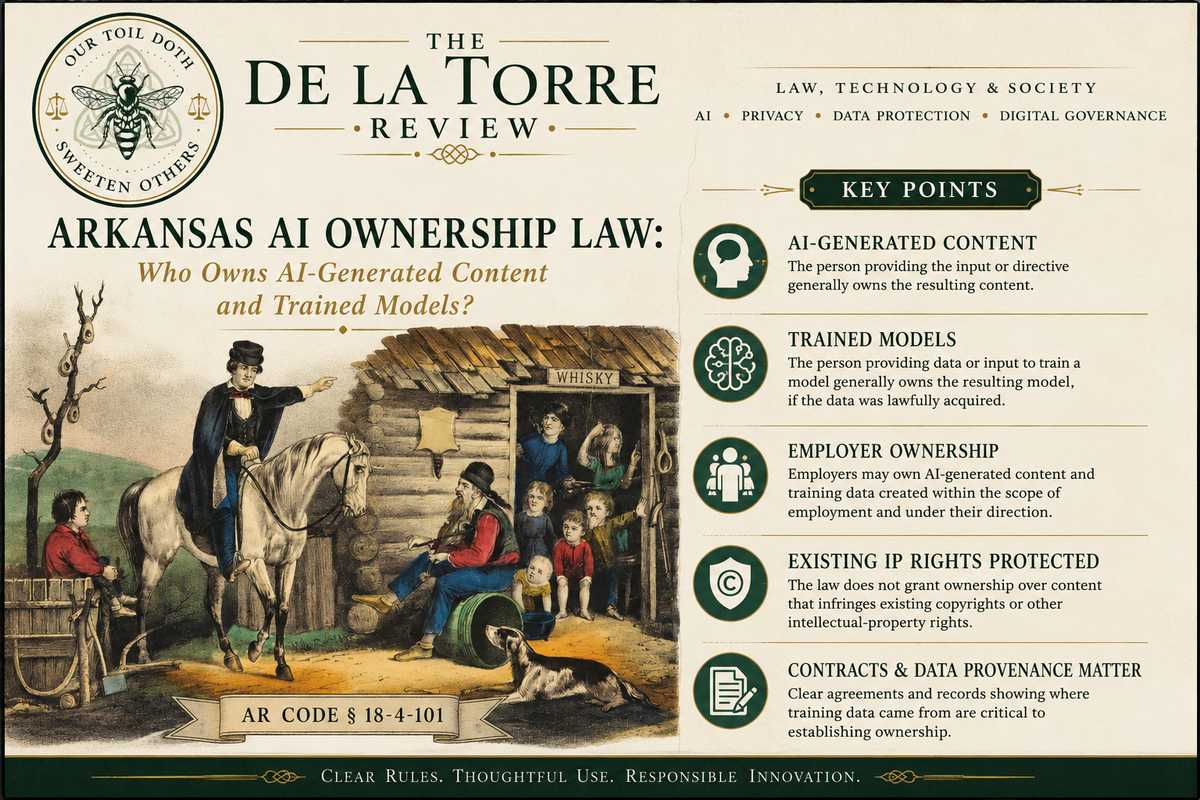
Key Points: Under Arkansas law: (1) AI-generated content: The person providing the input or directive generally owns the resulting content. (2) Trained models: The person providing the training data or input generally owns the resulting model. (3) Employee AI use: Employers generally own AI-generated content and model-training data created within the scope of employment.
Effective Date: April 21, 2025.
Arkansas Code § 18-4-101 addresses a narrow but increasingly important part of the AI ecosystem: the allocation of ownership between AI users, employees, and employers. Broadly speaking, the law provides that:
- a person providing the input or directive used to generate content owns the resulting content, subject to existing intellectual-property rights;
- a person providing data or input to train a generative AI model owns the resulting trained model, subject to specified conditions; and
- when an employee is directed to use generative AI within the scope of employment and under the employer's direction and control, the resulting model-training data and generated content belong to the employer.
The Arkansas rules make clear the importance of establishing data provenance—where training data came from and how it was obtained. Because the law conditions ownership of a trained model on the training data being lawfully acquired, documenting its provenance can be critical to establishing ownership.
The law does not create a comprehensive intellectual-property regime for artificial intelligence. Instead, it establishes an Arkansas state-law ownership rule while expressly preserving pre-existing copyright and other intellectual-property rights. Section 18-4-101(a)(1) provides that a person supplying the input or directive used to generate content owns that content provided it does not infringe existing copyrights or intellectual-property rights, while subsection (c) reinforces that the Act does not grant ownership over infringing content regardless of the use of generative AI.
Organizations should distinguish ownership of an AI output under state law or contract from whether the output qualifies for federal intellectual-property protection. Arkansas Code § 18-4-101 does not resolve that separate question.
Additionally, the law does not create individual rights to access, delete, or correct information, opt out of AI processing, or obtain disclosures or explanations about an AI system’s use or decisions.
Who Is Subject to the Law? (Territorial Scope)
The operative provisions apply when a "person" uses a generative artificial intelligence tool to:
- generate content; or
- conduct model training.
The law also expressly addresses employees and employers when generative AI is used as part of an individual's employment duties.
What Is Regulated? (Material Scope)
Unlike many AI statutes Arkansas Code § 18-4-101 is not concerned with regulating AI developers. Instead, its focus is on allocating ownership of the products of generative-AI use.
Specifically, the law regulates ownership in connection with two principal uses of generative AI:
- Generating content using a generative AI tool. (§ 18-4-101(a)(1))
- Training a generative AI model by providing data or other input. (§ 18-4-101(a)(2))
Obligations and Ownership Rules
1. Ownership of AI-Generated Content
When a person uses a generative AI tool to generate content, the person providing the input or directive owns the generated content, provided that the content does not infringe existing copyrights or intellectual-property rights.
2. Ownership of Trained Models
When a person uses generative AI to conduct model training, the person providing the data or input used to train the model owns the resulting trained model, provided that:
- the training data was lawfully acquired; and
- ownership rights have not been transferred through contract or agreement.
PRACTICE TIP: Given the absence of a comprehensive federal framework and the potential for diverging state rules on AI ownership, organizations should clearly allocate rights to AI-generated content, trained models, training data, and other inputs by contract. Clear contractual terms can reduce uncertainty as the state-law landscape evolves.
3. Employee Use of Generative AI
If an individual is employed by a person or entity and is directed to use a generative AI tool to conduct model training or generate content as part of the individual's employment duties, the resulting trained model, and generated content are the property of the employer.
That rule applies only where the AI use is:
- within the scope of the individual's employment; and
- conducted under the direction and control of the employer.
PRACTICE TIP: Employers that expect employees to use generative AI should consider expressly addressing authorized AI use in employment policies, job responsibilities, project instructions, intellectual-property agreements, and AI governance documentation. Evidence that AI use occurred within the employee's duties and under the employer's direction and control will become important in an ownership dispute.
Conclusion
Arkansas Act 927 is not a comprehensive AI governance law. Instead, it addresses a specific question that is becoming increasingly important as generative AI becomes integrated into ordinary business activity: Who owns what humans create or train using generative AI?
Arkansas answers that question by establishing several default rules:
- AI-generated content: the person providing the input or directive generally owns the resulting content;
- trained AI models: the person providing the training data or input generally owns the resulting trained model, assuming the data was lawfully acquired and ownership was not transferred by contract;
- employee AI use: qualifying AI-generated content and model-training data belong to the employer when the employee's use occurs within the scope of employment and under the employer's direction and control; and
- existing IP rights: none of these rules creates ownership over material that infringes pre-existing copyrights or other intellectual-property rights.
Organizations using generative AI should know who supplies prompts, who supplies training data, whether that data was lawfully acquired, what their contracts say about ownership, and whether employees are using AI within clearly defined employment responsibilities.
Resources
Arkansas Legislation
- Arkansas Act 927 of 2025 (HB 1876) — The Act as enacted in 2025 regarding the Ownership of Model Training and Content Generated by a Generative Artificial Intelligence Tool; and for Other Purposes.
- Arkansas Code § 18-4-101 — Generative artificial intelligence tool — Ownership of model training and generated content — Work made for hire — Exceptions.
Related Federal Intellectual-Property Issues
Organizations applying Act 927 should separately consider federal intellectual-property rules governing copyright-ability and ownership of AI-assisted works, infringement, training data, and other AI-related intellectual-property questions.
Comments ()