
Prohibited AI Practices Under the EU AI Act: Non Consensual Intimate Material and Child Sexual Abuse
The EU AI Act’s new prohibitions target AI-generated intimate material without consent and child sexual abuse material. Explore their scope, provider safeguards, deployer duties and limited exceptions
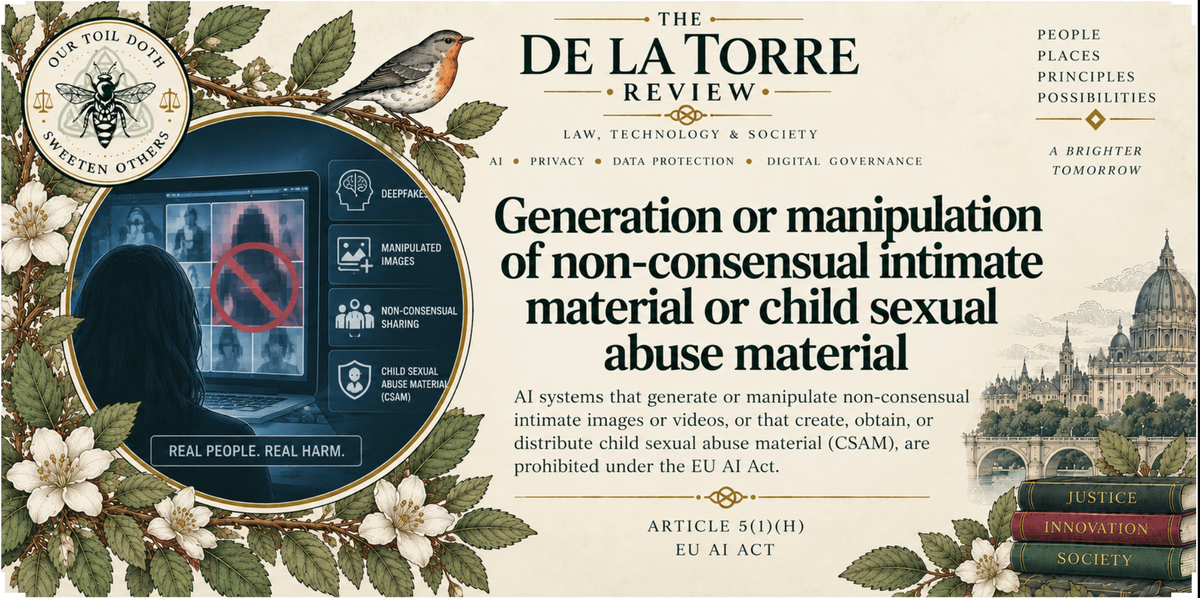
The EU AI Act is a risk-based regulatory framework, but some practices are considered unacceptable and are prohibited outright.
This article examines the new prohibitions on using AI to generate or manipulate non-consensual intimate material or child sexual abuse material. Enacted through the Digital Omnibus on AI, these prohibitions are not covered by the Commission’s July 29, 2025 Guidelines. This analysis instead draws on the amended AI Act and the Omnibus recitals, which explain their scope, safeguards and exceptions.
For an overview of all prohibited practices, see Prohibited AI Practices Under the EU AI Act: Where Europe Draws the Line.
Non Consensual Intimate Material and Child Sexual Abuse Material Under the EU AI Act
Generative AI can create intimate depictions of real people without their consent and produce child sexual abuse material without recording an actual act of abuse. These practices threaten dignity, privacy and sexual autonomy, and can perpetuate harm as the material circulates. The EU AI Act addresses both through new prohibitions in Article 5(1)(ba) and (bb), introduced by the Digital Omnibus on AI.
- The rules distinguish between providers who make systems available and deployers who use them. Providers must consider both the system’s intended purpose and foreseeable misuse. For deployers, the prohibition turns on the purpose for which they use the system.
The new prohibitions, together with Article 5(1a) and (1b), apply from 2 December 2026.
AI Act, Article 113(a); Regulation (EU) 2026/1744 (Digital Omnibus on AI), Recitals 10–16.
Generating or Manipulating Prohibited Intimate Material
Article 5 establishes two related prohibitions:
- Non-consensual intimate material: Article 5(1)(ba) concerns realistic images, videos, audio or similar material depicting an identifiable person’s intimate parts or that person engaged in sexually explicit activities, generated or manipulated without the person’s qualifying consent.
- Child sexual abuse material and performances: Article 5(1)(bb) concerns material or performances falling within Article 2(c) or (e) of Directive 2011/93/EU (Directive on Fighting child sexual abuse), subject to a limited exception linked to a defense under national law.
For either prohibition, the analysis must establish:
- An AI system and relevant conduct: placing the system on the market, putting it into service or using it for the generation or manipulation concerned.
- Covered content: material or a performance meeting the applicable definition.
- The actor-specific conditions: the provider or deployer test in Article 5(1a).
- Creation and distribution are separate questions. The provisions address generation and manipulation; their text does not make publication, an intention to deceive or proof of significant harm a separate condition. Rules governing possession, sharing or publication may apply independently.
1 Non Consensual Intimate Material
Realistic depictions of identifiable people: The first prohibition combines three features: a realistic depiction, an identifiable natural person and intimate parts or sexually explicit activity. It covers audio and similar material as well as images and video.
- Realism concerns the person depicted not the setting. Omnibus Recital 12 explains that the person’s face, voice or body must be portrayed credibly, as in real life. The setting need not be realistic, and the depiction need not reproduce the person’s actual appearance or voice perfectly. An implausible scenario therefore does not necessarily take a credible depiction of a real person outside the prohibition.
- Intimate parts include, in the recital’s examples, genitals, the pubic area, anus, exposed buttocks and exposed female breasts, nipples or areolae. These examples clarify the provision’s scope; they are not a requirement that the material depict sexual activity as well.
The recital identifies material outside this particular prohibition, including:
- Depictions that do not concern identifiable natural persons.
- Realistic partial nudity that reveals no intimate parts and depicts no sexually explicit activity.
- Cartoonish or physically impossible depictions of the body, and non-realistic artistic nude works that do not realistically depict an identifiable person’s intimate parts or sexually explicit activity.
These limits concern Article 5(1)(ba). They do not determine whether material is prohibited as child sexual abuse material or unlawful under another law.
Example: A commercial service creates a credible intimate depiction of an identifiable adult without that person’s consent. Describing the output as fictional, or placing the person in a fantastical setting, does not by itself remove it from Article 5(1)(ba).
Omnibus recital 12, sentences 14–18
Practice Tip: Assess recognizability and realism together. A disclaimer that content was generated by AI does not supply consent or change an otherwise realistic depiction.
Consent to the specific generation or manipulation: The depicted person’s consent must be freely given, specific, informed, unambiguous and explicit, and must cover the generation or manipulation at issue.
- Consent to taking an original photograph, posting it online or appearing in earlier intimate material does not, by itself, establish consent to a new AI-generated depiction or alteration. Nor does an uploader’s agreement to a service’s terms establish that the depicted person consented.
- Appropriate mechanisms to collect and demonstrate consent reliably must be in place. The mechanisms must comply with the GDPR. As a practical matter, providers should be able to connect the consent to the depicted person and the particular operation authorized, rather than rely solely on a generic checkbox. (For more on consent under GDPR, see What is "Consent" under the GDPR?)
- Medical applications: The recital also preserves exceptional use by medical professionals for diagnosis or treatment when a person is incapable of consent, such as in an emergency. This is subject to fundamental rights, data protection and applicable medical law; it is not a general exemption for products marketed as medical tools.
Omnibus recital 12, sentence 18.
Edits to existing intimate material: Article 5(1b) limits what counts as manipulation for the non-consensual intimate material prohibition. An edit to pre-existing intimate material falls outside that term if it does not increase exposure of any depicted intimate parts and does not alter the nature of any depicted sexually explicit activities.
- Examples include changing a background, adding a text heading or adjusting brightness or contrast. Their treatment depends on the result: an apparently routine edit is not excluded if it actually increases exposure or changes the nature of the activity depicted.
- Conversely, increasing exposure or changing the depicted activity brings the alteration within the manipulation covered by the provision, subject to its other conditions.
Omnibus recital 12, sentences 19–20.
2 Child Sexual Abuse Material and Performances
Article 5(1)(bb) uses the definitions in Directive 2011/93/EU. The Directive’s terminology is “child pornography” and “pornographic performance”; this article uses “child sexual abuse material” except when identifying those statutory terms.
- For these definitions, a child is a person under 18. Covered material includes visual depictions of a child engaged in real or simulated sexually explicit conduct, or a child’s sexual organs for primarily sexual purposes. The definition also includes corresponding depictions of someone appearing to be a child and realistic images of a child, including synthetic images.
- A covered performance is a live exhibition aimed at an audience, including through information and communication technology, involving a child in real or simulated sexually explicit conduct or displaying a child’s sexual organs for primarily sexual purposes.
Synthetic material can be covered. Recital 11 expressly addresses wholly or partly synthetic child sexual abuse material. The absence of a photographed, identifiable child does not place realistic synthetic material outside the prohibition.
- The adult intimate-material analysis must not be imported wholesale into this provision. Article 5(1)(bb) does not require identification of a particular real child, and consent is not a general route to exemption. The incorporated definitions and the specific national-law exception govern.
3 When Providers Are Prohibited From Making a System Available
Article 5(1a)(a) establishes two routes by which placing a system on the market or putting it into service is prohibited. (See, Prohibited AI Practices Under the EU AI Act: Where Europe Draws the Line sub-title "What Conduct Does Article 5 Regulate?" to better understand what placing a system on the market or putting it into service means)
- Beyond “nudifier” apps: The provider test can also apply to general-purpose media generators and AI functionality supplied through APIs, white-label products or integrated services. The delivery method does not decide the issue. A company that has an AI system developed and markets or puts it into service under its own name or trademark may be a provider even if it did not build the underlying technology. Its role and the statutory conditions must be assessed separately.
First, the prohibited generation or manipulation is the system’s intended purpose. Recital 12 makes clear that the rules do not prevent development of generative media capabilities generally. The distinction is between those capabilities and a system intended to produce the prohibited material.
The safeguards route below concerns foreseeable misuse of a system with another intended purpose. It does not authorize a system whose intended purpose is prohibited generation or manipulation.
Second, the outcome is reasonably foreseeable and reproducible, and safeguards are inadequate. This route considers the system’s design, training, architecture, capabilities and user-facing functionality. The prohibited outcome must be achievable without significant technical modification, and the system must lack reasonable and adequate technical safety measures and other safeguards to reliably prevent foreseeable misuse and correct observed or reported misuse.
A general-purpose image tool can therefore fall within the provider prohibition even if its stated purpose is lawful. Equally, the mere theoretical possibility of an abusive output is not the complete test: foreseeability, reproducibility, technical modification and safeguards all matter.
AI Act, Article 5(1a)(a); Omnibus recital 12, sentences 2–9.
Reasonable and adequate safeguards: Recital 12 identifies possible safeguards, including:
- Cleaning training data and training the system to refuse prohibited requests.
- Safe prompt design, runtime prompt controls and output controls.
- Content classification and filtering.
- Usage restrictions and abuse detection.
- Notice and action mechanisms for reported misuse.
The recital presents these as possible measures, rather than a checklist that guarantees compliance. Measures should suit the particular system, reflect the state of the art and demonstrably prevent or sufficiently reduce the likelihood of prohibited generation or manipulation, including reasonably foreseeable circumvention without significant technical modification.
Corrective action matters. Providers should respond to observed or reported circumvention with adequate corrective measures that are reasonable for the system and its release and distribution strategy. A provider retaining effective control through a platform or web interface may use monitoring and reporting mechanisms, subject to EU privacy and data protection law.
Open-source releases: Recital 12 expressly recognizes open-source distribution when assessing reasonable corrective measures. That affects the assessment of what the provider can reasonably do; it does not create a blanket exemption. Article 2(12) preserves the Act’s application to open-source systems falling under Article 5.
Omnibus recital 12, sentences 6–9 and 13; AI Act, Article 2(12).
4 When Use by a Deployer Is Prohibited
Under Article 5(1a)(b), the use prohibition applies where the deployer uses the system for the purpose of generating or manipulating the prohibited material or performance.
Recital 12 includes misuse of a lawful system and circumvention of safeguards. A deployer cannot avoid the prohibition simply because the provider supplied a general-purpose tool or attempted to prevent abusive outputs.
The recital also distinguishes lawful use and accidental generation. A deployer using a system for a lawful purpose does not breach this use prohibition merely because the provider failed to install adequate safeguards. Accidental generation or manipulation is also outside the purpose-based use prohibition. That does not resolve other duties concerning the resulting material or the provider’s own compliance.
Scope matters: Article 2(10) excludes the Act’s obligations for natural-person deployers using systems in a purely personal, non-professional activity. This limit on AI Act deployer obligations does not exempt a provider supplying a covered system or make abusive personal conduct lawful under criminal or other law.
AI Act, Article 5(1a)(b), Article 2(10); Omnibus recital 12, sentences 10–12.
5 Limited Exceptions and Other Applicable Laws
Lawful authority and testing: Article 5(1)(bb) preserves an exception where a “without right” defence applies under national law. This concerns activities that have lawful authorization, in the context of Article 5(1) of Directive 2011/93/EU. Recital 13 identifies legitimate activities under domestic law, including authorities’ work in criminal proceedings or crime prevention, detection and investigation, and legitimate testing to assess compliance with the prohibition.
This is not a general “research,” “testing” or “law enforcement” exemption. The particular activity must have the required legal basis or defence. The exception belongs to the child sexual abuse material provision and should not be treated as an automatic exception to the separate non-consensual intimate material prohibition.
AI Act, Article 5(1)(bb); Omnibus recital 13.
Other laws and remedies remain relevant. Recitals 14–16 connect the prohibitions to existing EU and national protections against sexual violence and child sexual abuse. Conduct may also violate criminal law, data protection rules or rights concerning privacy, image and dignity. National legal remedies remain available.
The AI Act does not displace prosecution under criminal law. Where penalties under Article 99 are criminal in nature and the same conduct also attracts criminal proceedings, enforcement must respect the Charter’s protection against being tried or punished twice for the same offence, known as ne bis in idem.
Other Resources and Recommended Reading
- EU AI Act — Prohibited AI Practices — Article 5(1)(ba) and (bb) establishes the new prohibitions; Article 5(1a) distinguishes provider and deployer responsibilities; and Article 5(1b) limits what constitutes manipulation of existing intimate material.
- Digital Omnibus on AI — Regulation (EU) 2026/1744 — The amending legislation introducing the prohibitions through Article 1(7) and their application date through Article 1(40). Recitals 10–16 explain the rationale, covered material, consent, safeguards, exceptions, fundamental rights and national remedies.
- Directive 2011/93/EU — Combating Child Sexual Abuse and Exploitation — Article 2(a), (c) and (e) supplies the definitions of a child, covered material and performances incorporated into the AI Act. Article 5(1) and Recital 17 explain the “without right” qualification and its relationship with legitimate activities authorized under national law.
- General Data Protection Regulation — Consent and Sensitive Data — Articles 4(11) and 7 govern consent and its demonstration; Articles 5, 6 and 9 address processing principles, lawful bases and special categories, including data concerning sex life. Recitals 32, 42–43 and 51 provide relevant guidance on consent and sensitive data.
- Directive (EU) 2024/1385 — Combating Violence Against Women and Domestic Violence — Article 5addresses non-consensual sharing of intimate or manipulated material, including certain AI-generated depictions. Recitals 18–20 explain the harms, covered conduct and fundamental-rights qualifications. This complements the AI Act’s restrictions on generation and manipulation.
- Charter of Fundamental Rights of the European Union — Articles 1, 3, 7, 8 and 24 protect dignity, personal integrity, privacy, personal data and children. Article 50 establishes the protection against being tried or punished twice for the same criminal offence, relevant to Omnibus Recital 15.
Related The De La Torre Review Articles
- Prohibited AI Practices Under the EU AI Act: Where Europe Draws the Line — Introduces the prohibited-practices framework, its scope and the responsibilities of providers and deployers. Read the Article.
- Prohibited AI Practices Under the EU AI Act: When AI Persuasion Becomes Prohibited Manipulation — Explains the elements separating persuasion from prohibited harmful manipulation and deception. Read the Article.
- Prohibited AI Practices Under the EU AI Act: When AI Exploits Vulnerability — Examines exploitation linked to age, disability and social or economic circumstances, including the requirements of behavioral distortion and significant harm. Read the Article.
- Prohibited AI Practices Under the EU AI Act: The Social Scoring Ban — Explains when evaluations of behavior or personal characteristics lead to prohibited adverse treatment and how social scoring differs from legitimate assessments. Read the Article.
- Prohibited AI Practices Under the EU AI Act: Limits on Crime Prediction — Examines the prohibition on predicting individual criminal conduct based solely on profiling or personal characteristics and the exception for supporting human assessments grounded in objective, verifiable facts. Read the Article.
- Prohibited AI Practices Under the EU AI Act: Facial-Recognition — Explains the ban on untargeted scraping of facial images from the internet or CCTV footage to create or expand facial-recognition databases. Read the Article.
- Prohibited AI Practices Under the EU AI Act: Emotion Recognition at Work and School — Examines prohibited emotional inferences from biometric data in workplaces and educational institutions, including the medical and safety exceptions. Read the Article.
- Prohibited AI Practices Under the EU AI Act: Inferring Sensitive Characteristics From Biometrics — Explains the prohibition on individual biometric categorization used to infer specified sensitive characteristics, its exclusions and its relationship with data-protection law. Read the Article.
- Prohibited AI Practices Under the EU AI Act: Real-Time Remote Biometric Identification — Explains the conditions, exceptions and safeguards governing real-time biometric identification in publicly accessible spaces for law-enforcement purposes. Read the Article.



Comments ()