
Prohibited AI Practices Under the EU AI Act: Real-Time Remote Biometric Identification
The EU AI Act restricts real-time biometric identification by law enforcement in public spaces. Discover narrow exceptions, national authorization, strict necessity and safeguards for each deployment.
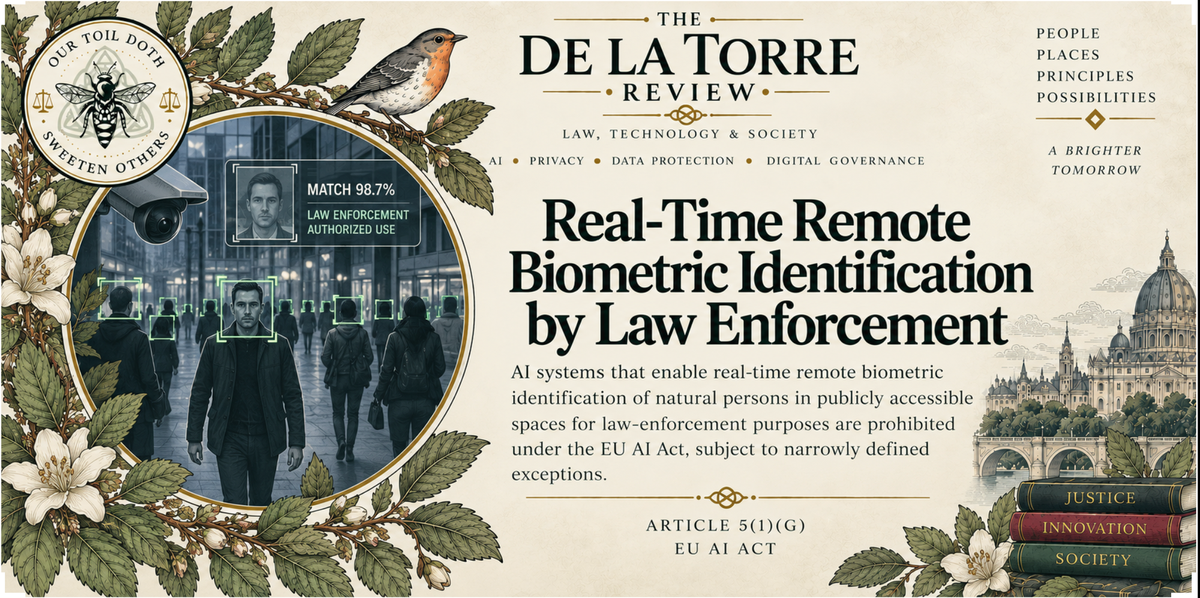
The EU AI Act is a risk-based regulatory framework, but some practices are considered unacceptable and are prohibited outright.
This article examines the prohibition on real-time remote biometric identification, drawing on the Commission’s final July 29, 2025 Guidelines on prohibited artificial intelligence practices. These guidelines superseded the February 2025 draft and provide the detailed examples discussed below.
For an overview of all prohibited practices, see Prohibited AI Practices Under the EU AI Act: Where Europe Draws the Line.
Real-Time Remote Biometric Identification (RBI)
Article 5(1)(h) of the EU AI Act prohibits law-enforcement use of real-time remote biometric identification in publicly accessible spaces, subject to three narrowly defined exceptions. Those exceptions are not automatic permissions: they require national legislation, strict necessity and proportionality, and safeguards for each deployment.
- The prohibition responds to the risks of identifying people as they move through public life. Such monitoring can intrude on privacy, discourage participation in demonstrations and other lawful activities, and produce discriminatory outcomes through inaccurate matches. Real-time identification adds urgency: authorities may act before an error can be checked or corrected.
Commission Guidelines, § 9.1, paras. 293–294; Recital 32.
Three cumulative conditions define the prohibition:
- The practice involves the use of a real-time AI-enabled remote biometric identification system.
- The use takes place in a publicly accessible space.
- The purpose is law enforcement.
When all conditions are met, the use is prohibited unless it falls within an authorized exception and satisfies the accompanying conditions.
Commission Guidelines, § 9.2, paras. 295–296.
Practice Tip: A prohibition on use. Unlike most Article 5 prohibitions, Article 5(1)(h) does not itself prohibit placing these systems on the market or putting them into service. It addresses deployment. Providers still have obligations under the applicable high-risk framework; permitted law-enforcement uses are also subject to that framework.
Commission Guidelines, paras. 289–292.
1 What counts as real time RBI?
1.a Identification from biometric data
Article 3(41) defines remote biometric identification as a system that uses AI to identify natural persons without their active involvement, typically at a distance, by comparing their biometric data with data in a reference database.
- The database supplies the comparison material needed to identify or locate the person being sought.
- Facial recognition is the best-known example, but the concept is broader. Voice, gait, contactless fingerprints and other physical or behavioral biometric characteristics may also be used.
Commission Guidelines, § 9.2.1, paras. 297–302 and 307–309; Article 3(41); Recital 15.
Example: Cameras in a metro station compare passengers’ faces against a police watchlist without the passengers actively participating. This is remote biometric identification. A body-worn camera that identifies participants in a demonstration can also meet the remoteness condition, even though an officer is physically present.
Biometric verification is different. It checks whether a person is who they claim to be, such as comparing a traveler’s face with the photograph in their passport at an e-gate. Commission Guidelines, § 9.2.1, para. 303. The Commission also distinguishes access systems in which people consciously present themselves at a sensor solely to obtain access to a service, device or premises. Commission Guidelines, § 9.2.1, para. 305.
Practice Tip: Notice is not active participation. Signs informing people that cameras are present do not turn passive surveillance into a verification or access-control exercise. Review how people actually interact with the sensor and what the system does with their biometric data.
Commission Guidelines, § 9.2.1, paras. 303–308.
1 b Real time includes short delays
Identification is real-time when capture, comparison and identification occur instantaneously, near-instantaneously or without a significant delay. A short processing delay does not remove the use from the prohibition.
- The Act does not establish a universal number of seconds or minutes. The assessment depends on the circumstances. The Guidelines explain that a delay is generally significant at least when the person is likely to have left the place where the biometric data were captured. The distinction concerns the timing of the processing, not whether a vendor calls the system “live” or “retrospective.”
Example: Screening people as they enter a concert is real-time RBI. Analyzing the recording after the concert to identify someone involved in an incident is post-remote biometric identification. An officer covertly photographing someone and immediately submitting the image for a database search may constitute real-time RBI, depending on the circumstances.
Commission Guidelines, § 9.2.2, paras. 310–312; Article 3(42).
Practice Tip: Adding a brief delay is not a reliable way to avoid the prohibition. Examine the full sequence from capture to identification and whether the system enables an immediate response to the person’s presence.
2 Publicly Accessible Spaces
A publicly accessible space is a physical space accessible to an undetermined number of people. Public or private ownership is irrelevant. Tickets, registration, age restrictions, security checks and capacity limits do not, by themselves, make a space non-public.
- Examples include streets, parks, shops, restaurants, stadiums, concert venues, railway stations and airports. A privately owned shopping center can therefore fall within the prohibition, as can a ticketed sporting event.
Restricted workplaces, prisons and border-control areas generally fall outside this concept. Online spaces are also excluded because the definition concerns physical spaces. A site can contain both public and restricted areas: an airport’s common areas may be publicly accessible while its dedicated border-control area is not.
Practice Tip: Assess the specific area and time of deployment. A park inside a gated development may be publicly accessible during public opening hours but restricted at other times. Ownership and the presence of a gate do not settle the question.
Commission Guidelines, § 9.2.3, paras. 313–318; Article 3(44); Recital 19.
3 Law enforcement purposes
Law enforcement includes preventing, detecting, investigating and prosecuting criminal offenses, executing criminal penalties, and safeguarding against or preventing threats to public security. It is not limited to investigations of crimes that have already occurred.
- The prohibition can apply to private entities exercising public powers under national law or acting on behalf of law-enforcement authorities. The Guidelines explain that acting “on behalf of” involves instructions and supervision by the authority. Examples include transport companies or sports organizations asked to perform security tasks for the police.
Example: A shopping center uses live facial recognition independently to identify known shoplifters. That use falls outside this particular prohibition because it is not for law-enforcement purposes. If the police entrust the shopping center with the same search under their instructions and supervision, the purpose becomes law enforcement. Searching for ordinary shoplifters does not fall within the permitted exceptions.
Commission Guidelines, § 9.2.4, paras. 319–325; § 10.8.
Practice Tip: Identify who determines and supervises the task. Outsourcing a police operation does not avoid Article 5(1)(h). Conversely, a business’s independent security activity is not automatically law enforcement, although data-protection law may still prohibit it.
4 Authorized Exceptions And Safeguards
The exceptions are exhaustive. General crime prevention, convenience, crowd management or an organization’s broad security interests do not provide an additional ground for deployment.
A Member State must adopt legislation authorizing the relevant use and specifying its conditions. It may permit only some of the exceptions or impose stricter restrictions. Without the required national legislation, a qualifying objective alone does not authorize deployment.
Commission Guidelines, § 9.3, paras. 326–328; § 10.4, paras. 411–416.
4.1 Authorized Exceptions
(a) Specific victims and missing persons: The first exception concerns targeted searches for specific victims of abduction, human trafficking or sexual exploitation, as well as searches for missing persons. It does not create a general permission to identify everyone who might belong to a vulnerable population.
Example: Police have concrete indications that a kidnapped child is being transported by car along a particular route. Real-time RBI may assist a targeted search within a defined perimeter and period, provided national law authorizes the use and all safeguards are met.
The purpose of a missing-person search matters. The Guidelines recognize that some searches occur through administrative procedures without a law-enforcement purpose. Those uses fall outside Article 5(1)(h), but remain subject to other rules, including data-protection law. The disappearance of an adult also does not automatically justify police intervention; the circumstances and applicable national law matter.
Commission Guidelines, § 9.3.2, paras. 329–336.
(b) Threats to life or terrorist attacks: The second exception covers prevention of a specific, substantial and imminent threat to life or physical safety, or a genuine and present or genuine and foreseeable threat of a terrorist attack.
- For threats to life or physical safety, the circumstances must be concrete rather than hypothetical, serious enough to meet the substantial-threat condition, and urgent enough to require immediate action. A threat to critical infrastructure may qualify when its disruption would create an imminent danger to people’s lives or physical safety. Protecting property alone is insufficient.
Example: Police receive concrete information that a former student is preparing an imminent armed attack at a specified university. The threat may support the exception, but the use still requires the prescribed legal basis, targeting, proportionality and authorization safeguards.
A terrorist threat likewise requires sufficiently concrete circumstances. A generalized concern about terrorism is not enough. The Commission explains that a targeted operation may involve several people linked to the same planned attack, including circumstances in which authorities do not yet know who will execute the plan.
Practice Tip: Document the particular threat and the connection between the targeted people and that threat. A general threat level does not, by itself, justify continuous biometric screening of public spaces.
Commission Guidelines, § 9.3.3, paras. 337–347; § 10.1, paras. 357–359, Recital 33.
(c) Suspects of specified serious crimes: The third exception concerns locating or identifying a person suspected of having committed an offense, for criminal investigation, prosecution or execution of a criminal penalty. Two requirements apply together: the offense must be listed in Annex II, and it must carry a maximum custodial sentence or detention order of at least four years in the Member State concerned. This is a threshold for the maximum available penalty, not a requirement that the person has received a four-year sentence.
- Annex II lists terrorism; human trafficking; sexual exploitation of children and child pornography; illicit trade in narcotic drugs or psychotropic substances, weapons, munitions or explosives, human organs or tissue, or nuclear or radioactive materials; murder and grievous bodily injury; kidnapping, illegal restraint or hostage-taking; crimes within the International Criminal Court’s jurisdiction; unlawful seizure of aircraft or ships; rape; environmental crime; organized or armed robbery; sabotage; and participation in a criminal organization involved in one or more listed offenses.
- The Guidelines require serious grounds and sufficient evidence linking a suspect to the offense. An outstanding warrant does not automatically qualify a person for real-time RBI: the offense and penalty requirements must still be met.
Example: Police use live facial recognition within a defined neighborhood and weekend to locate a burglary suspect. The use remains prohibited if the offense is not listed in Annex II. Geographic targeting and a short deployment period cannot cure the absence of a qualifying objective.
Commission Guidelines, § 9.3.4, paras. 348–355; § 10.8; Annex II.
Practice Tip: Check the precise offense and its national maximum penalty. Do not treat “wanted person,” “serious crime” or “arrest warrant” as substitutes for the statutory conditions.
4.2 Safeguards for every permitted deployment
(a) Targeting and strict necessity: Permitted use must be directed at confirming the identity of specifically targeted individuals, which can include locating them. The requirement does not invariably mean that their names must already be known. It does require a concrete basis for the search and an appropriate reference database, rather than indiscriminate identification of the public.
- The authority must weigh the seriousness, probability and scale of the harm if the system is not used against the consequences for everyone affected by its use. This includes passersby and people whose biometric data are in the reference database, not only the target. Less intrusive alternatives must be considered.
- Deployment must have necessary and proportionate temporal, geographic and personal limits. An indefinite search, a broad mixed watchlist or routine citywide monitoring for general security does not satisfy those conditions.
Example: Police screen spectators outside a stadium against a watchlist containing serious-crime suspects, people of general intelligence interest and vulnerable individuals, without concrete information linking the targets to the event. The Guidelines treat this as prohibited even though some people on the list might individually fall within an exception.
Commission Guidelines, § 10.1, paras. 356–367; § 10.8.
(b) Impact assessment and registration: Before deployment, the law-enforcement authority must complete a fundamental rights impact assessment under Article 27 and register the system under Article 49. The FRIA should address intended use, affected people, risks, human oversight and mitigation measures, including how errors and complaints will be handled.
- The FRIA complements rather than replaces a required data protection impact assessment. It covers wider effects on rights such as assembly, expression, non-discrimination and the presumption of innocence. Actors supporting the authority must supply the information needed for the assessment.
- In duly justified urgent cases, deployment may begin before EU database registration, provided registration follows without undue delay. The Act does not establish a comparable urgency waiver for completing the FRIA. Law-enforcement registration takes place in the secure, non-public part of the database.
Practice Tip: Keep system assessment and operational approval distinct. A completed FRIA or registration does not authorize every subsequent search; each use requires its own authorization process.
Commission Guidelines, § 10.1.1–10.1.2, paras. 368–377.
(c) Independent authorization and urgency
Each use requires prior authorization from a judicial authority or an independent administrative authority whose decision is binding, in the Member State where the deployment will occur. The request must explain the operation and provide objective evidence or clear indications supporting its necessity, proportionality and limits.
- Installing cameras capable of biometric identification is different from using their identification function. An equipment approval cannot replace authorization for the particular operation.
- In a duly justified situation of urgency, use may begin before authorization if authorization is requested without undue delay and no later than 24 hours after use begins. This is a deadline to request authorization, not an unrestricted 24-hour permission to monitor people. The remaining substantive safeguards continue to apply.
- If the request is rejected, use must stop immediately and the data, results and outputs of that use must be discarded and deleted. The Guidelines distinguish a reference database built specifically for the rejected search from a database independently maintained lawfully for other legitimate purposes; the latter need not automatically be deleted.
Practice Tip: Keep evidence of when deployment started, why prior approval was objectively impossible, when approval was requested and what was deleted if authorization was refused.
Commission Guidelines, § 10.2, paras. 378–405; Article 5(3).
(d) Human checks and regulatory oversight
No decision producing an adverse legal effect may be based solely on the system’s output. A facial-recognition match alone cannot justify an arrest without further checks. Human oversight must be meaningful, with personnel able to understand limitations, identify errors and resist uncritical acceptance of the result.
- The applicable high-risk framework also includes the two-person verification rule for RBI identifications under Article 14(5), subject to the statutory qualification for law-enforcement, migration, border-control or asylum uses where Union or national law considers that requirement disproportionate.
- Each use must be notified to the relevant market surveillance authority and national data-protection authority under national rules. Notification is separate from authorization and excludes sensitive operational data. National authorities report annually to the Commission, which publishes aggregated annual reports.
Commission Guidelines, § 10.2.2.5, paras. 406–408; §§ 10.3 and 10.5–10.6, paras. 409–410 and 419–424; Articles 5(4)–(7) and 14(5).
Uses outside the prohibition and other applicable laws
- Post-remote biometric identification, genuinely participatory verification, use outside publicly accessible physical spaces, and use without a law-enforcement purpose may fall outside Article 5(1)(h). That conclusion does not establish overall lawfulness.
- RBI outside the prohibition generally falls within the Act’s high-risk framework where the Act applies. Biometric verification should be assessed separately: its exclusion from this prohibition does not itself make it high-risk. Retrospective law-enforcement RBI also has specific safeguards under Article 26(10).
- The GDPR, Law Enforcement Directive and applicable national rules continue to govern biometric processing. In particular, a private business’s independent facial-recognition use may fail data-protection requirements even though it lacks the law-enforcement purpose required by Article 5(1)(h). The Guidelines discuss schools, supermarkets and sports venues whose facial-recognition uses were rejected under data-protection law.
Practice Tip: Assess both the live comparison and the source of the reference database. A deployment exception does not authorize unlawful acquisition of biometric data or prohibited untargeted scraping of facial images under Article 5(1)(e).
Commission Guidelines, paras. 291–292; § 10.7, paras. 425–428; Article 5(1)(e).
Practice Takeaway: Article 5(1)(h) prohibits real-time remote biometric identification in public spaces for law enforcement unless a narrowly defined exception is authorized by national law and every deployment safeguard is met. The analysis must establish the system’s function, timing, location and purpose before examining the qualifying objective, targeted individuals, necessity, impact assessments and independent authorization. A useful security tool is not automatically a lawful one.
Other Resources and Recommended Reading
- EU AI Act — Real-Time Remote Biometric Identification — Article 5(1)(h) and (2)–(7) establish the prohibition, exceptions and safeguards. Recitals 32–41 explain necessity, authorization and national implementation / Articles 3(41), 3(42), 3(44) and 3(46) define the relevant systems, spaces and purpose. Annex II lists offenses; see recitals 15 and 19.
- EU AI Act — Oversight and Deployment Safeguards — Articles 14, 26, 27 and 49 address human oversight, deployer duties, fundamental-rights impact assessments and registration. See recital 96 on impact assessments.
- European Commission — Guidelines on Prohibited AI Practices — Explains the prohibition’s elements, permitted objectives, authorization, safeguards and distinctions from post-remote identification. See §§ 9–10, paragraphs 289–428.
- Law Enforcement Directive — Articles 8, 10 and 11 govern lawfulness, sensitive biometric data and automated decisions; recitals 37–38 explain associated safeguards.
- Charter of Fundamental Rights of the European Union — Articles 7, 8, 11, 12, 21, 47, 48 and 52 frame privacy, expression, assembly, equality, judicial protection and proportionate limitations.
Related The De La Torre Review Articles
- Prohibited AI Practices Under the EU AI Act: Where Europe Draws the Line — Introduces Article 5’s scope and the wider prohibited-practices framework. Read the Article.
- Prohibited AI Practices Under the EU AI Act: When AI Persuasion Becomes Prohibited Manipulation — Explains the elements separating persuasion from prohibited harmful manipulation and deception. Read the Article.
- Prohibited AI Practices Under the EU AI Act: When AI Exploits Vulnerability — Examines exploitation linked to age, disability and social or economic circumstances, including the requirements of behavioral distortion and significant harm. Read the Article.
- Prohibited AI Practices Under the EU AI Act: The Social Scoring Ban — Explains when evaluations of behavior or personal characteristics lead to prohibited adverse treatment and how social scoring differs from legitimate assessments. Read the Article.
- Prohibited AI Practices Under the EU AI Act: Limits on Crime Prediction — Examines the prohibition on predicting individual criminal conduct based solely on profiling or personal characteristics and the exception for supporting human assessments grounded in objective, verifiable facts. Read the Article.
- Prohibited AI Practices Under the EU AI Act: Facial-Recognition — Explains the ban on untargeted scraping of facial images from the internet or CCTV footage to create or expand facial-recognition databases. Read the Article.
- Prohibited AI Practices Under the EU AI Act: Emotion Recognition at Work and School — Examines prohibited emotional inferences from biometric data in workplaces and educational institutions, including the medical and safety exceptions. Read the Article.
- Prohibited AI Practices Under the EU AI Act: Inferring Sensitive Characteristics From Biometrics — Explains the prohibition on individual biometric categorization used to infer specified sensitive characteristics, its exclusions and its relationship with data-protection law. Read the Article.
- Prohibited AI Practices Under the EU AI Act: Non Consensual Intimate Material and Child Sexual Abuse — Examines the new Digital Omnibus prohibitions on generating or manipulating non-consensual intimate material or child sexual abuse material, including provider safeguards and deployer responsibilities. Read the Article.



Comments ()