
Prohibited AI Practices Under the EU AI Act: Where Europe Draws the Line
The EU AI Act does more than regulate risky AI—it prohibits certain practices outright. From manipulation and social scoring to biometric surveillance and non-consensual intimate imagery, Article 5 marks the line between regulated AI and AI uses the EU considers unacceptable.
NOTE: The principal source for this analysis is the Commission's final July 29, 2025 Guidelines on prohibited artificial intelligence practices, which superseded the earlier February 2025 draft materials and contain the detailed examples discussed below. Since those Guidelines were issued, however, the Digital Omnibus on AI amended Article 5 to add a new category of prohibited practices: AI systems that generate or manipulate non-consensual sexually explicit or intimate material involving identifiable persons, as well as AI systems that generate or manipulate child sexual abuse material. These new prohibitions apply from December 2, 2026. As of the date of publication of this article, the Commission's prohibited-practices Guidelines had not yet been updated to address this new category.
The EU AI Act is usually described as a risk-based regulatory framework. But at the top of that framework is a category where risk management is no longer enough.
Some AI practices are simply prohibited.
The rationale for drawing that line is rooted in fundamental rights and Union values. As the AI Act explains, alongside AI’s many beneficial uses, the technology can provide “novel and powerful tools” for manipulative, exploitative and social-control practices. Those practices are considered particularly harmful because they can conflict with human dignity, freedom, equality, democracy, the rule of law and fundamental rights, including non-discrimination, data protection, privacy and the rights of the child under the EU Charter of Fundamental Rights. Recital 28.
Article 5 identifies uses of AI that the EU considers to pose an unacceptable risk to fundamental rights and Union values. These include certain forms of manipulation, exploitation, social scoring, predictive policing, facial-image scraping, emotion recognition, biometric categorization, and real-time biometric identification.
The prohibitions originally contained in Article 5 have applied since February 2, 2025. The Digital Omnibus on AI subsequently added new prohibitions covering AI systems that generate or manipulate certain non-consensual intimate material and child sexual abuse material; those new prohibitions will apply from December 2, 2026.
Violations of Article 5 carry the Act's most severe potential administrative fines: up to €35 million or 7% of worldwide annual turnover for the preceding financial year, whichever is higher for undertakings.
The prohibitions generally concern particular practices involving AI systems, rather than technologies in the abstract. The same underlying technology may therefore be prohibited in one context, high-risk but permitted in another, and outside the relevant prohibition altogether in a third.
That distinction is central to understanding Article 5.
Article 5 is considerably more nuanced than a list of forbidden technologies.
The European Commission's 2025 Guidelines on Prohibited Artificial Intelligence Practices provide a detailed roadmap for conducting that analysis. The Guidelines are non-binding—the Court of Justice ultimately controls authoritative interpretation—but they explain how the Commission intends to understand and enforce Article 5. They also emphasize that the examples are illustrative and that application of the prohibitions requires a case-by-case assessment. Commission Guidelines, §§ 1–2, paras. 3–8.
Article 5 frequently turns on how the system is actually used.
The Commission interprets “use” broadly and emphasizes that deployers remain responsible for their deployment choices.
Article 5 Is About Practices, Not Just Products
That makes Article 5 a governance problem as much as a product-classification problem. Organizations need visibility into actual uses throughout the AI lifecycle—not merely vendor descriptions, contractual restrictions or technical capabilities.
Article 5 Also Applies to General-Purpose AI Systems
The Article 5 prohibitions are not limited to AI systems designed for a specific intended purpose. They apply to any AI system, including general-purpose AI systems capable of serving multiple purposes or being integrated into other AI systems. Responsibility follows the respective roles and degree of control of actors across the AI value chain: each operator is expected to take the measures for which it is best positioned to promote the responsible and safe provision and use of the system. Commission Guidelines, § 2.7, para. 39.
The Commission illustrates this with a general-purpose chatbot capable of manipulative or deceptive behavior likely to cause significant harm. Before placing such a system on the market, the provider is expected to take appropriate and proportionate measures to prevent conduct prohibited by Article 5(1)(a). Depending on the system, those measures may include safe and ethical design, technical safeguards, restrictions on use, transparency and user controls, and appropriate instructions. Commission Guidelines, § 2.7, para. 40.
The analysis becomes more nuanced where the prohibition depends on the specific context in which a general-purpose capability is deployed. A system capable of recognizing or inferring emotions, for example, may have lawful applications, while its use in workplaces or educational institutions is prohibited under Article 5(1)(f), subject to the medical and safety exceptions. A provider may not know in advance where that capability will ultimately be deployed. In those circumstances, the Commission contemplates measures such as expressly prohibiting unlawful uses in the terms of use, providing appropriate instructions to deployers, and taking appropriate action when the provider becomes aware of prohibited misuse. Any monitoring for misuse, however, should not become general monitoring of deployers and must comply with Union law. Commission Guidelines, § 2.7, para. 41.
Practice tip: Do not classify an AI system once and assume the analysis is finished. Article 5 frequently turns on how the system is actually deployed, and a use that is lawful in one context may be prohibited in another. Contractual restrictions do not cure a prohibited deployment: if a provider prohibits workplace emotion recognition but an employer nevertheless uses the system to infer workers’ emotions, the employer’s use may still violate Article 5. Commission Guidelines, § 2.3, para. 14.
What Conduct Does Article 5 Regulate?
Article 5 generally prohibits specified practices involving the “placing on the market,” “putting into service,” or “use” of an AI system. The distinction matters because these concepts capture different stages in an AI system’s lifecycle. The prohibition on real-time remote biometric identification in Article 5(1)(h) is narrower in this respect: it applies specifically to the use of those systems. Commission Guidelines, § 2.3, para. 11.
- Placing on the market means the first making available of an AI system on the Union market. “Making available,” in turn, includes supplying an AI system for distribution or use in the EU as part of a commercial activity, whether for payment or free of charge. The method of delivery does not matter: an AI system may be made available through an API, cloud service, direct download, physical copy, or as part of another product. The Commission gives the example of a real-time biometric identification system developed outside the EU and offered to users in one or more Member States through an API or other online interface. Commission Guidelines, § 2.3, para. 12; AI Act, Arts. 3(9)–(10).
- Putting into service concerns the first supply of an AI system to a deployer—or its first use by the provider itself in the EU—for its intended purpose. Importantly, this captures in-house development and deployment, not merely systems purchased from third-party vendors. The Guidelines illustrate the point with a public authority that develops its own scoring system and deploys it to predict fraud risk among household-allowance beneficiaries. Commission Guidelines, § 2.3, para. 13; AI Act, Arts. 3(11)–(12).
- Finally, although the AI Act does not separately define “use,” the Commission interprets it broadly. It encompasses deployment throughout the system’s lifecycle after the system has been placed on the market or put into service, including integration into services, organizational processes, infrastructure, or more complex systems. Most importantly, for Article 5 purposes, “use” can include misuse—even misuse that was not reasonably foreseeable by the provider. Commission Guidelines, § 2.3, para. 14.
That last point has an important consequence: a provider’s contractual restrictions do not necessarily protect a deployer that uses an AI system for a prohibited purpose. The Commission gives the example of an employer using AI to infer workers’ emotions. That use may violate Article 5(1)(f) even if the provider expressly prohibited workplace emotion recognition in its terms of use. The deployer remains responsible for the lawfulness of its own use. Commission Guidelines, § 2.3, para. 14.
Who Is Responsible for a Prohibited AI Practice?
The AI Act recognizes several categories of operators, but the Commission's Article 5 Guidelines focus principally on providers and deployers. For a fuller discussion of the different operator roles and how they can change or overlap across the AI value chain, see Who Is Regulated Under the EU AI Act? Understanding Providers, Deployers, Importers, Distributors and Other Operators.
For present purposes, the important distinction is one of control and responsibility. Providers are responsible for ensuring that the AI systems they place on the market or put into service comply with applicable requirements, while deployers are responsible for the decisions they make about whether and how an AI system is actually used. Commission Guidelines, § 2.4, paras. 16–17.
The Commission also clarifies who counts as the deployer when people operate AI on an organization's behalf. Where a legal person—such as a law-enforcement authority or private security company—controls the deployment, individual employees acting within its procedures and under its control ordinarily are not themselves deployers. The organization likewise remains the deployer when contractors or external personnel operate the system on its behalf and under its responsibility and control. Commission Guidelines, § 2.4, para. 18.
Providers and deployers have different responsibilities depending on their respective control over the system's design, development and actual use.
For deployers, the rule is straightforward: an AI system may not be used in a manner prohibited by Article 5, including by circumventing safeguards implemented by its provider. But responsibility does not rest exclusively with the deployer. Providers should not place on the market or put into service AI systems—including general-purpose systems—that are reasonably likely to behave, or to be directly used, in a manner prohibited by Article 5. Where harmful behavior or misuse is reasonably foreseeable, providers are expected to adopt effective, verifiable, feasible and proportionate safeguards, as well as contractual restrictions, appropriate instructions and provisions for human oversight. Commission Guidelines, § 2.7, para. 40.
Because compliance is continuous throughout the AI lifecycle, the Commission calls for responsibility to be interpreted proportionately, taking into account which actor in the value chain is best positioned to prevent or mitigate the prohibited practice. Commission Guidelines, § 2.4, para. 20.
Ongoing monitoring and updates to AI systems are required to ensure that an AI system remains compliant throughout its lifecycle and that it does not result in a practice prohibited under Article 5 of the AI Act.
The Nine Prohibited AI Practices
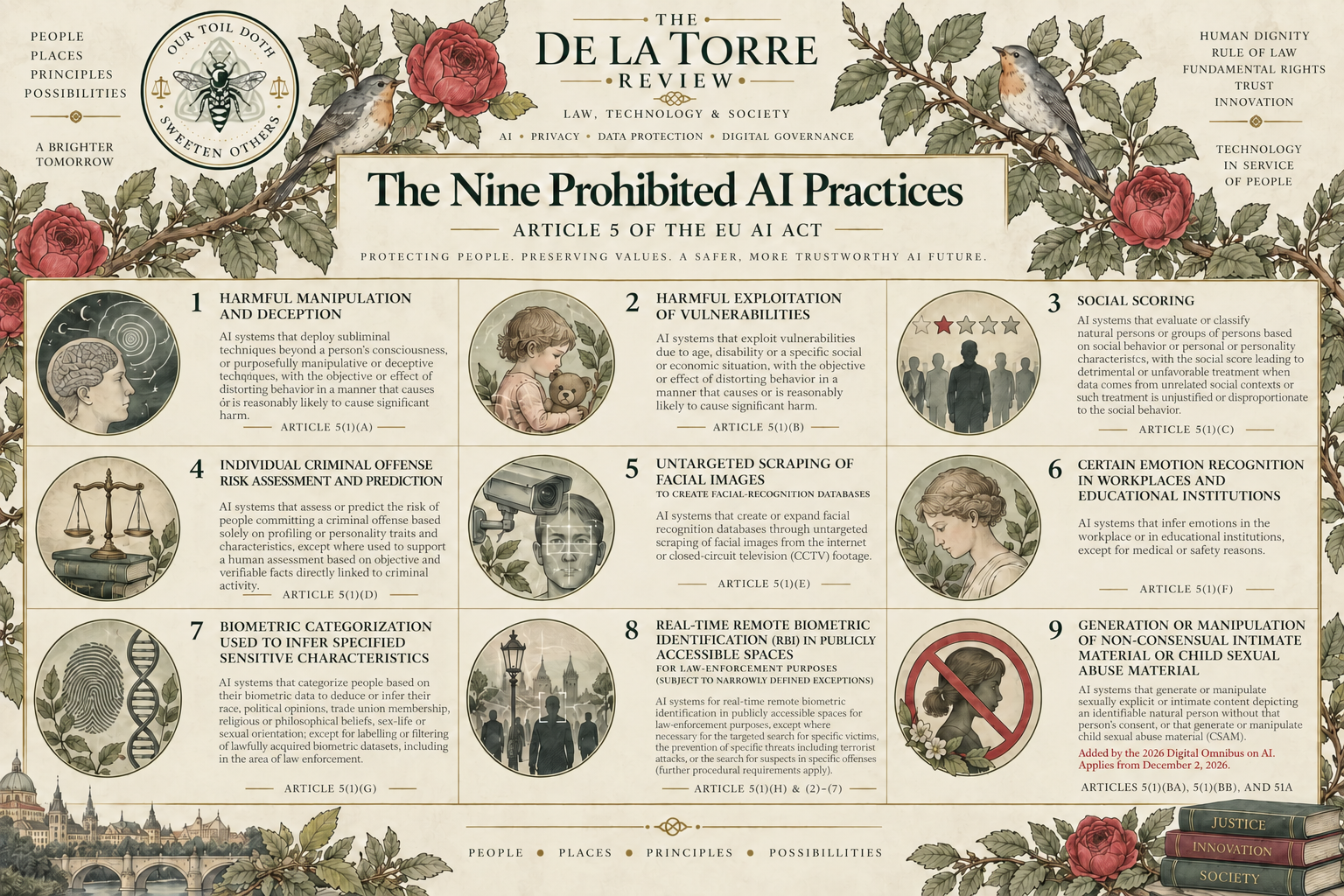
Article 5 addresses nine principal categories:
- Harmful manipulation and deception: AI systems that deploy subliminal techniques beyond a person’s consciousness or purposefully manipulative or deceptive techniques, with the objective or with the effect of distorting behavior, in a manner that causes or is reasonably likely to cause significant harm (Article 5(1)(a)) For more on this, see Prohibited AI Practices Under the EU AI Act: When AI Persuasion Becomes Prohibited Manipulation
- Harmful exploitation of vulnerabilities: AI systems that exploit vulnerabilities due to age, disability or a specific social or economic situation, with the objective or with the effect of distorting behavior, causing or reasonably likely to cause significant harm (Article 5(1)(b)) For more on this, see Prohibited AI Practices Under the EU AI Act: When AI Exploits Vulnerability.
- Social scoring: AI systems that evaluate or classify natural persons
or groups of persons based on social behavior or personal or personality characteristics, with the social score leading to detrimental or unfavorable treatment when data comes from unrelated social contexts or such treatment is unjustified or disproportionate to the social behavior. (Article 5(1)(c)) For more on this, see Prohibited AI Practices Under the EU AI Act: The Social Scoring Ban. - Individual criminal offense risk assessment and prediction: AI systems that assess or predict the risk of people committing a criminal offense based solely on profiling or personality traits and characteristics; except to support a human assessment based on objective and verifiable facts directly linked to a criminal activity. (Article 5(1)(d)) For more on this, see Prohibited AI Practices Under the EU AI Act: Limits on Crime Prediction.
- Untargeted scraping of facial images to create facial-recognition databases: AI systems that create or expand facial recognition databases through untargeted scraping of facial images from the internet or closed-circuit television (‘CCTV’) footage. (Article 5(1)(e)) For more on this, see Prohibited AI Practices Under the EU AI Act: Facial-Recognition.
- Emotion recognition in workplaces and educational institutions: AI systems that infer emotions at the workplace or
in educational institutions; except for medical or safety reasons. (Article 5(1)(f)) For more on this, see Prohibited AI Practices Under the EU AI Act: Emotion Recognition At Work and School. - Biometric categorization used to infer specified sensitive characteristics: AI systems that categorize people based on their biometric data to deduce or infer their race, political opinions, trade union membership, religious or philosophical beliefs, sex-life or sexual orientation; except for labelling or filtering of lawfully acquired biometric datasets, including in the area of law enforcement. (Article 5(1)(g)) For more on this, see Prohibited AI Practices Under the EU AI Act: Inferring Sensitive Characteristics From Biometrics
- Real-time remote biometric identification (RBI) in publicly accessible spaces for law-enforcement purposes (subject to narrowly defined exceptions): AI systems for real-time remote biometric identification in publicly accessible spaces for the purposes of law enforcement; except if necessary for the targeted search of specific victims, the prevention of specific threats including terrorist attacks, or the search for suspects of specific offenses (further procedural requirements apply.) (Article 5(1)(h) & (2)-(7)) For more on this, see Prohibited AI Practices Under the EU AI Act: Real-Time Remote Biometric Identification.
- Generation or manipulation of non-consensual intimate material or child sexual abuse material: Article 5 prohibits AI systems that generate or manipulate sexually explicit or intimate content depicting an identifiable natural person without that person’s consent, or that generate or manipulate child sexual abuse material (CSAM). This prohibition was added to Article 5 by the 2026 Digital Omnibus on AI and applies from December 2, 2026. (Article 5(1)(ba) and (bb) and 51(a)) For more on this, see Prohibited AI Practices Under the EU AI Act: Non Consensual Intimate Material and Child Sexual Abuse.
Commission Guidelines, § 2.1, para. 9. (original eight categories.)
Those categories look broad. Their statutory conditions often are not.
That matters because the Commission expressly cautions that Article 5 should be interpreted narrowly, particularly given the seriousness of the prohibitions and the penalties attached to them. Commission Guidelines, § 2.9.2, paras. 55–57.
AI prohibitions should be interpreted narrowly
The list of prohibited AI practices is not exhaustive. AI practices can be prohibited also under other EU laws, in particular under data protection laws, non-discrimination laws, consumer protection laws or competition laws. Recital 45.
Prohibited Does Not Mean “High-Risk”
One of the most important distinctions in the AI Act is between an AI system that is prohibited and one that is high-risk. They are not synonyms.
- A prohibited practice crosses Article 5's unacceptable-risk threshold and generally cannot be carried out.
- A high-risk system can be deployed, but only subject to the Act's extensive compliance framework.
The boundary can depend on relatively small factual differences.
- An emotion-recognition system used by an employer to infer workers' emotions may be prohibited.
- An emotion-recognition system outside the Article 5 prohibition may instead be high-risk.
- A criminal-risk system predicting offending solely from personality characteristics may be prohibited.
- An AI system supporting a human investigation already grounded in objective evidence may instead be high-risk.
- A social-scoring system using unrelated information to impose disproportionate consequences may be prohibited.
- A properly designed creditworthiness system using relevant information for a legitimate purpose may instead be high-risk.
The Commission expressly recognizes this relationship between Articles 5 and 6. Commission Guidelines, § 2.6, paras. 37–38.
Falling Outside Article 5 Does Not Mean the Practice Is Lawful
There is one final trap.
The Article 5 prohibitions are not an exhaustive statement of what organizations may not do with AI.
An AI practice that falls outside Article 5 may still violate:
- the GDPR;
- the Law Enforcement Directive;
- consumer-protection law;
- employment law;
- anti-discrimination law;
- product-safety rules;
- other provisions of the AI Act; or
- national law.
The Commission specifically emphasizes that compliance with Article 5 is not sufficient to establish compliance with other Union legislation. Commission Guidelines, § 2.8, paras. 43–46.
For example, workplace emotion recognition used for a qualifying safety purpose might escape the Article 5(1)(f) prohibition while remaining subject to data-protection, employment and workplace-safety requirements.
So the correct conclusion is never simply:
“Not prohibited, therefore permitted.”
It is:
“Not prohibited under Article 5. Now continue the classification and legal analysis.”
A Practical Article 5 Screening Test
For organizations building an AI inventory, Article 5 can be translated into a relatively practical screening exercise:
- Does the activity involve an “AI system” within Article 3(1)?
- Is the activity within the territorial and material scope of the AI Act?
- What is the system actually being used to do—not merely what the vendor call it?
- Could the use involve manipulation, exploitation, social scoring, individual crime prediction, facial-image scraping, emotion recognition, sensitive biometric categorization or real-time RBI?
- Are all of the elements of the relevant Article 5 prohibition satisfied?
- Does the provision contain an exception, and are all conditions for that exception satisfied?
- If Article 5 does not prohibit the use, does it instead qualify as high-risk under Article 6 and Annex III?
- What other EU or national laws independently regulate the activity?
And there is an important governance implication: a possible Article 5 issue should generally trigger escalation, not an automatic conclusion that the system is unlawful.
The Commission repeatedly emphasizes contextual, case-by-case analysis. At the same time, because Article 5 represents the AI Act's hardest regulatory boundary, organizations should be able to document why a potentially problematic use does—or does not—cross the prohibition's elements.
The Bottom Line
Article 5 is where the EU AI Act stops managing risk and starts drawing lines.
But those lines are more precise than headlines such as “the EU bans emotion recognition,” “the EU bans predictive policing,” or “the EU bans social scoring” suggest.
The better way to understand Article 5 is as a series of fact-specific legal tests.
- What information does the AI use?
- What does it infer?
- Who is affected?
- In what context?
- How does it influence a decision?
- What consequence follows?
- Is the treatment related and proportionate?
- Is a human assessment grounded in objective facts?
- Is biometric identification targeted or indiscriminate?
- And does a statutory exception actually apply?
Those questions determine whether an AI deployment is merely regulated—or whether the EU has decided that the practice should not occur at all.
Practice takeaway: Article 5 should therefore sit near the beginning of any EU AI Act classification workflow. Once a technology qualifies as an AI system and falls within the Act's scope, organizations should screen for prohibited practices before asking whether the system is high-risk. If Article 5 applies and no exception is available, there is no high-risk compliance program that cures the problem: the practice itself is prohibited.
Other Resources and Recommended Reading
- EU AI Act — Prohibited Practices and Scope — The statutory framework: Articles 2, 3 and 5; recitals 28–45. Articles 99 and 113 address penalties and application dates.
- European Commission — Guidelines on Prohibited AI Practices — Explains the original prohibitions, their scope and the responsibilities of providers and deployers. See §§ 1–2, paragraphs 3–57.
- Digital Omnibus on AI — Regulation (EU) 2026/1744 — The amending law adding the intimate-material and child-abuse-material prohibitions. See Article 1(7) and (40), recitals 10–16 and Article 4; compare AI Act Article 5(1)(ba) and (bb), (1a) and (1b).
- Charter of Fundamental Rights of the European Union — Articles 1, 7, 8, 21 and 24 explain the protections for dignity, privacy, personal data, equality and children underlying the prohibitions.
- General Data Protection Regulation — Articles 5, 6, 9 and 22 remain relevant to personal-data processing and automated decisions. See recitals 39, 51 and 71.
- Law Enforcement Directive — Articles 4, 8, 10 and 11 govern law-enforcement data processing, sensitive data and automated decisions; recital 38 addresses automated decision-making and profiling.
Related The De La Torre Review Articles
- Prohibited AI Practices Under the EU AI Act: When AI Persuasion Becomes Prohibited Manipulation — Explains the elements separating persuasion from prohibited harmful manipulation and deception. Read the Article.
- Prohibited AI Practices Under the EU AI Act: When AI Exploits Vulnerability — Examines exploitation linked to age, disability and social or economic circumstances, including the requirements of behavioral distortion and significant harm. Read the Article.
- Prohibited AI Practices Under the EU AI Act: The Social Scoring Ban — Explains when evaluations of behavior or personal characteristics lead to prohibited adverse treatment and how social scoring differs from legitimate assessments. Read the Article.
- Prohibited AI Practices Under the EU AI Act: Limits on Crime Prediction — Examines the prohibition on predicting individual criminal conduct based solely on profiling or personal characteristics and the exception for supporting human assessments grounded in objective, verifiable facts. Read the Article.
- Prohibited AI Practices Under the EU AI Act: Facial-Recognition — Explains the ban on untargeted scraping of facial images from the internet or CCTV footage to create or expand facial-recognition databases. Read the Article.
- Prohibited AI Practices Under the EU AI Act: Emotion Recognition at Work and School — Examines prohibited emotional inferences from biometric data in workplaces and educational institutions, including the medical and safety exceptions. Read the Article.
- Prohibited AI Practices Under the EU AI Act: Inferring Sensitive Characteristics From Biometrics — Explains the prohibition on individual biometric categorization used to infer specified sensitive characteristics, its exclusions and its relationship with data-protection law. Read the Article.
- Prohibited AI Practices Under the EU AI Act: Real-Time Remote Biometric Identification — Explains the conditions, exceptions and safeguards governing real-time biometric identification in publicly accessible spaces for law-enforcement purposes. Read the Article.
- Prohibited AI Practices Under the EU AI Act: Non Consensual Intimate Material and Child Sexual Abuse — Examines the new Digital Omnibus prohibitions on generating or manipulating non-consensual intimate material or child sexual abuse material, including provider safeguards and deployer responsibilities. Read the Article.



Comments ()