
Prohibited AI Practices Under the EU AI Act: Facial-Recognition
The EU AI Act prohibits AI-enabled untargeted scraping of facial images to create recognition databases. Explore the limits of the ban, targeted searches and why public availability does not mean consent.
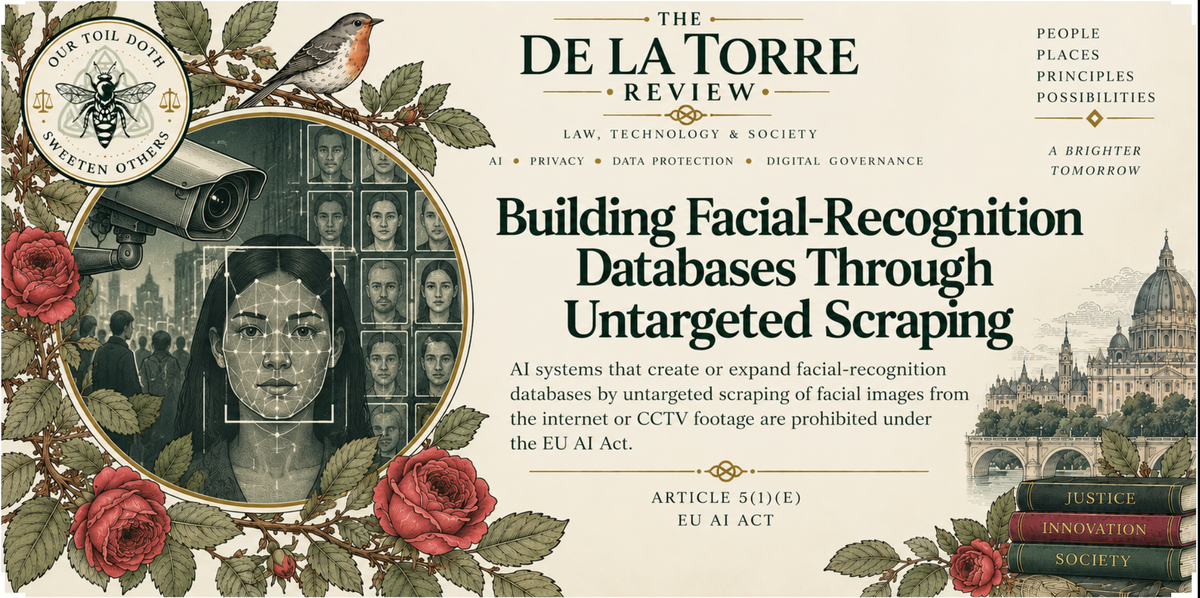
The EU AI Act is a risk-based regulatory framework, but some practices are considered unacceptable and are prohibited outright.
This article examines the prohibition on building facial-recognition databases, drawing on the Commission’s final July 29, 2025 Guidelines on prohibited artificial intelligence practices. These guidelines superseded the February 2025 draft and provide the detailed examples discussed below.
For an overview of all prohibited practices, see Prohibited AI Practices Under the EU AI Act: Where Europe Draws the Line.
The Facial Recognition Prohibition
Article 5(1)(e) prohibits placing on the market, putting into service for this specific purpose, or using AI systems to create or expand facial-recognition databases through the untargeted scraping of facial images from the internet or CCTV footage.
The prohibition responds to the serious interference with privacy, data protection and the ability to remain anonymous created by the indiscriminate collection of facial images. Recital 43 connects the practice to a feeling of mass surveillance and the risk of gross violations of fundamental rights.
Four cumulative conditions must be satisfied:
- The practice must involve the "placing on the market", "putting into service" or "use" of an AI system (see, Prohibited AI Practices Under the EU AI Act: Where Europe Draws the Line sub-title "What Conduct Does Article 5 Regulate?").
- The purpose must be to create or expand a facial-recognition database.
- The database must be populated through AI-enabled untargeted scraping.
- The facial images must come from the internet or CCTV footage.
The prohibition applies to providers and deployers within their respective responsibilities.
Commission Guidelines, §§ 6–6.2, paras. 222–225.
Scraping without AI: The prohibition does not apply where no AI system is involved in the scraping. Other EU or national laws may still regulate or prohibit the collection.
Dividing mass collection into smaller searches does not avoid the prohibition. Organizations cannot evade Article 5(1)(e) by dividing indiscriminate collection into a series of nominally targeted searches. A company might, for example, scrape facial images one geographic area, demographic group or category at a time. If those searches cumulatively produce the same result as untargeted mass scraping, the Commission considers the practice prohibited. The same principle applies to systems that combine targeted and untargeted searches. The targeted component does not legitimize the untargeted collection. Commission Guidelines, § 6.2.2, paras. 230–231.
Practice Tip: Evaluate the collection program as a whole. Repeatedly scraping smaller groups may still constitute untargeted scraping when the combined result is functionally equivalent to indiscriminate collection.
Existing databases: Article 5(1)(e) prohibits using AI-enabled untargeted scraping to create or expand facial-recognition databases. A database constructed before the prohibition became applicable is not prohibited merely because it continues to exist, provided it is not further expanded through prohibited scraping. Its retention and use must nevertheless comply with the GDPR, the Law Enforcement Directive or other applicable data-protection rules. Commission Guidelines, § 6.3, para. 236.
1. Creating Or Expanding a Facial-Recognition Database
A database is an organized collection of data or information designed for rapid computer search and retrieval.
A facial-recognition database allows a human face captured in a photograph or video frame to be compared against stored faces to determine whether there is a likely match. The database may be temporary or permanent; centralized or decentralized; or designed principally for facial recognition or merely capable of being used for that purpose.
Commission Guidelines, § 6.2.1, para. 226.
Practice Tip: Focus on the database’s capabilities, not its label. A collection does not need to be called a “facial-recognition database” or exist solely for identification. It may fall within Article 5(1)(e) if stored facial images can be searched and compared to identify individuals.
Other biometric data: The provision concerns facial images. Untargeted scraping of other biometric information, such as voice samples, falls outside Article 5(1)(e), although it may violate data-protection law or other provisions.
Databases not used to recognize people: A facial-image dataset used to train or test an AI model falls outside Article 5(1)(e) when it is not capable of being used to identify the people depicted. Similarly, collecting facial images to train a system that generates images of fictitious people does not create a facial-recognition database if the system cannot recognize real individuals. Such systems may nevertheless be subject to Article 50 transparency obligations. Commission Guidelines, § 6.3, paras. 234–235.
Practice Tip: A dataset containing faces is not automatically a facial-recognition database. The decisive question is whether it can be used to match a face against stored images and identify a real person.
2. AI Enabled Untargeted scraping
“Scraping” generally means using web crawlers, bots or other automated tools to extract data or content from sources such as websites; social-media platforms; online videos; publicly accessible image repositories; or CCTV systems.
The extracted information is then collected and used for another purpose—in this case, creating or expanding a facial-recognition database.
Commission Guidelines, § 6.2.2, para. 227.
Untargeted: The Commission describes untargeted scraping as operating like a “vacuum cleaner”: it absorbs as much data and content as possible without focusing on specifically identified individuals or a defined group.
- The central characteristic is indiscriminate harvesting. The system searches broadly for images containing human faces rather than looking for the face of a particular person or members of a genuinely predefined group. Commission Guidelines, § 6.2.2, para. 228.
Practice Tip: Technical restrictions on crawling do not determine whether scraping is targeted. The relevant question is whether the system searches for identified individuals or a defined group—or indiscriminately collects facial images wherever it is permitted to crawl.
- Scraping becomes targeted when the tool is instructed to collect images or videos of a specifically identified person; or a predefined group of people. Commission Guidelines, § 6.2.2, paras. 229–230.
Example: Crawlers search social-media services for images of trafficking victims posted by human traffickers. Because the search focuses on an identified class of victims rather than indiscriminately collecting every available face, it is targeted and therefore outside Article 5(1)(e).
3. Images From The Internet or CCTV footage.
Internet Images:
A person’s decision to publish a photograph does not constitute consent to automated collection of the image; extraction of facial features; transformation of those features into a biometric template; inclusion in a facial-recognition database; or future identification by unknown users.
- A scraper remains untargeted even if it respects technical opt-out mechanisms such as
robots.txt. Compliance with a website’s crawling instructions may limit where the system searches, but it does not transform indiscriminate harvesting into targeted collection.
Commission Guidelines, § 6.2.3, para. 232.
Practice Tip: Do not treat public availability as permission for biometric reuse. A photograph posted online may be visible to the public without the person consenting to its collection, biometric conversion and inclusion in a facial-recognition database.
CCTV footage: Relevant footage may come from surveillance cameras operating in airports; streets; parks; transportation facilities; commercial spaces; or other monitored locations.
- The prohibition concerns the source and method used to populate the database. It is not limited to photographs collected from websites or social-media services.
Commission Guidelines, § 6.2.3, para. 232.
NOTE ON APPLICABILITY OF OTHER LAWS: The concrete act of identifying someone through biometric comparison is governed by other provisions of the AI Act and other EU laws. Depending on the circumstances, the use may implicate the prohibition on real-time remote biometric identification by law enforcement; high-risk AI requirements; GDPR rules governing biometric data; the Law Enforcement Directive; or national laws governing surveillance and identification. A database may therefore have been created without violating Article 5(1)(e) while a particular use remains unlawful—or vice versa. Commission Guidelines, § 6.3, para. 237.
Practice Tip: Analyze database creation and biometric identification separately. Article 5(1)(e) asks how the database was populated; other provisions determine whether and how the database may be used to identify people.
NOTE ON DATA PROTECTION LAW IMPLICATIONS: The Commission takes a particularly strong position on the data-protection implications of the prohibited practice. According to the Guidelines, untargeted scraping of internet or CCTV material to create or expand a facial-recognition database constitutes personal-data processing for which no legal basis can be relied upon under the GDPR; the EU Data Protection Regulation governing EU institutions; or the Law Enforcement Directive. Commission Guidelines, § 6.4, para. 238.
Practice Takeaway: Article 5(1)(e) does not prohibit facial-recognition technology in the abstract. It prohibits using AI to indiscriminately harvest facial images from the internet or CCTV footage to create or expand a database capable of recognizing real people. The analysis turns on the database’s capabilities, the source of the images and, above all, whether the collection is genuinely targeted or functionally equivalent to mass scraping.
Other Resources and Recommended Reading
- EU AI Act — Untargeted Facial-Image Scraping — Article 5(1)(e) concerns creating or expanding facial-recognition databases through untargeted scraping. Recital 43 explains the mass-surveillance and fundamental-rights concerns.
- European Commission — Guidelines on Prohibited AI Practices — Explains database capabilities, targeted and untargeted collection, internet and CCTV sources, and data-protection implications. See § 6, paragraphs 222–238.
- General Data Protection Regulation — Articles 4(14), 5, 6 and 9 address biometric data, processing principles, legal bases and special categories. See recital 51.
- Law Enforcement Directive — Articles 4, 8 and 10 govern law-enforcement processing and sensitive biometric data; recital 37 explains the protection of sensitive data.
- EU Institutions Data Protection Regulation — Regulation (EU) 2018/1725, Articles 4, 5 and 10, addresses processing by EU institutions. Recital 29 concerns special categories of data.
Related The De La Torre Review Articles
- Prohibited AI Practices Under the EU AI Act: Where Europe Draws the Line — Places untargeted facial-image scraping within the wider list of prohibited practices. Read the Article.
- Prohibited AI Practices Under the EU AI Act: When AI Persuasion Becomes Prohibited Manipulation — Explains the elements separating persuasion from prohibited harmful manipulation and deception. Read the Article.
- Prohibited AI Practices Under the EU AI Act: When AI Exploits Vulnerability — Examines exploitation linked to age, disability and social or economic circumstances, including the requirements of behavioral distortion and significant harm. Read the Article.
- Prohibited AI Practices Under the EU AI Act: The Social Scoring Ban — Explains when evaluations of behavior or personal characteristics lead to prohibited adverse treatment and how social scoring differs from legitimate assessments. Read the Article.
- Prohibited AI Practices Under the EU AI Act: Limits on Crime Prediction — Examines the prohibition on predicting individual criminal conduct based solely on profiling or personal characteristics and the exception for supporting human assessments grounded in objective, verifiable facts. Read the Article.
- Prohibited AI Practices Under the EU AI Act: Emotion Recognition at Work and School — Examines prohibited emotional inferences from biometric data in workplaces and educational institutions, including the medical and safety exceptions. Read the Article.
- Prohibited AI Practices Under the EU AI Act: Inferring Sensitive Characteristics From Biometrics — Explains the prohibition on individual biometric categorization used to infer specified sensitive characteristics, its exclusions and its relationship with data-protection law. Read the Article.
- Prohibited AI Practices Under the EU AI Act: Real-Time Remote Biometric Identification — Explains the conditions, exceptions and safeguards governing real-time biometric identification in publicly accessible spaces for law-enforcement purposes. Read the Article.
- Prohibited AI Practices Under the EU AI Act: Non Consensual Intimate Material and Child Sexual Abuse — Examines the new Digital Omnibus prohibitions on generating or manipulating non-consensual intimate material or child sexual abuse material, including provider safeguards and deployer responsibilities. Read the Article.



Comments ()