
Mississippi’s Definition of Artificial Intelligence
Mississippi HB 1723 defines artificial intelligence as a machine-based system operating toward human-defined objectives. This article breaks down the definition, explains its key elements, and compares Mississippi’s approach with California’s broader definition of AI.
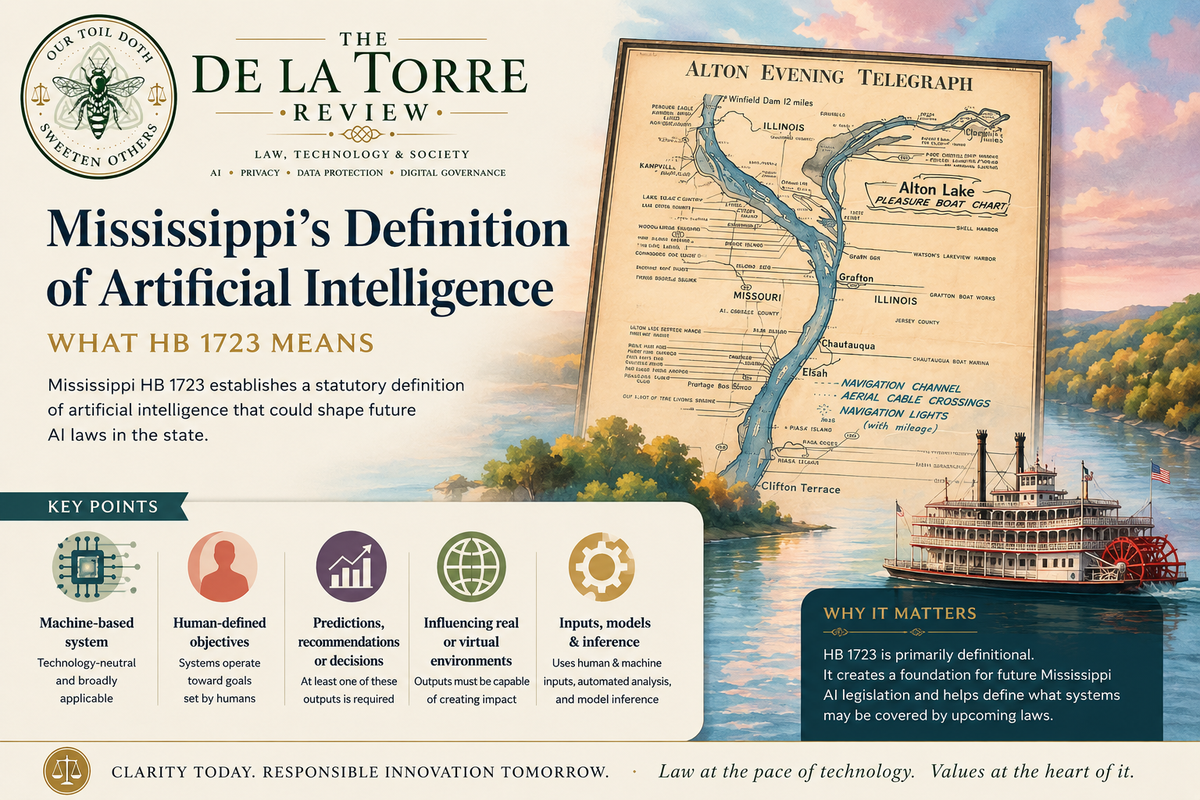
Key Takeaways: (1) Mississippi has established a statutory definition of artificial intelligence. (2) AI is defined as a machine-based system operating toward human-defined objectives. (3) The system must be capable of making predictions, recommendations or decisions influencing real or virtual environments. (4) The definition expressly addresses inputs, automated analysis, models and model inference. (5) The definition is technology-neutral and is not expressly limited to generative AI. (6) HB 1723 is primarily definitional rather than regulatory, but the definition may provide a foundation for future Mississippi AI legislation
In Force: July 1, 2026
Mississippi HB 1723 (codified as Miss. Code Ann. § 1-3-85) defines artificial intelligence as a:
“machine-based system that can, for a given set of human-defined objectives, make predictions, recommendations or decisions influencing real or virtual environments.”
The definition adds that AI systems use machine- and human-based inputs to perceive real and virtual environments, abstract those perceptions into models through automated analysis, and use model inference to formulate options for information or action.
HB 1723 is primarily definitional. It does not establish substantive obligations for AI developers or deployers. Instead, it creates a statutory definition that may serve as a foundation for other Mississippi laws that regulate artificial intelligence.
For organizations developing or deploying AI systems in Mississippi, the practical significance will depend on if and how this definition is incorporated into other statutory requirements.
How Mississippi Defines Artificial Intelligence
The definition has four core elements:
- Machine-based system. The definition is technology-neutral and is not limited to generative AI or any particular AI technique.
- Human-defined objectives. The system operates toward objectives established by humans.
- Predictions, recommendations or decisions. The system must be capable of producing at least one of these types of outputs.
- Influence on real or virtual environments. The system’s outputs must be capable of affecting physical or digital environments.
The statute further explains that AI systems use human- and machine-based inputs, transform perceptions into models through automated analysis, and use model inference to formulate options for information or action.
How Does Mississippi’s Definition Compare with California’s?
Mississippi and California take somewhat different approaches.
California defines AI as an engineered or machine-based system that varies in its level of autonomy and that, for explicit or implicit objectives, infers from the input it receives how to generate outputs that can influence physical or virtual environments. See: California Defines AI: AB 2885 and Its Impact
The key differences are:
- Objectives: Mississippi requires human-defined objectives; California refers more broadly to explicit or implicit objectives.
- Autonomy: California expressly recognizes that AI systems vary in their level of autonomy. Mississippi does not.
- Outputs: California uses the broader concept of outputs. Mississippi specifically identifies predictions, recommendations, or decisions.
- Inference: Both definitions incorporate inference, but Mississippi provides more detail about the process, referring to perception, automated analysis, models, and model inference.
- System: California covers an “engineered or machine-based system,” while Mississippi uses only “machine-based system.”
Mississippi’s definition is more descriptive of the technical process by which an AI system operates, while California’s definition is broader and more technology-neutral in describing objectives, autonomy, and outputs.
The differences between the Mississippi and the California definitions of AI illustrate an emerging challenge in state AI regulation: the same system may need to be analyzed under different statutory definitions of AI depending on the state law that applies.
Conclusion
Mississippi's definition of artificial intelligence focuses on how an AI system operates: it receives human- or machine-based inputs, analyzes perceptions through automated processes, uses models and inference, and produces predictions, recommendations or decisions capable of influencing real or virtual environments.
HB 1723 is short, but its significance may extend beyond its length. Establishing a statutory definition gives Mississippi a common legal starting point for determining what qualifies as artificial intelligence when that term is used in future legislation.
Additional Resources
Mississippi
- Mississippi HB 1723 (2026) — Establishes Mississippi’s statutory definition of “artificial intelligence” and provides for its codification in Chapter 3, Title 1 of the Mississippi Code of 1972.
Related Articles
- California Defines AI: AB 2885 and Its Impact, The de la Torre Review — Examines California’s technology-neutral definition of AI under AB 2885, including its treatment of autonomy, objectives, inference, inputs, and outputs. It provides a useful comparison with Mississippi’s definition.


Comments ()