
Tele2 Sverige and Watson and Others: When Fighting Crime Cannot Justify Retaining Everyone’s Communications Data
In Tele2 Sverige and Watson and Others, the CJEU held that fighting serious crime cannot justify retaining everyone’s traffic and location data. It prohibited general and indiscriminate retention and required limits, independent review, and effective safeguards for government access to retained data
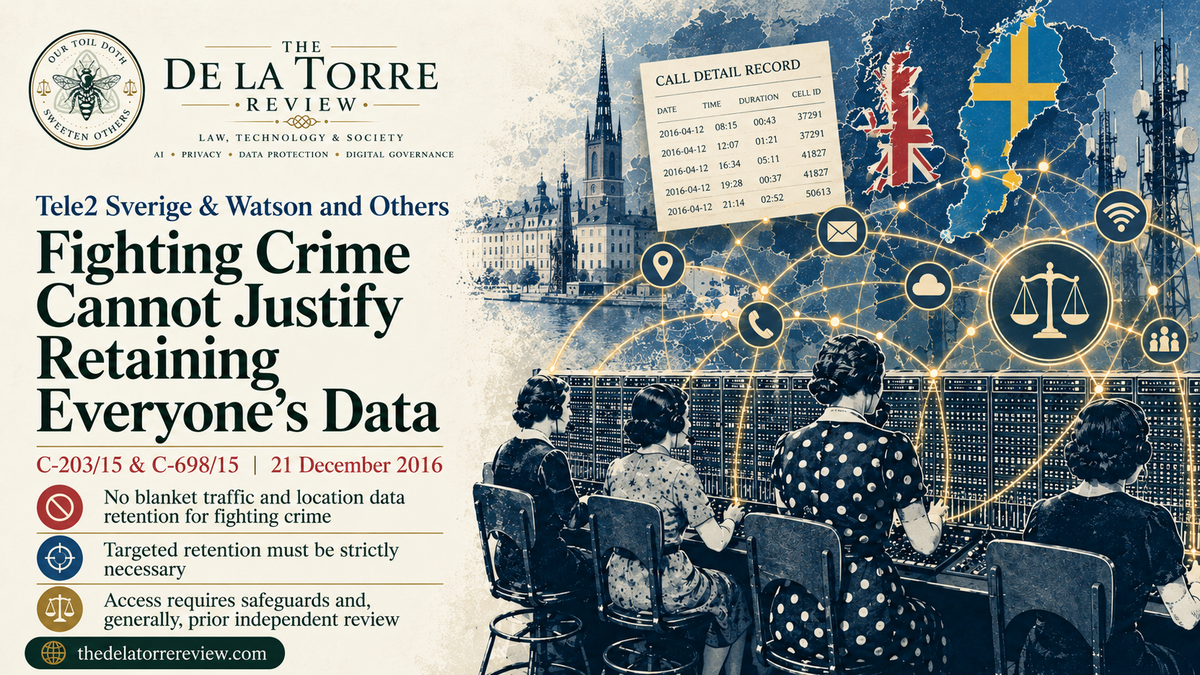
Joined Cases C-203/15 and C-698/15 | Tele2 Sverige AB v Post-och telestyrelsen and Secretary of State for the Home Department v Tom Watson and Others | Court of Justice of the European Union | Grand Chamber | 21 December 2016
Practice Takeaways: ① Fighting crime cannot justify general and indiscriminate retention of all traffic and location data relating to everyone’s electronic communications. ② Targeted retention for fighting serious crime requires objective limits on the data, communications, people, and retention period. ③ Government access needs its own substantive and procedural safeguards, including, as a general rule, prior judicial or independent administrative review. ④ Metadata can reveal an intimate picture of private life even without communications content. ⑤ Notice, security, deletion, and independent supervision help make protection effective.
Can a government require communications providers to keep everyone’s communications metadata so that investigators can consult it later? Does limiting access to that database make the underlying retention lawful?
In Tele2 Sverige and Watson and Others, the Court addressed those questions after Digital Rights Ireland invalidated the EU Data Retention Directive. It held that national legislation requiring general and indiscriminate retention of traffic and location data for fighting crime exceeded what was strictly necessary. Targeted retention could be permissible, but both retention and government access required carefully defined limits.
NOTE: The judgment interpreted Article 15(1) of Directive 2002/58, the ePrivacy Directive, in light of the Charter of Fundamental Rights. It was not a judgment applying the GDPR. Later cases further distinguished between different data categories, degrees of interference, and national-security objectives.
Practice Tip: Examine the legal justification for retaining data separately from the justification for disclosing it. Access controls do not answer whether the underlying retention obligation is permissible.
What happened
The joined cases arose from national responses to Digital Rights Ireland, the 8 April 2014 judgment declaring Directive 2006/24 invalid.
In Sweden, Tele2 Sverige told the Post and Telecom Authority that it would stop retaining the communications data covered by Swedish legislation and erase data already retained. Following a government-commissioned review concluding that the Swedish rules remained compatible with EU law, the authority ordered Tele2 to resume retention. The national regime required retention for six months. Tele2 challenged the order, and the dispute reached the Administrative Court of Appeal in Stockholm. (Judgment, paras. 44–51.)
The Swedish court asked whether a general obligation covering all persons, means of electronic communication, and traffic data could comply with EU law. It also asked whether access restrictions, security safeguards, and a six-month retention period could make such retention permissible. (Judgment, para. 51.)
In the United Kingdom, Tom Watson, Peter Brice, and Geoffrey Lewis challenged Section 1 of the Data Retention and Investigatory Powers Act 2014, known as DRIPA. That provision empowered the Home Secretary to require public telecommunications operators to retain relevant communications data for up to 12 months. The challenge concerned the compatibility of the statutory scheme with fundamental rights, including the adequacy of the rules governing access. (Judgment, paras. 52–59.)
The cases therefore raised related questions about the reach of EU law, the permissibility of broad retention obligations, and the conditions governing authorities’ access to retained data.
Why the case matters
Digital Rights Ireland had invalidated an EU directive. Tele2 Sverige and Watson and Others explained what EU law required of national legislation governing communications providers after that directive was gone.
The judgment also addressed a basic feature of surveillance systems: their impact begins with the systematic retention of data. A database capable of reconstructing communications patterns creates an interference before an investigator obtains a particular person’s records.
Keeping everyone’s communications history requires justification at the point of retention, as well as at the point of access.
The case is equally significant for its treatment of metadata. Records of who communicated with whom, when, how often, and from where can reveal relationships, routines, movements, and social environments. Excluding the words spoken or messages sent does not remove the serious interference with private life. (Judgment, paras. 98–101.)
Key holding
The Court reached two principal substantive conclusions:
- General and indiscriminate retention for fighting crime was prohibited. Article 15(1) of the ePrivacy Directive, read in light of Articles 7, 8, and 11 and Article 52(1) of the Charter, precluded national legislation requiring the general and indiscriminate retention of all traffic and location data of all subscribers and registered users relating to all means of electronic communication. (Judgment, para. 112.)
- Access and security required separate safeguards. The same provisions precluded legislation governing retained traffic and location data where access, in the context of fighting crime, was not confined to fighting serious crime, was not subject to prior judicial or independent administrative review, and the legislation did not require retention within the European Union. The Court’s reasoning recognized an exception to prior review for validly established urgency. (Judgment, paras. 120, 125.)
The Court also declared inadmissible a separate UK question asking whether Digital Rights Ireland provided broader protection than Article 8 of the European Convention on Human Rights. An answer was unnecessary to resolve the dispute. (Judgment, paras. 126–133.)
The Court’s analysis
1. National retention and access rules fell within the ePrivacy Directive
The Directive excludes certain State activities, including activities concerning public security, State security, and criminal law. That exclusion did not remove the national measures at issue from its scope.
- The measures regulated communications providers’ processing: requiring them to retain personal data and make those data available to authorities. Article 15(1) expressly permits certain restrictions for specified public purposes, subject to conditions. Treating every such measure as outside the Directive would deprive that provision of its purpose. (Judgment, paras. 68–81.)
The Court therefore applied the Directive to both the retention obligations and the rules governing authorities’ access to providers’ retained data.
2. Confidentiality was the starting point
The ePrivacy Directive establishes confidentiality of communications and related traffic data. Its provisions constrain processing and storage, with specific rules for purposes such as transmission and billing and for processing based on consent. (Judgment, paras. 84–87.)
- Article 15(1) permits legislative restrictions for specified objectives, but those exceptions must be interpreted strictly. They cannot turn the exception to confidentiality into the general rule. The permitted objectives are exhaustive, and measures pursuing them remain subject to the Charter. (Judgment, paras. 88–95.)
This mattered because the challenged Swedish scheme required systematic and continuous retention across the population. Retention had effectively become the default. (Judgment, paras. 97, 104.)
3. Metadata could reveal a detailed picture of private life
The retained data could identify the source and destination of communications, their timing and duration, the equipment used, and the location of mobile equipment. Taken together, those records could support detailed conclusions about a person’s habits, movements, activities, relationships, and social surroundings. (Judgment, paras. 98–99.)
- The Court described the interference with privacy and data protection as particularly serious. Retention without informing users could also create a sense of constant surveillance, while awareness of retention could affect how people communicate and exercise freedom of expression. Articles 7, 8, and 11 of the Charter were therefore relevant. (Judgment, paras. 92–93, 100–101.)
Practice Tip: Assess what a dataset can reveal when records are combined over time. A field-by-field review can miss the privacy consequences of an extensive communications history.
4. Fighting serious crime did not justify retaining everyone’s data
Given the seriousness of the interference, only fighting serious crime could justify retention of this kind in the criminal-law context. But the importance of that objective did not establish that general and indiscriminate retention was necessary. (Judgment, paras. 102–103.)
- The Swedish legislation covered users without requiring evidence of any connection, even an indirect or remote one, with serious crime. It also applied to communications subject to professional secrecy. It did not require a relationship between the data retained and a threat to public security or meaningfully limit retention by time, geographical area, or relevant groups of people. (Judgment, paras. 105–106.)
That breadth exceeded what was strictly necessary. A serious objective could not, by itself, justify retaining all covered data about everyone. (Judgment, paras. 107, 112.)
"[...] the effect of such legislation, in the light of its characteristic features as described in paragraph 97 of the present judgment, is that the retention of traffic and location data is the rule, whereas the system put in place by Directive 2002/58 requires the retention of data to be the exception." (Judgment, para. 104.)
5. Targeted retention required objective and effective limits
The Court allowed room for preventive, targeted retention to fight serious crime. Such retention had to be limited to what was strictly necessary in relation to:
- The categories of data retained.
- The means of communication affected.
- The people concerned.
- The retention period.
Legislation also had to provide clear and precise rules governing the measure’s scope and application, together with minimum safeguards against misuse. (Judgment, paras. 108–109.)
The targeting criteria had to establish a connection between the data and the objective and actually constrain the population affected. The Court contemplated objective evidence identifying people whose data could reveal a link with serious offences, contribute to fighting serious crime, or prevent a serious risk to public security. Geographical criteria could be used where objective evidence indicated a high risk of preparation for or commission of serious offences. (Judgment, paras. 110–111.)
The judgment did not restrict permissible targeting to named suspects. It required an objectively justified boundary around the retention measure.
6. Access needed substantive limits as well as a legitimate purpose
Even where retention was permissible, access required a separate assessment. Merely stating that authorities could obtain data to fight serious crime was insufficient. National law had to establish substantive and procedural conditions limiting access to what was strictly necessary. (Judgment, paras. 113–118.)
- As a general rule, access in the context of fighting crime could concern the data of people suspected of planning, committing, or having committed a serious crime, or of being otherwise implicated in it.
The Court recognized that access to other people’s data might be justified in particular situations—for example, terrorist threats to vital national-security, defence, or public-security interests—where objective evidence showed that those data could make an effective contribution to combating the activities in question. (Judgment, para. 119.)
The governing rules therefore needed an objective connection between the requested data and the purpose of access.
7. Independent review and later notice made safeguards effective
As a general rule, authorities’ access had to undergo prior review by a court or an independent administrative body, following a reasoned request. The Court recognized an exception for validly established urgency. (Judgment, para. 120.)
- Authorities also had to notify affected people as soon as doing so would no longer jeopardize the investigations. That notice helped enable individuals to exercise their right to a legal remedy. (Judgment, para. 121.)
These safeguards addressed different needs: independent review constrained access before it occurred, while notice enabled people to challenge an infringement afterward.
8. Security, deletion, and supervision were part of the required protection
The Directive’s power to restrict certain confidentiality obligations did not permit Member States to derogate from its security requirements.
- Given the volume and sensitivity of retained data and the risk of unlawful access, providers had to guarantee a particularly high level of protection through appropriate technical and organizational measures. National legislation had to require retention within the European Union and irreversible destruction at the end of the retention period. (Judgment, para. 122.)
Independent supervision was also essential under Article 8(3) of the Charter. The national courts had to assess the access, protection, and security rules against the Court’s requirements. (Judgment, paras. 123–124.)
Practice Tip: Review the retention mandate, disclosure process, security arrangements, deletion requirements, and independent oversight together. Each addresses a distinct part of the system’s impact on individuals.
The Advocate General’s Opinion
Advocate General Henrik Saugmandsgaard Øe delivered his Opinion on 19 July 2016. He considered that a general retention obligation could, in principle, comply with EU law if stringent cumulative conditions were satisfied. (Opinion, points 190–214, 263.)
- Those conditions included accessible and foreseeable legal rules, respect for the essence of privacy and data-protection rights, strict necessity in fighting serious crime, all the safeguards identified in Digital Rights Ireland, and proportionality within a democratic society. Even a scheme containing those minimum safeguards could still be disproportionate when its risks were weighed against its benefits. (Opinion, points 215–245, 246–263.)
- His analysis also explained why metadata could be exceptionally revealing. It could facilitate the identification of groups through their communications patterns and permit extensive profiling of individuals and populations. The Court expressly drew on that reasoning when assessing the sensitivity of the retained data. (Opinion, points 253–259; Judgment, para. 99.)
The Court nevertheless departed from his proposed answer on the central retention question. It held that general and indiscriminate retention of all traffic and location data for fighting crime exceeded strict necessity. It identified targeted retention as a potentially permissible alternative rather than accepting a general obligation subject to the Advocate General’s conditions. (Judgment, paras. 103–112.)
What the Court did—and did not—decide
The Court established the limits imposed by EU law on national retention and access legislation. It did not itself resolve every question about the national schemes. In particular, the referring courts retained responsibility for assessing compliance with the detailed access and security requirements. (Judgment, para. 124.)
The judgment also did not establish a fixed lawful retention period. Six months or 12 months was not a general safe harbor: the measure’s scope and duration still needed to satisfy strict necessity.
Its serious-crime holding must be read in relation to the serious interference created by the traffic and location data at issue.
- In the later Ministerio Fiscal judgment, the Court explained that narrowly confined access to subscriber-identification information, incapable of revealing detailed private-life information, could be justified by investigating criminal offenses generally. That distinction turns on the seriousness of the interference.
- Later case law also addressed national security separately. In La Quadrature du Net and Others, the Court permitted, under strict conditions, a temporary instruction requiring general and indiscriminate retention of traffic and location data where a Member State faces a serious national-security threat shown to be genuine and present or foreseeable.
Conclusion
Tele2 Sverige and Watson and Others required Member States to justify the reach of retention itself, as well as authorities’ subsequent access.
For fighting crime, a system retaining everyone’s traffic and location data went beyond strict necessity. Targeted retention remained possible, but objective limits, independent review, notice, security, deletion, and supervision were essential to ensuring that the power of communications data remained subject to effective legal constraints.
Sources and Useful Reading
Sources
CJEU judgments, Advocate General opinions, and related case materials are available through InfoCuria, the Court of Justice of the European Union’s official case-law database. The joined cases can be located using Cases C-203/15 and C-698/15, Tele2 Sverige and Watson and Others.
- Court of Justice of the European Union, Grand Chamber, Joined Cases C-203/15 and C-698/15, Tele2 Sverige AB v Post- och telestyrelsen and Secretary of State for the Home Department v Tom Watson and Others, Judgment of 21 December 2016, ECLI:EU:C:2016:970, text rectified by order of 16 March 2017.
- Opinion of Advocate General Henrik Saugmandsgaard Øe, Joined Cases C-203/15 and C-698/15, delivered 19 July 2016, ECLI:EU:C:2016:572.
Directive 2002/58/EC, particularly Articles 4–6, 9, and 15, as amended by Directive 2009/136/EC. Read the ePrivacy Directive.
Charter of Fundamental Rights of the European Union, particularly Articles 7, 8, 11, and 52. Read the Charter.
Useful reading from The de la Torre Review
- What Is the Charter of Fundamental Rights of the European Union? — Explains the Charter’s status and its framework for limiting fundamental rights. Provides the foundation for the judgment’s analysis of privacy, data protection, freedom of expression, and proportionality. Read the Article.
- Satakunnan & Satamedia: Public Data Is Still Personal Data — Explains why derogations from data protection must remain strictly necessary, including when reconciling privacy with freedom of expression. Tele2 Sverige and Watson and Others expressly cites Satakunnan, paragraph 56, for this principle. (Tele2 Judgment, para. 96.) Read the Article.
- Digital Rights Ireland: Why Communications Metadata Can Reveal a Life — Examines the 2014 judgment invalidating the EU Data Retention Directive. Provides the essential background to Tele2’s application of strict necessity to national retention laws. Read the Article.
- Ireland v. Parliament: The EU Had Power to Require Data Retention—But That Wasn’t the End of the Story — Explains the earlier ruling on the Directive’s internal-market legal basis and the distinction between providers’ retention obligations and authorities’ access. Provides context for the later scrutiny of both under fundamental rights. Read the Article.
- Promusicae: When an IP Address Becomes a Person — Examines communications confidentiality and the balance between competing fundamental rights. Tele2 cites it on the ePrivacy framework and the scope of Article 15(1). (Judgment, paras. 72, 85–86, 88, 90.) Read the Article.
- Ministerio Fiscal: Not All Access to Communications Data Is Equally Intrusive — Explains the later distinction between serious interference through revealing communications data and more limited access to subscriber-identification information. Helps prevent Tele2’s serious-crime requirement from being applied indiscriminately to every data request. Read the Article.
- Puškár: Tax Fraud Lists, Court Access, and the Limits of Procedural Barriers — Applies necessity to a tax-authority register and individual inclusion. Puškár cites Tele2 for the principle that limitations on personal-data protection must remain strictly necessary. (Puškár Judgment, para. 112.) Read the Article.
- Schrems I: When EU Data Protection Crossed the Atlantic — Tele2 Sverige and Watson and Others cites Schrems Ion interpretation in light of the Charter, the importance of privacy and data protection, strict necessity, effective remedies, and independent supervision. (Tele2 Judgment, paras. 91, 93, 96, 121, 123.) Read the Article.
- Google Spain: The “Right to Be Forgotten”—While the Past Remains Online — Tele2 Sverige and Watson and Others cites Google Spain, paragraph 68, by analogy for the requirement to interpret data protection legislation in light of the fundamental rights guaranteed by the Charter. (Tele2 Judgment, para. 91.) Read the Article.
- La Quadrature du Net: When National Security Can Justify Retaining Everyone’s Communications Data — Explains the national-security exception to Tele2’s prohibition on general retention of traffic and location data. A serious threat shown to be genuine and present or foreseeable may justify temporary general retention, subject to effective independent review and strict safeguards. The judgment also distinguishes targeted retention, source IP addresses, civil-identity data, and expedited preservation. (Judgment, paras. 134–168.) Read the Article
- Probst: Selling a Debt Does Not Remove Control Over Communications Data — Examines the limits on transferring traffic data for debt recovery. Tele2 Sverige and Watson and Others cites Probst, paragraph 23, by analogy for the requirement to interpret exceptions to communications confidentiality strictly. (Tele2 Judgment, para. 89.) Read the Article.



Comments ()