
What Is an AI System Under the EU AI Act—and How Is It Classified?
What counts as an AI system under the EU AI Act? Explore Article 3’s broad, technology-neutral definition, the key concepts of autonomy and inference, the distinction between AI systems and GPAI models, and how systems are classified under the Act’s risk-based framework.
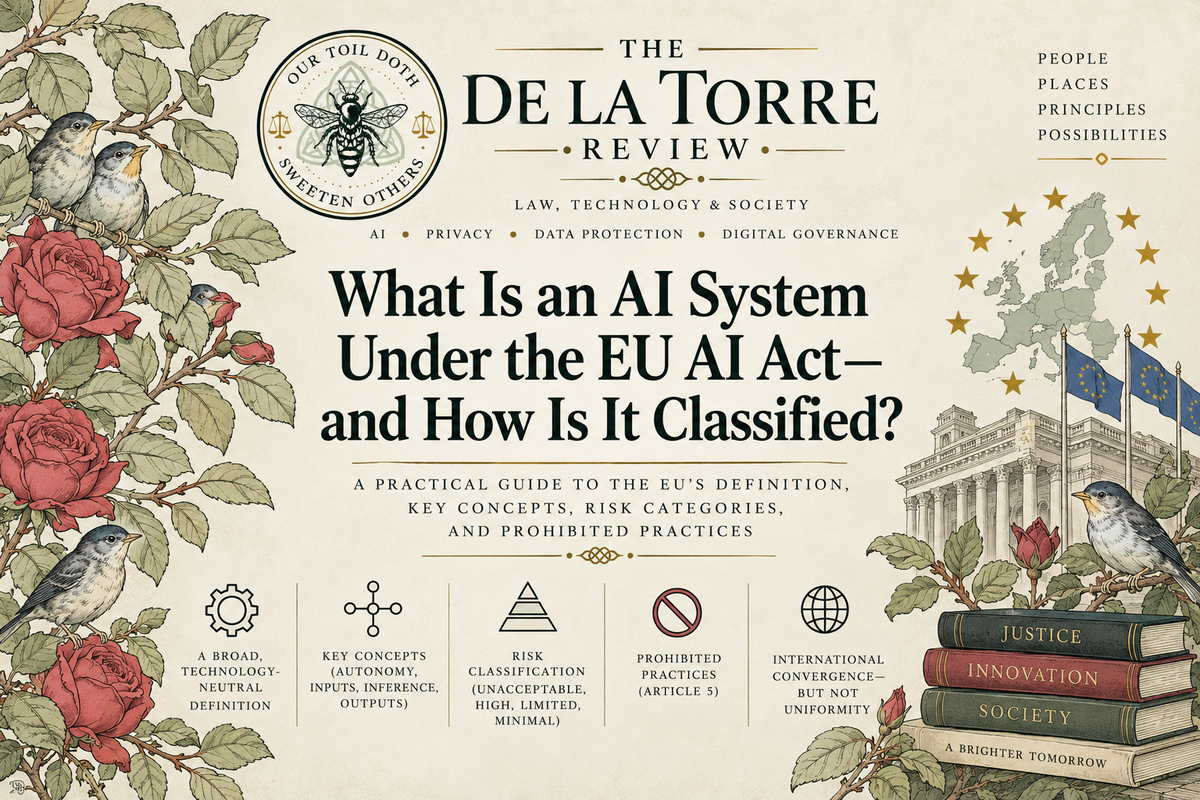
The EU AI Act is often described as a risk-based AI law: the greater the risks associated with an AI system or its use, the more demanding the rules become. But before getting to risk, there is a more basic question:
Is the technology actually an “AI system” under the EU AI Act?
That question matters because, as explained in The De La Torre Review General Guide to the EU AI Act (Free subscription required for access), the Act generally regulates AI systems and then determines what rules apply based largely on what those systems are designed and used to do.
- There is one important exception to the general rule that the EU AI Act regulates only AI systems: the Act also separately regulates general-purpose AI (GPAI) models. It does so because a single GPAI model can serve as the foundation for many different downstream systems, potentially spreading capabilities and risks across the AI value chain. An AI model and an AI system are not the same thing, and the classification of a GPAI model does not determine the classification of the applications built on it. The article General-Purpose AI Models Under the EU AI Act: Classification, Obligations, and Systemic Risk covers that separate framework.
Here, we focus on AI systems: what counts as one under the Act and, once it does, how to determine where it falls within the Act’s risk-based framework.
The analysis therefore begins with classification. Once something qualifies as an AI system, the next question is what regulatory category applies. The European Commission describes the Act as dividing AI systems into four broad risk categories: unacceptable risk, high risk, transparency risk, and minimal or no risk.
The EU AI Act’s architecture is straightforward: identify the system, understand its use, classify the risk, and apply the corresponding obligations.
What Is an “AI System”?
Article 3(1) of the AI Act defines an AI system as:
“a machine-based system that is designed to operate with varying levels of autonomy and that may exhibit adaptiveness after deployment, and that, for explicit or implicit objectives, infers, from the input it receives, how to generate outputs such as predictions, content, recommendations, or decisions that can influence physical or virtual environments.”
For high-risk AI systems, the Act takes this broad definition of AI and narrows it considerably. Not every AI system is high-risk, and systems that do not pose a significant risk of harm are generally not subject to the Act’s more demanding high-risk requirements. In particular, systems that do not materially influence the outcome of a decision may fall outside the high-risk category and instead be subject only to more limited requirements, such as applicable transparency obligations.
The European Commission is authorized to further specify the definition of AI systems in the AI Act by means of guidelines (see Article 96(1)(f)).
AI Is Broader Than Generative AI
The breadth of the definition makes more sense when read alongside Recital 4. The AI Act does not conceive of AI simply as technology that generates text, images, or other content. It describes AI as a rapidly evolving family of technologies capable of improving predictions, optimizing operations and resource allocation, and personalizing digital solutions, with applications across sectors ranging from healthcare and education to transportation, public services, security, and environmental protection.
That helps explain why Article 3(1) defines AI systems by reference to how they operate and the outputs they produce, rather than by reference to a particular technology. Predictions, recommendations, decisions, and content can all qualify as AI outputs.
Generative AI is only one part of the much broader universe of AI systems covered by the EU AI Act.
AI Exists on a Spectrum
Drawing the line between AI and conventional software is not always straightforward. The Future of Privacy Forum’s Spectrum of Artificial Intelligence illustrates why: technologies commonly grouped under the AI umbrella range from symbolic and expert systems to robotics, computer sensing, natural language processing, and machine learning, and there is not complete consensus on how the different approaches should be categorized.
The AI Act attempts to draw that legal boundary through the characteristics identified in Article 3(1) and elaborated in Recital 12. Importantly, a system does not qualify as AI simply because it uses sophisticated software or is marketed as “AI.” Recital 12 specifically seeks to distinguish AI systems from simpler traditional software and excludes systems based solely on rules defined by humans to automatically execute operations.
Practice tip: When conducting an AI inventory, do not simply ask whether a vendor calls its product “AI.” Examine what the technology actually does—particularly whether it operates with some autonomy and infers how to generate outputs from its inputs.
The dividing line can nevertheless be difficult to apply in practice—particularly for logic- and knowledge-based systems. Recital 12 recognizes those approaches as capable of inference, while excluding systems that merely execute human-defined rules. The distinction therefore depends less on the label attached to the technology and more on how the particular system actually operates.
Breaking Down the Definition of an AI System
Article 3(1) packs several concepts into a single definition. Breaking it into its component parts makes it easier to understand what distinguishes an AI system from conventional software and where the boundaries of the definition lie. Several elements are important:
- the system is machine-based;
- it operates with some degree of autonomy;
- it may—but does not have to—be adaptive after deployment;
- it operates toward explicit or implicit objectives;
- it infers from inputs how to generate outputs;
- those outputs may include predictions, content, recommendations or decisions; and
- those outputs can influence physical or virtual environments.
Two concepts are particularly important for distinguishing AI from conventional software: autonomy and inference.
Autonomy
An AI system must operate with some degree of independence from human involvement.
That does not mean the system must operate entirely without humans. Rather, Recital 12 distinguishes AI systems from simpler software systems based solely on rules defined by humans to automatically execute predetermined operations.
A conventional program that simply applies a fixed human-written rule—“if X happens, do Y”—does not become AI merely because the process is automated.
Practice Tip — Expert Systems: Do not assume that an expert system falls inside—or outside—the AI Act simply because it uses logic-based “if-then” rules. Recital 12 recognizes logic- and knowledge-based approaches as capable of inference, which suggests that an expert system may qualify as AI where it has sufficient autonomy and inference capability. At the same time, Recital 12 excludes systems based solely on human-defined rules that automatically execute operations. The boundary is therefore uncertain. Assess how the particular system actually operates—especially its degree of autonomy and whether it genuinely infers outputs rather than merely executing predetermined rules.
Inference
The second critical concept is inference.
The system must infer from the inputs it receives how to generate its outputs.
As explained in Recital 12 ,inference is not limited to machine learning. It may involve:
- machine-learning techniques, where a system learns from data; or
- logic- or knowledge-based techniques, where the system reasons from encoded information or symbolic representations.
That means the AI Act is broader than generative AI, neural networks or large language models. Certain expert systems, for example, can qualify as AI systems when they use inference techniques to derive conclusions from a knowledge base.
Adaptiveness Is Optional
Article 3(1) says an AI system “may exhibit adaptiveness after deployment.”
The word may matters: A system does not need to continue learning after deployment to qualify as AI. Adaptiveness describes systems capable of changing their behavior during use, but it is not a mandatory element of the definition.
Through its definition of AI, the AI Act attempts to translate a broad technological spectrum into a workable legal boundary.
A Definition Designed for Convergence—but Not Uniformity
Recital 12 explains that the EU deliberately sought to align its definition of an “AI system” with the work of international organizations, both to promote legal certainty and international convergence and to keep the definition flexible enough to accommodate technological change. The connection to the OECD definition of an AI system is particularly clear. The OECD’s revised definition uses essentially the same building blocks: a machine-based system that, for explicit or implicit objectives, infers from inputs how to generate outputs—such as predictions, content, recommendations, or decisions—that can influence physical or virtual environments, with systems varying in their levels of autonomy and adaptiveness. See, What is AI? Can you make a clear distinction between AI and non-AI systems?
That alignment is important because there is no obvious technological dividing line between AI and non-AI software. The OECD describes AI as involving a continuum of characteristics and notes that technologies once widely perceived as AI—such as optical character recognition—may no longer be thought of that way by the public, even though they use established AI techniques. See also, The Spectrum of AI (Infographic tool by the Future of Privacy Forum.)
But convergence does not mean uniformity. There is no single legal definition of AI that applies across jurisdictions, and the precise definition must always be checked under the law at issue. California, for example, has adopted a substantially similar technology-neutral definition centered on autonomy, objectives, inference, inputs, and outputs, while its wording and legal scope differ from the EU AI Act. See California Defines AI: AB 2885 and Its Impact.
The practical lesson is simple: do not classify a system based on whether it is marketed or commonly described as “AI.” Start with the definition in the applicable law and examine how the particular system actually operates. Under the EU AI Act, that means breaking Article 3(1) into its component parts.
AI Systems Are Not the Same as AI Models
The Act also distinguishes an AI system from an AI model.
- An AI model is the underlying computational component developed through training or other techniques. It can provide capabilities such as generating text, recognizing images or making predictions, but it generally requires additional components before it becomes an operational system.
- An AI system may combine a model with interfaces, software, databases, APIs, prompts, business rules or other components to perform a particular function.
A chatbot built on a GPAI model, for example, may therefore be an AI system, while the underlying model may separately qualify as a GPAI model.
As mentioned above, this distinction is especially important for general-purpose AI models. The AI Act establishes a separate regulatory framework for GPAI models, while AI systems incorporating those models remain subject to the Act's rules applicable to AI systems. The article General-Purpose AI Models Under the EU AI Act: Classification, Obligations, and Systemic Risk covers that separate framework.
The AI Act Classifies AI Systems by Risk
Once a technology qualifies as an AI system, the next question is:
What kind of risk does its intended use create?
The Commission summarizes the Act's framework as four broad categories:
| Classification | Basic consequence |
|---|---|
| Unacceptable risk | The AI practice is prohibited |
| High risk | Extensive regulatory requirements apply |
| Transparency risk | Specific transparency obligations apply |
| Minimal or no risk | Generally no additional mandatory AI-system requirements |
The important point is that classification generally depends not simply on what technology is used, but on what the system does and the context in which it is used.
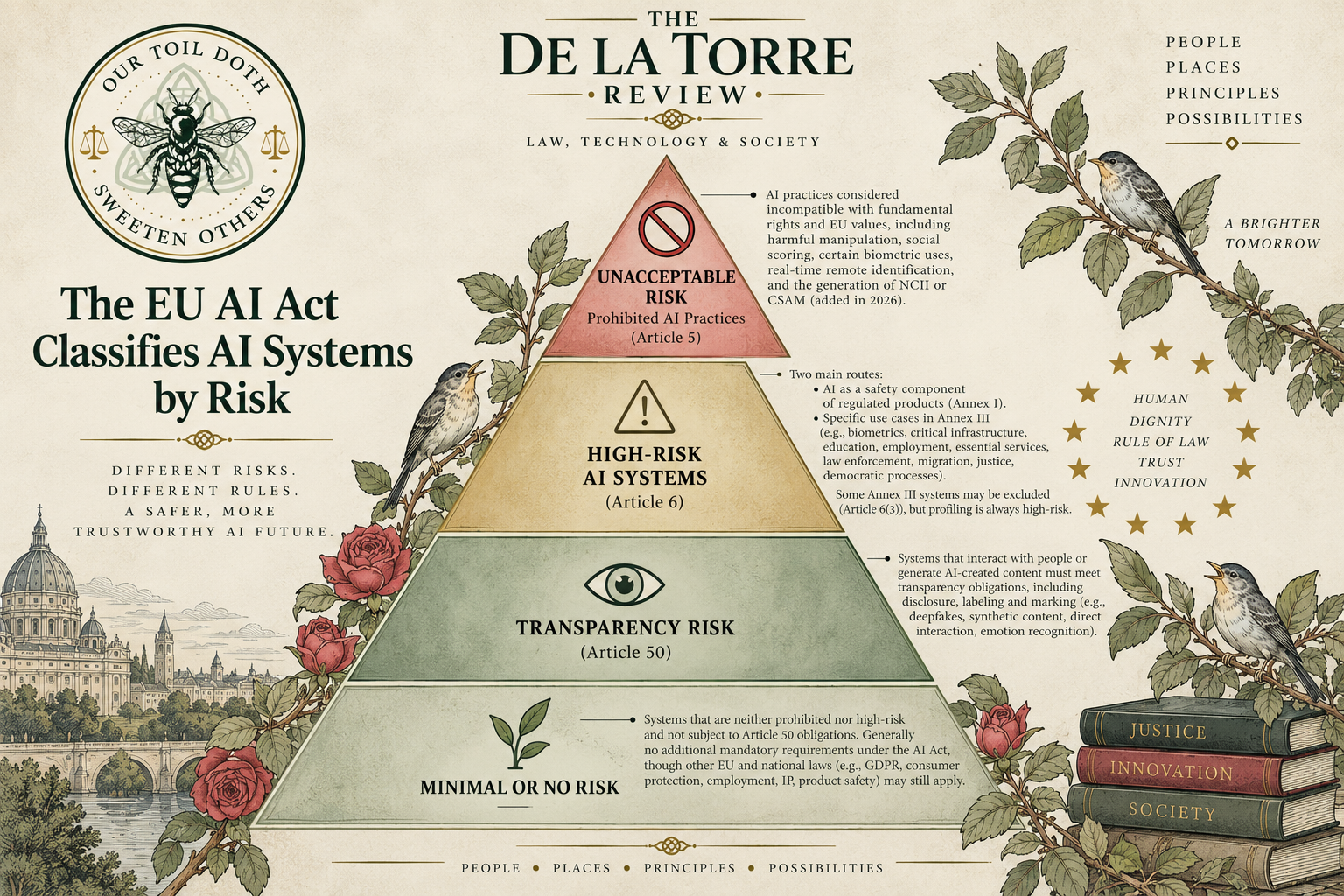
The same underlying AI technology can therefore lead to very different regulatory consequences depending on the use case.
1. Unacceptable Risk: Prohibited AI Practices
At the top of the hierarchy are AI practices the EU considers incompatible with fundamental rights and Union values. Article 5 prohibits specified practices involving AI systems, including certain forms of:
- harmful manipulation or deception;
- exploitation of vulnerabilities;
- social scoring;
- individual criminal-risk prediction based solely on profiling or personality characteristics;
- un-targeted scraping of facial images to build or expand facial-recognition databases;
- emotion recognition in workplaces and educational institutions, subject to limited exceptions;
- biometric categorization used to infer specified sensitive characteristics; and
- real-time remote biometric identification in publicly accessible spaces for law-enforcement purposes, subject to narrowly defined exceptions.
- use of AI systems to generate non-consensual intimate imagery (NCII) or child sexual abuse material (CSAM).
The last prohibition is new. It was added to Article 5 by the 2026 Digital Omnibus on AI, expanding the Act’s prohibited-practices framework to address AI systems used to generate these forms of harmful content.
Importantly, Article 5 does not necessarily prohibit an entire category of technology. The prohibitions generally turn on how an AI system is used and whether the specific conditions of the relevant prohibition are met.
An AI system that is permissible in one context may be prohibited in another.
For a closer look at where that line is drawn, see Prohibited AI Practices Under the EU AI Act: Where Europe Draws the Line. The article examines each Article 5 prohibition in detail, using the European Commission’s examples to distinguish prohibited practices from AI uses that may instead be high-risk or otherwise regulated.
2. High-Risk AI Systems
If the system is not prohibited, the next major question is whether it is high-risk under Article 6.
There are two principal routes into the high-risk category.
Route One: AI Used as a Safety Component of Regulated Products: Article 6(1) covers certain AI systems connected to products governed by EU product-safety legislation listed in Annex I.
Broadly, an AI system is high-risk through this route where it is:
- intended to be used as a safety component of a covered product, or is itself such a product; and
- the product must undergo a third-party conformity assessment under the applicable EU harmonization legislation.
This connects the AI Act to Europe's existing product-safety framework.
Route Two: Annex III High-Risk Use Cases: Article 6(2) provides the second—and for many organizations more familiar—route. AI systems used for specified purposes listed in Annex III are generally considered high-risk.
Annex III addresses areas including:
- biometrics;
- critical infrastructure;
- education and vocational training;
- employment and worker management;
- access to essential private and public services and benefits;
- law enforcement;
- migration, asylum and border control;
- administration of justice; and
- certain democratic processes.
The emphasis is again on use, not merely technology.
Practice Tip — Same Technology, Different Risk: Under the EU AI Act, classification depends heavily on how an AI system is used, not simply on the technology behind it. A machine-learning system that recommends movies may present minimal risk, while a system using similar techniques to determine whether a person receives access to an essential service may be classified as high-risk. Always assess the specific intended purpose and use case, not just the underlying technology.
...but Annex III Does Not Automatically Mean High-Risk
There is an important qualification: Article 6(3) provides that certain systems falling within Annex III are nevertheless not considered high-risk where they do not pose a significant risk of harm to health, safety or fundamental rights—including by not materially influencing the outcome of decision-making—and satisfy one of the statutory conditions.
And there is also an important exception to the exception: An Annex III system that performs profiling of natural persons is always considered high-risk.
Being excluded from high-risk classification under Article 6(3) does not remove the system from the AI Act altogether. The Commission specifically notes that such a system could still, for example, fall within an Article 5 prohibition.
3. Transparency Risk
Some AI systems are neither prohibited nor high-risk but present particular risks because people may not realize that they are interacting with AI or encountering AI-generated or manipulated content. Article 50 addresses these situations through transparency obligations.
Among other things, it covers certain:
- AI systems that interact directly with people;
- AI-generated or manipulated synthetic content;
- emotion-recognition and biometric-categorization systems;
- deepfakes; and
- AI-generated or manipulated text published to inform the public on matters of public interest.
For example, providers must generally design directly interactive AI systems so that individuals are informed that they are interacting with AI, while providers of systems generating synthetic content face machine-readable marking requirements. Deployers have separate disclosure obligations in specified circumstances.
Importantly, “transparency risk” is useful shorthand for describing this category; it is not a defined statutory classification comparable to “high-risk AI system.” The actual legal question is whether one or more of Article 50's specific obligations applies.
4. Minimal or No Risk
Finally, many AI systems do not fall within Article 5, Article 6 or the specific transparency obligations in Article 50. The Commission describes these systems as presenting minimal or no risk.
- They are generally not subject to additional mandatory requirements under the AI Act's risk-classification regime, although providers and deployers may voluntarily follow codes of conduct under Article 95.
This category may include many ordinary commercial applications of AI where the system is not being used in a sensitive or specifically regulated context.
That does not, however, mean that the system is unregulated. The GDPR, consumer-protection law, employment law, intellectual-property law, product-safety rules and other applicable EU or national laws may continue to apply. The Commission expressly emphasizes that compliance with the AI Act does not itself establish compliance with those other legal regimes. For more information on compliance with GDPR, read The De La Torre Review page on GDPR "EU Data Protection Law and the General Data Protection Regulation (GDPR)" (free subscription required for access.)
Classification Is About the Use Case
This leads to perhaps the most important practical point about the EU AI Act:
Do not classify AI solely by looking at the underlying technology. Classify the AI system in the context in which it will actually be used.
A facial-analysis technology, scoring algorithm, predictive model or generative AI system does not necessarily have one permanent regulatory classification.
Its treatment may depend on its intended purpose, functionality, deployment context and impact on individuals.
The Commission's prohibited-practices guidance illustrates this directly. A system that does not satisfy the conditions of an Article 5 prohibition may nevertheless fall into the high-risk category; conversely, an Annex III system may qualify for the Article 6(3) exception while remaining subject to other provisions of the Act.
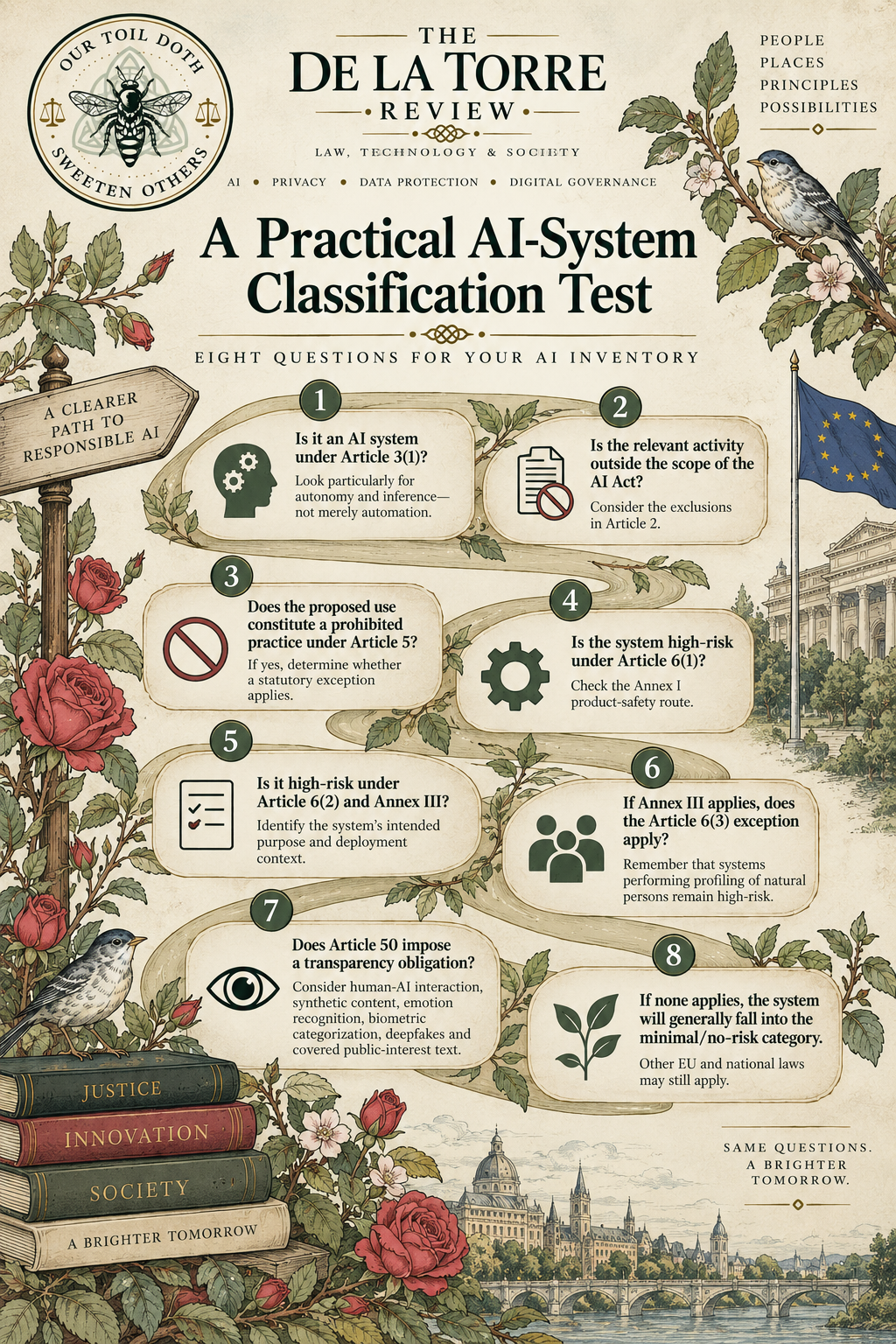
What obligations follow from the classification
Only after that classification exercise should an organization ask the operational question:
What obligations follow from the classification—and which actor in the AI value chain is responsible for satisfying them?
Sources and Additional Materials
Primary Sources
- EU Artificial Intelligence Act — Article 3: Definitions — Defines an “AI system” in Article 3(1).
- EU Artificial Intelligence Act — Article 5: Prohibited AI Practices — Establishes the Act’s prohibited-practices framework.
- EU Artificial Intelligence Act — Article 6: Classification Rules for High-Risk AI Systems — Establishes the two principal routes to high-risk classification and the Article 6(3) qualification for certain Annex III systems.
- EU Artificial Intelligence Act — Article 50: Transparency Obligations — Establishes specific transparency requirements for certain AI systems and AI-generated or manipulated content.
- EU Artificial Intelligence Act — Article 95: Codes of Conduct — Provides for voluntary application of certain requirements and codes of conduct to AI systems other than high-risk AI systems.
- EU Artificial Intelligence Act — Article 96 — Authorizes Commission guidelines on implementation of the Act, including application of the AI-system definition.
- EU Artificial Intelligence Act — Annex I — Identifies the EU harmonization legislation relevant to the Article 6(1) product-safety route.
- EU Artificial Intelligence Act — Annex III — Identifies specified high-risk use cases, including certain systems used in biometrics, critical infrastructure, education, employment, essential services, law enforcement, migration and border control, justice, and democratic processes.
- EU Artificial Intelligence Act — Recital 4 — Describes AI as a rapidly evolving family of technologies capable of supporting prediction, optimization, personalization, and other functions across a wide range of sectors.
- EU Artificial Intelligence Act — Recital 12 — Elaborates on the AI-system definition, including machine-based operation, autonomy, inference, adaptiveness, objectives, and the distinction between AI and simpler traditional software.
Guidance and Explanatory Materials
- European Commission — Guidelines on Prohibited Artificial Intelligence Practices — Commission guidance on interpreting Article 5, including the relationship between prohibited practices and the Act’s high-risk classification framework.
- OECD — What is AI? Can you make a clear distinction between AI and non-AI systems? — Explains the OECD AI-system definition and the concepts of inputs, outputs, inference, autonomy, and adaptiveness that substantially informed the EU AI Act’s approach.
- Future of Privacy Forum — The Spectrum of Artificial Intelligence — Illustrates AI as a technological spectrum encompassing approaches ranging from symbolic and knowledge-based systems to natural-language processing and machine learning.
Related Reading from The De La Torre Review
- General Guide to the EU AI Act — Overview of the Act’s scope, risk-based architecture, regulated actors, and principal obligations. (Free subscription required for access.)
- General-Purpose AI Models Under the EU AI Act: Classification, Obligations, and Systemic Risk — Explains the separate regulatory framework applicable to GPAI models and why classification of a model does not determine the classification of downstream AI systems.
- California Defines AI: AB 2885 and Its Impact — Compares California’s technology-neutral approach to defining AI with the substantially similar concepts reflected in the EU and OECD definitions.
- EU Data Protection Law and the General Data Protection Regulation (GDPR) — Background on the GDPR requirements that may apply alongside the AI Act even where an AI system is classified as minimal or no risk. (Free subscription required for access.)
- Prohibited AI Practices Under the EU AI Act: Where Europe Draws the Line — Detailed analysis of Article 5’s unacceptable-risk prohibitions, the Commission’s prohibited-practices guidance and examples, the boundary between prohibited and high-risk AI, and the new prohibitions added by the 2026 Digital Omnibus on AI.


Comments ()